Ranking on page one of Google no longer guarantees that an AI tool will recommend you. Ahrefs found that only 37.9% of the pages cited in Google AI Overviews also rank in the top 10 for the same query. For a hotel, restaurant or spa, that means a venue can rank well and still go unnamed when a guest asks an AI tool where to book.
This guide explains what the research says, what it does not say, and how a UK venue can earn citations by publishing one original data point from its own business. It builds on our guides to GEO for hotels, GEO for restaurants, and GEO for spas.
Quick answer
AI tools do not simply repeat Google’s top results. To be cited, publish a specific fact that other venues have not published, such as booking lead times or guest survey results from your own business. Put the finding in the first two sentences, structure the page so each claim can be lifted out, state your sample and date, and keep your other listings consistent.
1. What the research says about ranking and AI citations
Three recent studies are worth knowing. Each has limits, which matter for how much weight to give it.
Why ranking is not the same as being cited, and how UK venues can earn AI citations with original data. |
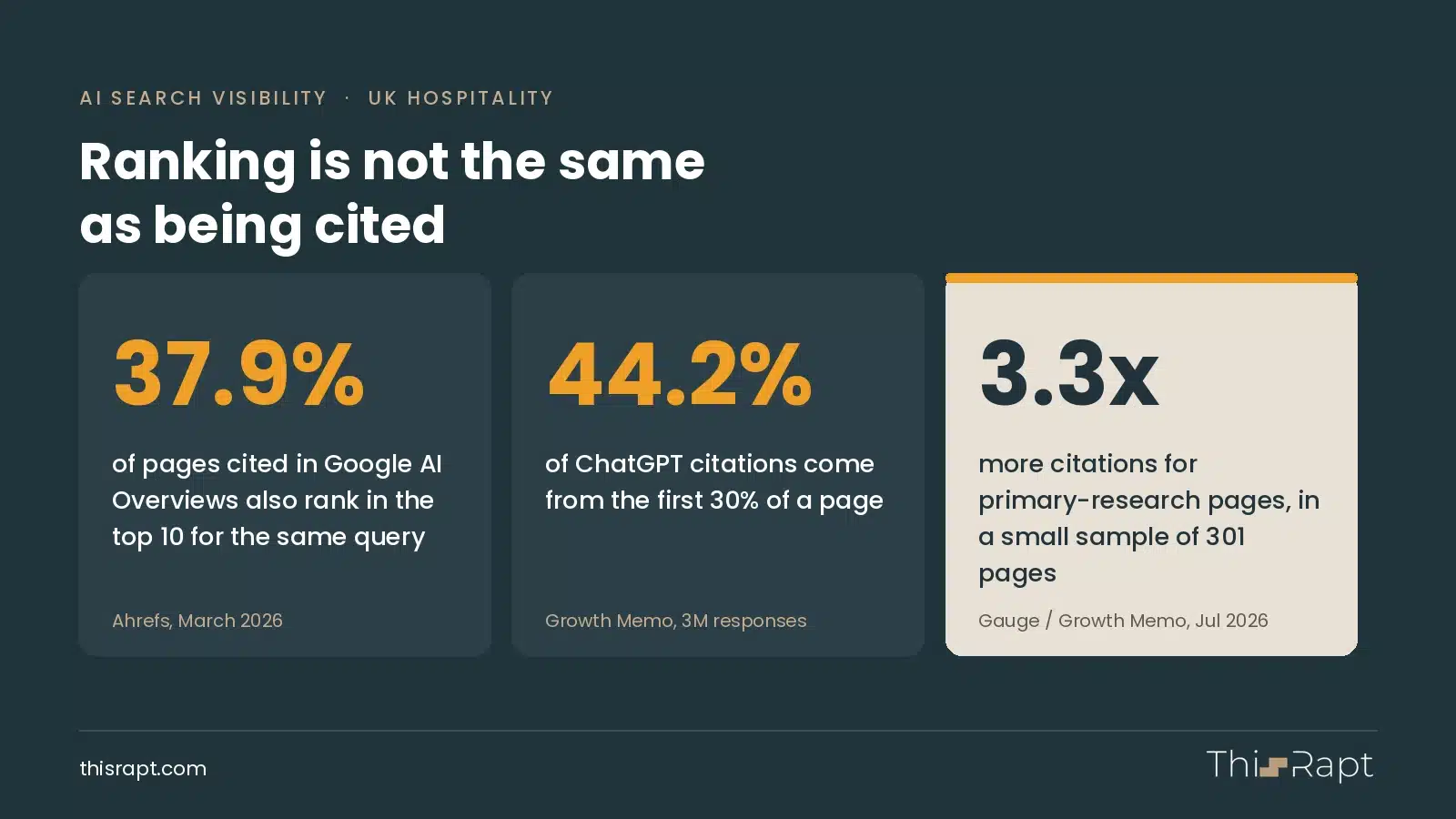
Ranking and being cited are separate jobs. Sources: Ahrefs (March 2026), Growth Memo (2026), Gauge via Growth Memo (July 2026).
| Finding | Source | What it means for a venue | Limit to remember |
|---|---|---|---|
| 37.9% of URLs cited in AI Overviews also rank in Google’s top 10 for the same query | Ahrefs, March 2026, about 4 million AI Overview URLs across 863,000 keywords | Ranking helps, but a page outside the top 10 can still be cited | An earlier Ahrefs study found about 76%, but the method changed, so the two figures are not a perfect like-for-like comparison |
| 44.2% of ChatGPT citations come from the first 30% of a page | Growth Memo analysis of 3 million ChatGPT responses and 30 million citations | Put your main finding early, not at the end | Covers ChatGPT only, and it describes where citations sit, not why |
| Primary-research pages averaged 11.3 citations against 3.4 for other pages | Gauge, reported in Growth Memo and Search Engine Land, July 2026 | Original data can earn more citations than commentary | Only 8 of 301 pages in the sample qualified, and most were technology benchmarks |
A fourth source is the academic paper that named the field. Its authors report that generative engine optimisation methods can raise visibility in AI answers by as much as 40%, with results varying by subject area (Aggarwal and colleagues, 2023). Treat that as an upper bound from a test benchmark, not a promise for your venue.
Notice what the third study actually concluded. Its author argued that AI does not reward original data by default. What earned most of the citations was one format: a benchmark that answers a question such as “which is best”. That is useful for hospitality, where guests ask exactly that kind of question.
2. Why a number nobody else has published gets cited
An AI answer has to make claims, and it prefers claims it can attribute. Generic advice, such as “book early for Christmas”, is on thousands of pages, so no single page is needed. A specific fact, such as how far ahead your guests actually booked last December, exists on one page only. That makes your page the natural source.
Most venues have never published one. They have the data, in booking systems, till reports, review platforms and guest emails, but they use it internally and never explain it publicly. That gap is the opportunity, and it needs no research budget.
3. Five data points a UK venue can publish this month
Pick one. Start with the data you already hold, and keep every figure aggregated. The example findings in the table are illustrations of the format, not real data, so replace them with your own figures.
| Data point | Where it comes from | Example finding to lead with | Guard rail |
|---|---|---|---|
| Booking lead times | Your booking system | “Last December, 62% of our party bookings were made more than six weeks ahead” (use your own figure) | Aggregate only. No guest details |
| Guest survey | A short QR code or email survey (30 to 100 replies) | “We asked 84 guests what decides where they eat Sunday lunch” | State the sample size and dates. Do not claim it represents the UK |
| Local price benchmark | Published menus or rates of about ten local competitors | “The average Sunday roast within five miles of us costs £X, as of October 2026” | Public information only, dated, and checked for accuracy |
| Seasonality | Your covers or occupancy by month | “Our quietest weekday is Tuesday, and here is when guests book” | Round small numbers and avoid anything that identifies a person |
| Review themes | Your own reviews, counted by topic | “Of 200 recent reviews, 41% mention the garden” | Count themes, never quote or name guests |
For more ideas that feed these pages, see our guide to fresh content angles for hospitality. Reviews are a rich source of themes, and our guide to hotel review management shows how to collect and answer them.
Want your venue named when guests ask AI where to go?
ThisRapt works exclusively with UK hospitality SMEs on search, AI visibility and direct bookings. Book a free consultation to see where your venue stands today.
4. How to publish it so AI tools can use it
- Lead with the finding. Put the number and what it means in the first two sentences, so it sits inside the first 30% of the page.
- Write one claim per sentence. Short, specific sentences are easier to lift out and quote accurately.
- Use a question as the heading, such as “When do guests book Christmas parties?”, and answer it directly underneath.
- Add a method note: sample size, dates, and how you counted. A source can be trusted when it shows how the number was reached.
- Put the key figures in a simple table, and add an FAQ section marked up with FAQPage schema.
- Add the date and update the page when new figures arrive. Some studies find that recently updated pages are cited more often.
- Keep your website, Google Business Profile, and listings consistent, because AI tools check more than one source.
Ranking still matters for the pages that get cited, so keep the basics strong. Our hospitality SEO guide and local SEO guide for hospitality businesses cover the foundations, and hotels can start with their Google Business Profile.
5. Using data responsibly in the UK
This is general guidance, not legal advice.
- Keep personal data out. Publish aggregated results only, and avoid breakdowns so small that a guest could be identified.
- Tell guests how survey answers will be used, and keep to your privacy notice.
- Do not overstate. A survey of 40 guests describes your guests, not the whole UK market. Say so.
- Check competitor comparisons for accuracy, date them, and use public information only.
- Claims in marketing must be backed by evidence. If you cannot explain how you got a number, do not publish it.
6. A 30-day plan to earn your first citation
- Week 1: choose one data point from the table in section 3 and pull the figures. Write the finding in one sentence.
- Week 2: build a page that opens with the finding, with a method note, a small table, and a short FAQ.
- Week 3: add FAQPage schema, check your Google Business Profile and listings match the page, and link the page from related posts.
- Week 4: share the findings in your email list and on social channels, send it to a local journalist or blogger, and set up your monthly check.
For the monthly check, write down ten questions a guest would ask. Ask each in ChatGPT, Gemini, and Google AI Overviews, and log whether you are named, how you are described, and which pages are cited. Many venues do not track this yet, so even a simple log gives you an edge.
7. Common mistakes to avoid
- Publishing a statistic you cannot source. AI tools and readers both lose trust in it.
- Hiding the finding at the end of a long page. In the Growth Memo study, citations clustered near the top.
- Calling a survey of a dozen people “research”.
- Gating the data behind a form. A page that AI tools cannot read cannot be cited.
- Letting figures go out of date. Add the date and refresh it.
8. Key takeaways
- Ranking and being cited are different jobs: only 37.9% of AI Overview citations came from top-10 pages in Ahrefs’ March 2026 study.
- Put the main finding in the first two sentences. 44.2% of ChatGPT citations in one large study came from the first 30% of a page.
- Original data can earn more citations, but the best-cited format is the benchmark that answers a clear question.
- One honest data point from your own venue is enough to start. State the sample, the dates, and the method.
- Keep data aggregated and claims proportionate, in line with UK data protection and advertising rules.
- Check ten guest questions in AI tools every month and keep a log.
Sources:
Ahrefs, AI Overview citations and the top 10 (March 2026);
Search Engine Land, why most original data never gets cited (July 2026);
Growth Memo analysis of citation position, as reported by Scalevise;
Aggarwal et al., GEO: Generative Engine Optimization.
Your booking data, guest feedback, and reviews can become pages that AI tools and guests trust. ThisRapt can help you plan and publish them.
Turn your own numbers into new bookings
ThisRapt works exclusively with hospitality SMEs to grow direct bookings through search, email and social.
9. Frequently asked questions
AI search visibility is how often, and how accurately, AI tools such as Google AI Overviews, ChatGPT and Gemini name or cite your venue when someone asks a question you should be answering. It is separate from your Google ranking, because the pages these tools cite are not always the pages that rank highest.
Yes. Rankings still drive most search traffic, and the pages AI tools cite often come from the same pool. Ahrefs found that 37.9% of URLs cited in AI Overviews also rank in the top 10 for the same query, so rankings matter but do not guarantee a citation. Treat ranking and citation as two jobs.
Publish specific, checkable facts on your own website, put the main finding in the first few sentences, structure the page with clear headings and short claims, and keep your Google Business Profile and listings consistent. Original numbers from your own venue, with a short method note, give AI tools something to cite that nobody else has published.
No, and a small venue cannot run large studies. One honest, well-explained data point is enough to start, such as booking lead times from your own system or a short guest survey with the sample size stated. There is no guarantee of a citation, so treat it as improving your odds.
Aggregated results that cannot identify a person are generally fine. Keep names, contact details and small-number breakdowns out, tell guests how their answers will be used, and do not claim more than the data supports. This is general guidance, not legal advice, so check with your data protection lead.
There is no reliable timeline. AI tools update at different speeds and results vary by query. Check a fixed set of questions once a month and look for steady changes over a few months rather than quick wins.
Write down the ten questions a guest would ask, such as the best Sunday lunch in your town. Ask each one in ChatGPT, Gemini and Google AI Overviews each month, and record whether your venue is named, how it is described and which sources are cited.
They overlap. GEO (generative engine optimisation) and AEO (answer engine optimisation) both mean shaping your content so AI answers can use it. AI SEO is the broader label. In practice the work is the same: clear facts, answer-first pages, structured data and consistent listings.