

In today’s digital-first world, travelers no longer rely on travel agents or walk-ins to find accommodations. Instead, they search online, most often with location-based queries. This is where local SEO for hospitality becomes your most powerful growth strategy.
Local SEO used to be one game: rank in the map pack, get the calls, win the booking.
In 2026, it’s two games running simultaneously. Google AI Overviews now appear on roughly 68% of local searches – up from just 8% in early 2025 – and increasingly sit above the map pack entirely, while 45% of consumers now use ChatGPT or another AI tool directly for local business recommendations. A hotel can still rank well in the traditional local pack while being completely invisible in the AI-generated answer for the same search. Those two used to be the same game. They aren’t anymore.
A well-executed local search optimisation strategy ensures that your property appears in relevant local search results, drives more direct bookings, and enhances guest trust. But it’s not just about getting found; it’s about getting chosen.
This comprehensive guide explores why local SEO for hospitality is a game-changer and how you can implement it strategically to compete with larger chains and OTAs.
1. What is local SEO?
Local SEO (Search Engine Optimisation) refers to the process of optimising your digital presence so that your hotel appears in location-based search results, especially on platforms like Google Search and Google Maps.
For example, when someone types “beach resorts near Miami” or “budget hotels in London,” Google serves up nearby, optimised listings based on proximity, relevance, and credibility.
For hoteliers, this means being visible at the exact moment someone is ready to book.
Local SEO for hospitality focuses on:
- Optimising your Google Business Profile
- Being listed in local business directories for hospitality
- Using geo-targeted marketing for hotels
- Creating content tailored to local events or attractions
- Gathering authentic reviews from guests
According to a 2024 report by BrightLocal, 78% of location-based mobile searches result in an offline purchase, and in the hotel industry, this often translates to a booking. If your property isn’t appearing in these local searches, you’re leaving money on the table.
2. Why local SEO still matters – And what’s actually changed
Local intent remains enormous: nearly half of all Google searches carry local intent, and “near me” search variations alone see over 7 million searches a month. The behavioural pattern hasn’t changed either — the vast majority of “near me” mobile searches lead to a visit or booking within 24 hours, making local search among the highest-intent traffic any hospitality business can capture.
What has changed is where that intent gets satisfied.
The split now depends heavily on query type:
- Simple, transactional local searches (“hotels near me,” “restaurants in Bath”) still lean heavily on the traditional local pack, which appears on roughly 93% of local-intent searches and captures the largest share of clicks
- Informational and hybrid-intent queries (“best boutique hotels for a weekend in the Cotswolds,” “average cost of a spa weekend near Edinburgh”) trigger AI Overviews the vast majority of the time – in some studies, 92–97% of comparable hybrid queries
- When an AI Overview does appear, click-through to any individual website roughly halves compared to a page with no AI Overview – meaning being cited inside the answer matters as much now as being clicked through to
The practical implication: a hospitality business needs to win both games — the traditional map pack for direct, transactional searches, and AI citation for the research-and-comparison queries increasingly answered before a guest ever sees a list of links.
3. Common pain points for hoteliers related to digital marketing
Before diving into tactics, let’s address the real challenges hoteliers face:
- Drowning in OTA commission fees
Many hotels rely heavily on Booking.com, Expedia, and other OTAs, paying 15-25% commissions per booking. Without strong local search optimisation, direct bookings remain elusive. - Invisible to high-intent travellers
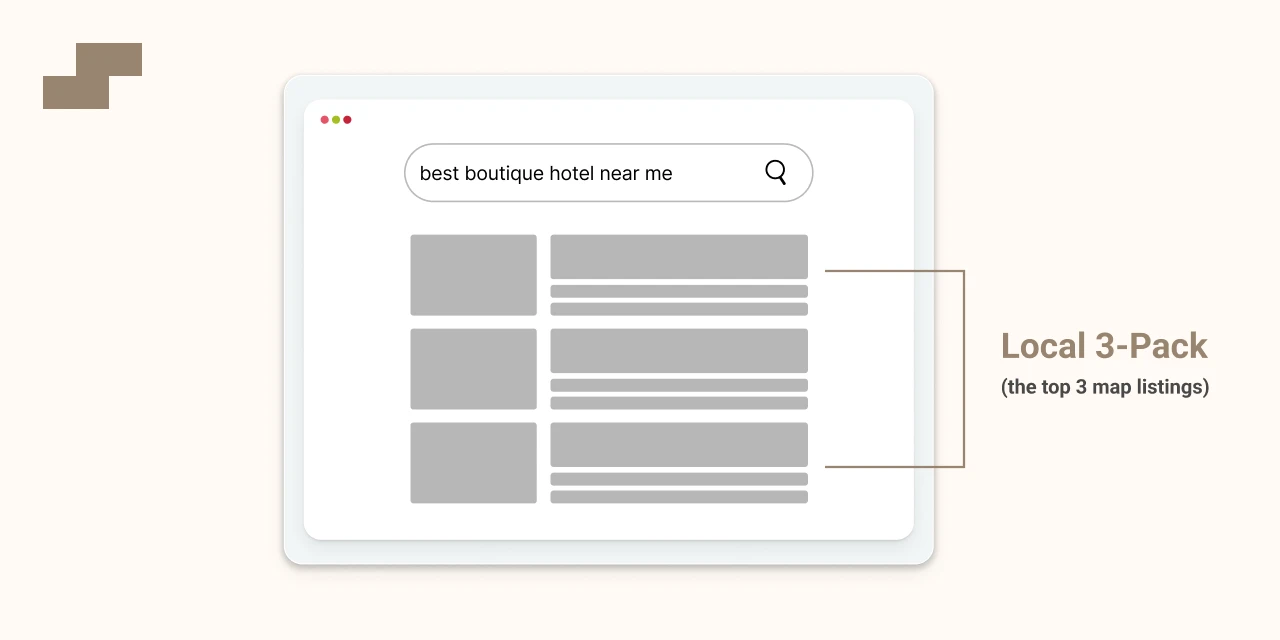
Your property might be excellent, but if it doesn’t appear in the local 3-pack (top 3 Google Maps results), potential guests will never find you. This is especially painful for independent hotels competing with chain brands. - Inconsistent online presence
Different addresses, phone numbers, or business names across directories confuse search engines and damage your local rankings. This is a silent killer for local SEO for hospitality. - Lack of time and technical expertise
Most hoteliers are experts in hospitality, not SEO. Managing Google Maps optimisation for hotels alongside daily operations feels overwhelming. - Negative reviews damaging reputation
A few bad reviews left unaddressed can tank your local rankings and discourage bookings, even if your service is generally excellent. - Limited marketing budget
Small hotels can’t compete with big chains on advertising spend, making organic strategies like SEO absolutely critical.
- Drowning in OTA commission fees
4. Google Business Profile: The foundation
Your Google Business Profile remains the single most important local visibility asset you control — and research shows that the vast majority of hotel links surfaced in Google’s AI Mode responses route directly to a GBP rather than a hotel’s own website, making it arguably more important for AI visibility than your website itself.
Because GBP optimisation deserves proper depth, we’ve covered it exhaustively in a dedicated guide – read our full Google Business Profile optimisation guide here for the complete checklist (photos, Q&A, posts, review response strategy, and AI-specific optimisation). The short version for this article: complete every field, keep NAP identical everywhere, post updates weekly, and respond to every review within 48 hours.
5. Why local SEO is critical for hotel bookings
Today, 4 out of 5 consumers use search engines to find local information. For travelers, this behavior is even more specific, looking for location, ratings, amenities, and photos before making a decision.
If you’re not optimised for local search, potential guests may never see your property, even if you’re the best in town.
According to Google, 46% of all searches have a local intent, and hospitality businesses that appear in the local 3-pack (the top 3 map listings) receive 700% more clicks than those listed below.
Investing in local search optimisation is no longer optional; it’s foundational.
6. Google Maps optimisation for hotels
Being listed on Google Maps is not enough. You need to optimise your listing.
Make sure your Google Business Profile includes:
- High-quality bedroom, pool, dining & lobby images
- Accurate NAP (Name, Address, Phone Number)
- Updated amenities list
- Booking link
- Review responses
- Google Posts featuring offers
According to Moz, Google Maps optimisation for hotels can drive up to 30% more traffic to your booking site when done properly. It also improves trust and visibility, two essential factors for conversion.
7. Mastering local business directories for hospitality
One of the simplest yet most underused tools in local SEO for hospitality is listing your property on local business directories for hospitality.
These include:
- TripAdvisor
- Booking.com
- Yelp
- MakeMyTrip
- Agoda
- Niche local directories based on region or tourism boards
Why directory consistency matters:
By ensuring consistency across these platforms (same name, address, and phone number), you boost your local search optimisation score.
A study by Yext found that businesses listed on at least 5 local directories saw a 76% higher engagement rate and improved organic visibility.
Directory management best practices:
- Claim all listings (don’t let incorrect information persist)
- Use an identical NAP across every platform
- Fill out every field completely (business hours, amenities, photos)
- Keep information updated (especially seasonal changes)
- Monitor and respond to reviews on all platforms
- Use tracking URLs to measure traffic from each directory
Pro Tip: Create a spreadsheet tracking all your directory listings with login credentials, publication dates, and review response dates.
8. Geo-targeted marketing for hotels: The competitive edge
Geo-targeted marketing for hotels allows you to push promotions, ads, or content to people based on their current location or areas they’ve shown interest in.
Effective Geo-Targeting Strategies:
- Facebook or Google Ads targeted at people searching for “hotels near Manchester”
- Radius targeting around your property (5-50 miles, depending on location)
- SMS or WhatsApp promotions sent to guests currently in your city
- Push notifications through your hotel app for guests nearby
- Instagram Stories targeted at travellers who visited nearby tourist spots
- Facebook event promotions for local festivals or conferences
- Blog posts about “Top 10 Things to Do Near [Your Hotel]”
- Neighbourhood guides showcasing nearby restaurants, shops, and attractions
9. SEO strategies for small and independent hotels
Boutique properties can outcompete larger chains on local search specifically because personalisation and authenticity are genuine ranking and trust advantages here:
- Hyperlocal keyword targeting (“heritage homestay near the Royal Mile” rather than generic “Edinburgh hotel”)
- Blog content around local events, cuisine, and experiences – the destination-first content pattern that also feeds AI Overview citation
- Partnerships with local tourism boards, bloggers, and news outlets for backlinks
- Consistent, personal brand voice that a templated chain listing can’t replicate
Technical local SEO essentials:
- Mobile-optimised, fast-loading website (under 3 seconds where possible)
- Local business/Hotel schema markup – this is no longer optional; it’s the primary mechanism by which both traditional local pack algorithms and AI systems parse and trust your business data
- Dedicated local landing pages if you operate multiple properties
- HTTPS security
10. Structuring your local presence for AI citation
This is the section most 2026 local SEO content still skips, and it’s the single biggest addition this topic needs.
AI systems – Google AI Overviews and AI Mode, ChatGPT, Perplexity – increasingly build local answers from a combination of business websites, Google Business Profile data, and review platforms. A business with incomplete GBP data, missing schema markup, or inconsistent NAP across directories is functionally invisible to voice search and AI local recommendations at the same time – these aren’t separate optimisation challenges; they share the same underlying data requirements.
Practical steps to be AI-citable, not just rankable:
- Implement Hotel, LocalBusiness, and FAQPage schema consistently across your site
- Keep information identical across your website, GBP, and every directory – AI entity resolution depends on this consistency more than traditional SEO ever did
- Publish genuinely specific, factual content (exact amenities, distances, policies) rather than vague marketing language – this is what gets extracted and cited
- Don’t optimise for one AI engine only – Google’s AI systems, ChatGPT, and Perplexity currently pull from different mixes of sources, and each engine now serves a meaningful share of local recommendation queries
11. The power of reviews in local SEO
Reviews function as both a ranking signal and, increasingly, an AI trust signal simultaneously.
- Ranking factor – review quantity and quality directly influence local pack position
- Click-through factor – properties with 4+ stars see significantly higher CTR
- Trust factor – the overwhelming majority of consumers read reviews before choosing a local business, and this now extends to how confidently an AI system recommends you
- Content signal – review text provides keyword-rich, genuinely useful context search engines and AI systems both parse
- Recency signal – a steady flow of recent reviews outperforms a high average score built entirely on old reviews

Local SEO Checklist
| Hotels | Restaurants | Spas |
|---|---|---|
|
|
|
12. Final thoughts
The fundamentals of local SEO — a complete Google Business Profile, consistent directory presence, and a steady flow of genuine reviews – haven’t gone anywhere. What’s changed is that the same data quality now needs to satisfy two audiences simultaneously: the traditional local pack algorithm, and the AI systems increasingly answering the query before a guest ever sees a list of links. Get both right, and your hospitality business stays visible wherever guests are actually searching in 2026 – not just where they searched two years ago.
Ready to build a local SEO strategy built for both the map pack and the AI Overview?
13. Local SEO FAQs
Local SEO helps hotels, restaurants, and spas rank in location-based search results – Google Maps, Google Search’s local pack, and increasingly AI search tools like AI Overviews, AI Mode, and ChatGPT – by optimising Google Business Profile, directory consistency, reviews, and structured local content.
AI Overviews now appear on a majority of local searches, particularly informational and comparison queries, and often sit above the traditional local pack. This means visibility now requires being cited inside AI-generated answers, not just ranking in map results – both depend on the same underlying data quality (schema, NAP consistency, complete GBP).
To some degree, yes — different AI systems currently draw from different source mixes. But the foundational work overlaps heavily: clean schema markup, consistent business data everywhere, and genuinely specific, factual content improve visibility across all of them simultaneously.
A complete, active Google Business Profile directly affects visibility for high-intent searches like “hotels near me,” and research shows most hotel links inside AI Mode responses route to GBP specifically, not the hotel’s own website — making it arguably the single highest-leverage local SEO asset available.
Yes, disproportionately – hyperlocal content, authentic voice, and personal storytelling are advantages independents have that large chains typically can’t replicate at scale, and these same qualities tend to perform well in both traditional local rankings and AI citation.
Inconsistent business details across platforms confuse both traditional search ranking algorithms and AI entity resolution – a business an AI system can’t confidently identify as a single, coherent entity is one it’s less likely to recommend at all, regardless of quality.
Quick wins (completing your GBP, fixing NAP inconsistencies) can show impact within days to weeks. Broader local pack improvements typically build over 4–8 weeks, with more substantial, compounding gains over 3–6 months — and AI citation visibility tends to build alongside traditional ranking rather than on a separate timeline.









I’ve been browsing online more than 4 hours today, yet I never
found any interesting article like yours. It is pretty worth enough
for me. In my opinion, if all webmasters and bloggers made good content as
you did, the internet will be a lot more useful than ever before.