The hospitality industry has become far more competitive in the digital age. Guests no longer rely on recommendations or choose the closest option. They begin with a search. Within seconds, they compare hotels, scan restaurant menus, read reviews, and shortlist options. For businesses, the first impression no longer happens at the front desk or dining table. It happens on a search results page.
A user searching for “hotel near me” or “restaurant open now” is not exploring. They are ready to act. These are high-value moments where visibility directly influences bookings and walk-ins.
User behaviour in hospitality follows clear patterns. Research shows that more than 80% of travellers search online before booking, and around 70% of diners check reviews before choosing a restaurant. These decisions are often made on mobile devices, frequently within a short time frame. In many cases, users move from search to booking within minutes or hours.
What drives these decisions is not just information, but trust signals. Users rely on quick indicators such as ratings, number of reviews, photos, pricing, and proximity. A hotel with slightly higher prices but stronger reviews often gets chosen over a cheaper alternative. A restaurant with clear images and updated menus attracts more immediate clicks. A spa with visible ratings builds confidence before the user even visits the website.
These are micro-moments where users make fast decisions based on limited but highly influential signals. Search engines prioritise businesses that match this intent with relevance, credibility, and usability.
This is where SEO becomes critical. It ensures your business appears in these decision-making moments with the right information, at the right time. Unlike paid ads, which offer temporary visibility, SEO builds a consistent presence across these high-intent searches.
In practical terms, SEO is no longer an optional marketing channel for hospitality businesses. It is one of the core growth drivers that shapes how users discover, evaluate, and choose where to stay, eat, or book.
1. What is hospitality SEO? Understanding the fundamentals
Hospitality SEO is the process of making hotels, restaurants, and spas easier to find on search engines, attracting users ready to book and turning them into bookings, reservations, or appointments. Hospitality SEO prioritises local search visibility, real-time booking intent, and decision-driven queries, unlike broader SEO strategies that focus more on informational and long-term discovery.
2. How search engines work and how to win in hospitality
To understand how Hospitality SEO drives revenue growth, you need to know how search engines evaluate and rank your business. Google does not rank websites randomly. It follows a structured process based on accessibility, relevance, and trust.
2.1 Crawling: Can search engines access your booking pages?
Search engines first need to discover and access your website. If your booking, service, or location pages are not properly linked or blocked, they may never appear in search results.
In hospitality, this is a common issue. Many booking engines are difficult for search engines to crawl, which limits visibility for high-intent queries.
2.2 Indexing: Is your content actually stored and understood?
Once pages are discovered, search engines decide whether to store them in their index. If your pages lack clear structure, relevant content, or unique information, they may not be indexed properly.
For example, if multiple hotel location pages use similar or duplicate content, search engines may ignore them or rank them poorly. Each page must clearly communicate its purpose, location, and value.
2.3 Ranking: Why do competitors appear above you?
After indexing, search engines rank pages based on how well they match user intent and how trustworthy they appear.
In hospitality, ranking decisions are heavily influenced by three factors:
a. Local SEO: Proximity, relevance, and prominence
For location-based searches, Google evaluates:
- Proximity – how close your business is to the user
- Relevance – how well your listing matches the search
- Prominence – how well-known and trusted your business is
This is why Local SEO for hotels, restaurants, and spas directly impacts visibility in map results and “near me” searches.
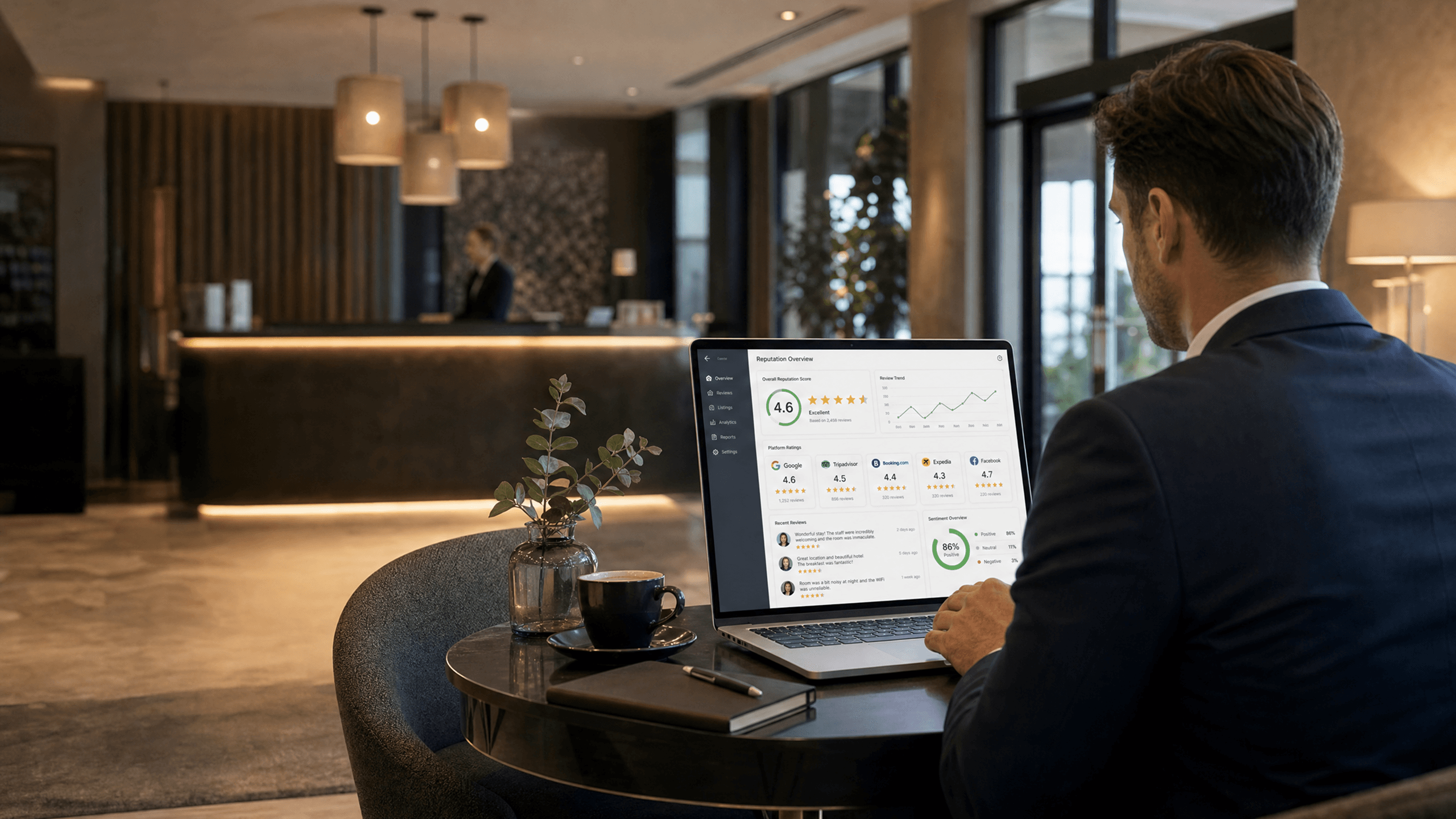
b. Reviews and reputation: Trust signals
Reviews are not just feedback. They are ranking signals. Search engines consider:
- number of reviews
- average rating
- recency and consistency
A business with strong, recent reviews is more likely to rank higher and attract clicks compared to one with limited or outdated feedback.
c. Content: Matching real user intent
Search engines prioritise content that directly answers what users are searching for. This includes:
- service pages aligned with booking intent
- location pages targeting specific areas
- content that addresses common questions
If your content does not match intent, even a well-designed website may fail to rank.
In simple terms, Hospitality SEO works when your website is accessible, your content is relevant, and your business appears trustworthy. These factors together determine whether you show up when users are ready to book.
3. What makes hospitality SEO unique
Users search with clear intent, like “book hotel near airport” or “restaurant near me open now.” This is why Hospitality SEO services focus on conversion-driven traffic.
Businesses must target both tourists and local customers. This makes local SEO for hotels, restaurants, and spas essential.
Demand changes based on seasons, holidays, and events. A strong Hotel, Restaurant, and Spa marketing SEO strategy must adapt to these trends dynamically.
Customer decisions depend heavily on reviews these days. This makes Google Business Profile optimisation a key part of hospitality digital marketing. Fresh reviews are weighted higher.
4. Difference between hospitality SEO and generic SEO
Generic SEO focuses on increasing traffic and visibility. Hospitality SEO, on the other hand, focuses on generating bookings, reservations, and appointments.
It combines multiple elements:
- Local SEO
- Conversion optimisation
- Reputation management
- Content strategy
This makes it more focused on results than traditional SEO methods.
4.1 Search intent types
Understanding intent is essential for a strong Hospitality SEO strategy.
a. Booking intent (high value)
These users are ready to act. Examples:
- “Book hotel near me”
- “Reserve a table tonight”
b. Discovery intent (top funnel)
These users are looking for options. Examples:
- “Best hotels in Edinburgh”
- “Top restaurants in Victoria Street”
4.2 Hospitality customer journey + SEO mapping
Customers usually go through three stages before deciding.

Research phase keywords
Users search for ideas and choices.
Examples:
- “Best hotels in Edinburgh”
- “Top spas near me”

Comparison phase keywords
Users compare different options.
Examples:
- “Hotel with pool vs hotel with spa”
- “Best Italian restaurant near me”

Booking/reservation phase keywords
Users are ready to take action.
Examples:
- “Book hotel now”
- “Spa booking near me”
A well-planned hospitality SEO strategy makes sure there is content for each stage of this journey.
5. Key ranking factors specific to hospitality
Search engines rank hospitality businesses based on how well they match real booking behaviour, not just general SEO signals.
- Local pack visibility: For searches like “hotel near me” or “restaurant nearby,” Google prioritises proximity, relevance, and prominence. Most high-intent clicks come from these results.
- Reviews and ratings: Review volume, average rating, and recency directly influence rankings and decisions. Businesses with consistent, recent feedback attract more clicks and bookings.
- Google Business Profile activity: Complete and active profiles with updated details, images, and menus perform better in local search and improve user trust.
- Visual content: High-quality photos of rooms, food, or services increase click-through rates and influence user choice.
- Location-specific content and booking readiness: Pages tailored to specific locations, combined with a smooth booking experience, perform better than generic or slow websites.
These factors show why Hospitality SEO is driven by real booking behaviour. It is not just about visibility, but about matching intent, building trust quickly, and making it easy for users to take action.
6. Common hospitality SEO mistakes to avoid
Even well-known hospitality businesses can lose visibility and bookings due to common SEO mistakes that hurt their online presence.
6.1 Ignoring local SEO
Failing to focus on Local SEO for hotels, restaurants, and spas means missing high-intent users searching nearby. This affects visibility in map results and local searches.
6.2 Poor mobile experience
Most users browse and book on mobile devices. Slow loading and poor navigation cause drop-offs and lost conversions.
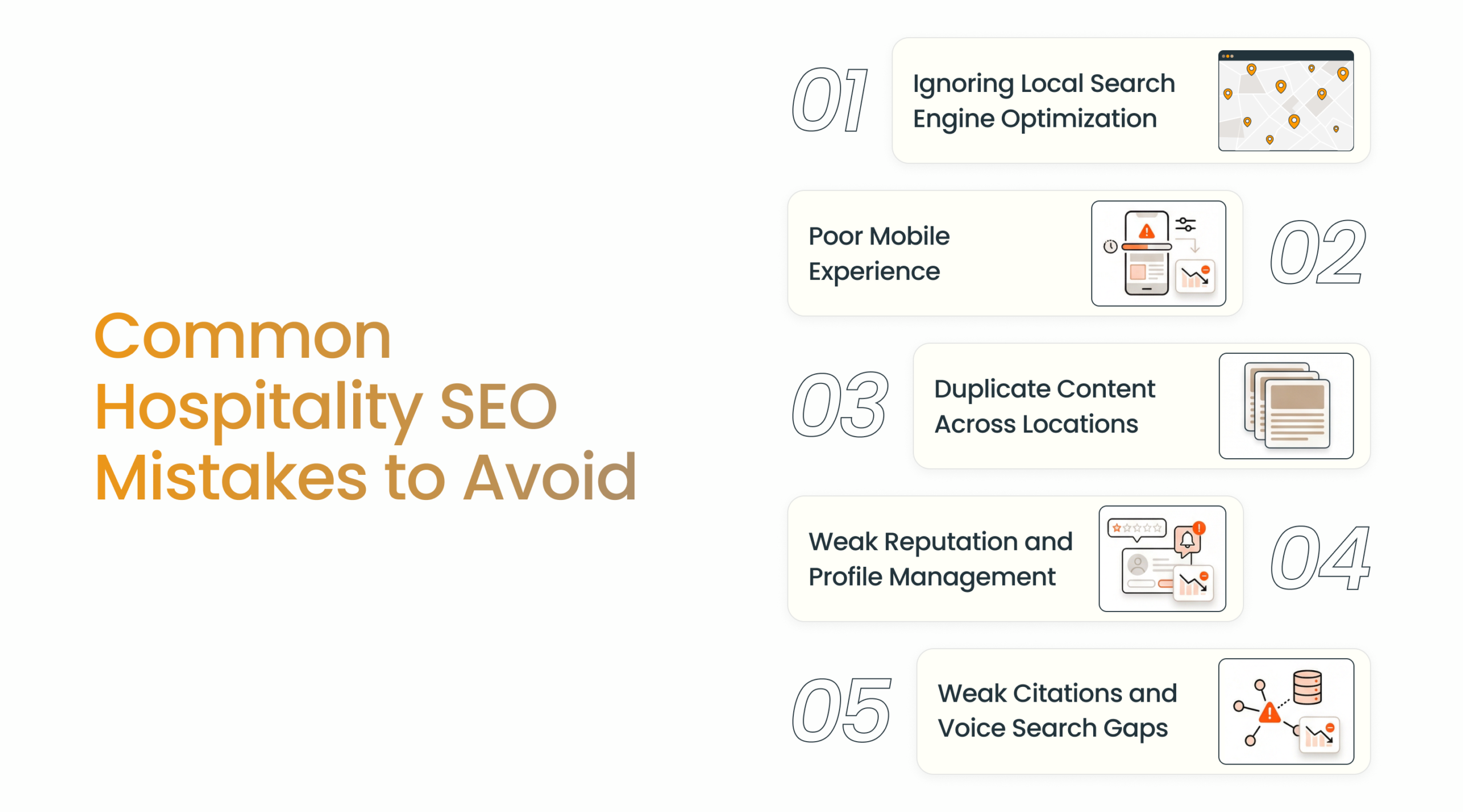
6.3 Duplicate content across locations
Using the same content for multiple locations weakens rankings. Each location needs unique, relevant content to rank well in search results.
6.4 Weak reputation and profile management
Not managing reviews or ignoring Google Business Profile optimisation reduces trust and local visibility. Accurate listings and active review responses are essential.
6.5 Weak citations and voice search gaps
Inconsistent business information harms rankings, while ignoring conversational queries limits reach. Optimising for voice search and maintaining accurate citations strengthens the overall Hospitality SEO strategy.
7. How hospitality SEO actually works
Hospitality SEO works through a structured framework built on four core pillars. Each pillar supports a different part of the customer journey, from discovery to booking. When combined, they create a complete Hospitality SEO strategy that drives visibility, traffic, and conversions.
7.1 Local SEO (Revenue Driver)
Local SEO is the main way to get direct bookings and visitors. It makes sure your business shows up in location-based searches.
Google Business Profile optimisation is the foundation. Your profile must include accurate business details, updated hours, high-quality photos, services, and menus. A well-optimised profile improves visibility in local search and maps.
A strong review strategy is equally important. Positive reviews increase trust and influence rankings. Responding to reviews shows credibility and improves customer perception.
Local citations help search engines verify your business information across platforms. Consistent name, address, and phone number details improve local authority and rankings. This is critical for Local SEO for hotels and restaurants, and Local SEO for spas.
7.2 Technical SEO (Foundation)
Technical SEO makes sure your website works well and helps it show up in search results.
- Site speed is critical, especially for mobile users. Slow websites lead to higher drop-offs and lost bookings.
- Schema markup like Hotel, Restaurant, and Local Business helps search engines understand your content better and show enhanced results.
- Mobile-first considerations are essential since most users search and book on mobile devices.
- International and multi-location SEO makes sure each location has its own unique, optimized page to target local searches well.
- Booking engine crawlability is very important. Search engines need to access and index booking pages to bring in organic bookings.
7.3 Content SEO (Authority Engine)
Content SEO builds trust and attracts users at different steps of their journey.
- Location pages target city or area-specific searches.
- Service pages clearly explain what you offer and help turn visitors into customers.
- Blog clusters answer user questions and improve search visibility.
This content setup makes the overall Hospitality SEO strategy stronger.
7.4 Conversion SEO (Often Ignored)
Conversion SEO focuses on turning traffic into bookings.
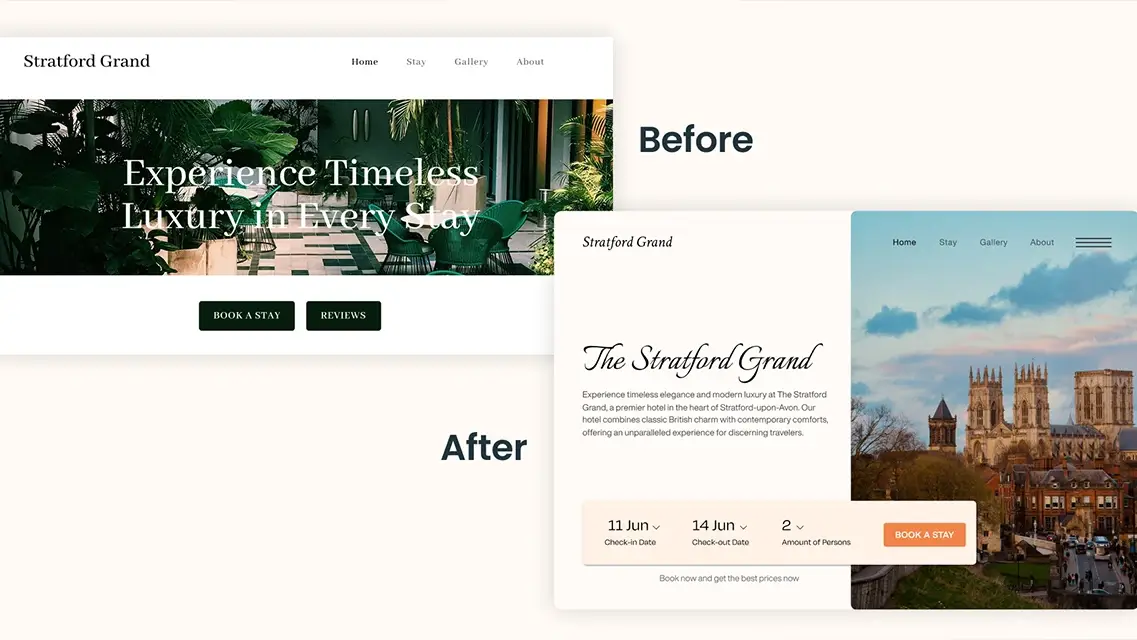
- UX for the booking flow should be simple and fast.
- CTA placement must be clear and visible.
- Landing page optimisation ensures each page is focused on a specific action.
This pillar ensures that Hospitality SEO services deliver measurable revenue, not just traffic.
7.5 Additional ranking factors in hospitality SEO
Beyond core SEO pillars, several factors directly affect visibility and decision-making in hospitality. These are often overlooked but play a critical role in rankings and conversions.
Voice Search SEO
Many hospitality searches are conversational, especially on mobile and voice assistants. Queries like “best hotel near me right now” or “restaurant open late nearby” reflect natural language patterns.
To capture this demand, content should include conversational phrases, FAQs, and location-based queries that match how users actually speak.
Zero-Click Searches
Users often make decisions directly from search results without visiting a website. Information shown in Google Business Profiles, reviews, menus, and maps can influence bookings instantly.
This makes it important to optimise listings with complete and accurate information so users can act without additional steps.
Visual SEO
In hospitality, visuals strongly influence user choice. Photos of rooms, food, interiors, and amenities often determine whether a user clicks or skips a listing.
High-quality, updated images improve engagement, increase click-through rates, and build trust before the user even visits the website.
E-E-A-T in Hospitality
Experience, expertise, authority, and trust are critical in hospitality. Users rely on credible information, consistent reviews, and clear service details before making decisions.
Strong E-E-A-T signals come from: authentic reviews, accurate business information, and consistent branding across platforms
These signals improve both rankings and user confidence.
8. Why ranking is hard in hospitality (and how to beat it)
Ranking in hospitality is more challenging than in most industries because search results are highly competitive and often dominated by large platforms.
8.1 Google favors aggregators
Search results for hotels, restaurants, and spas are often led by OTAs, review platforms, and listing sites. These platforms have strong domain authority and large volumes of content, making it difficult for individual businesses to compete.
8.2 High competition for local queries
Searches like “hotel near me” or “best restaurant nearby” are highly competitive. Multiple businesses target the same keywords within a limited geographic area.
8.3 Review volume competition
In hospitality, businesses are constantly competing for reviews. A competitor with more recent and higher-rated reviews often gains both ranking advantage and higher click-through rates.
9. What actually wins in hospitality SEO
To compete effectively in hospitality search results, businesses need to outperform competitors on depth, local presence, and brand trust signals.
- Content depth: Detailed, location-specific pages and service content that match real user intent
- Local authority: Strong presence across Google Business Profile, citations, and local signals
- Brand signals: Branded searches, repeat visits, and recognition that indicate trust and credibility
In hospitality, success comes from showing up with the right information, in the right place, with enough trust for users to act immediately.
10. Hospitality SEO by business type
10.1 Hotel SEO strategy
A well-planned hotel marketing SEO strategy focuses on visibility, user experience, and direct bookings.
a. On-page optimisation for hotels
Hotels should create dedicated pages for rooms, amenities, services, and nearby attractions. Each page should target specific keywords like room types, location-based searches, and guest intent queries. Proper use of headings, internal links, and structured content improves rankings.
b. Local SEO for hotels
Local visibility is critical. Hotels must optimise their listings, collect reviews, and maintain consistent business information across platforms. Strong local SEO for hotels and restaurants helps hotels appear in map results and “near me” searches.

c. Technical SEO considerations
Hotels must ensure fast loading speeds, a mobile-friendly design, and a smooth booking experience. Booking engines should be easy to use and accessible to search engines. Structured data (hotel schema) also improves visibility in search results.
d. Content marketing for hotels
Content should focus on travel guides, local attractions, seasonal offers, and guest experiences. This helps attract users in the research phase and supports the overall Hospitality SEO strategy.
Your 3-Month Free Hotel Marketing Plan Awaits!
90-day roadmap to increase direct bookings with weekly tasks, priorities, and proven strategies.
10.2 Restaurant SEO Strategy
Restaurant SEO services focus on capturing local demand and quick decision-making searches.
a. Google Business Profile mastery
Restaurants must fully optimize their profiles with menus, photos, hours, and reviews. Regular updates and responses to reviews improve visibility and trust. This is a key part of Google Business Profile optimisation.
b. Local search dominance
Restaurants should target “near me” and location-based keywords. Strong local listings and consistent citations help dominate local search results.
c. On-page restaurant SEO
Menu pages, event pages, and location-specific pages should be optimised with relevant keywords. Structured data for menus and reviews can improve search visibility.
d. Content strategies for restaurants
Content should include blogs about cuisine, chef stories, seasonal menus, and dining experiences. This supports brand visibility and strengthens the restaurant marketing SEO strategy.
Your 3-Month Free Restaurant Marketing Plan Awaits!
90-day blueprint to attract more diners with seasonal promotions, social content, and local SEO tactics.
10.3 Spa SEO Strategy
Spa SEO services focus on building trust and driving appointment bookings.
a. Service page optimisation
Each treatment should have a dedicated page with clear descriptions, benefits, pricing, and FAQs. This helps target specific search queries.
b. Local SEO for spas
Spas must optimise local listings, gather reviews, and maintain consistent business information. Strong Local SEO for spas ensures visibility in nearby searches.
c. Building trust through content
Content should include wellness guides, treatment explanations, and expert insights. This helps build credibility and supports the spa marketing SEO strategy.
d. Booking and conversion optimisation
Spas should offer a simple booking process, clear CTAs, and mobile-friendly pages. Optimised landing pages improve conversions and reduce drop-offs.
Medical spa and day spa marketing aren’t interchangeable. Learn the crucial distinctions to stay compliant and position your business effectively.
Your 3-Month Free Spa Marketing Plan Awaits!
90-day action plan to boost bookings with wellness content, loyalty programs, and targeted campaigns.
11. Essential SEO tools for hospitality businesses
A strong Hospitality SEO strategy depends on using the right tools at every stage.
| Category | Free Tools | Paid Tools |
|---|---|---|
| Keyword Research & Analysis | Google Keyword Planner, AnswerThePublic (limited), Google Trends | SEMrush, Ahrefs, AnswerThePublic Pro |
| Local SEO & Google Business Profile | Google Business Profile | BrightLocal, Moz Local, Whitespark, GeoRanker |
| Review Management | Trustpilot (basic/free listing) | Birdeye, ReviewTrackers, Grade.us |
| Analytics & Tracking | Google Analytics 4, Google Search Console, Looker Studio | Hotjar (paid plans for advanced tracking) |
| Technical SEO | Google PageSpeed Insights, Schema.org Validator | Screaming Frog, GTmetrix Pro, Sitebulb |
| Rank Tracking | (Limited free trials/tools) | AccuRanker, SERPWatcher (Mangools), Advanced Web Ranking, Local Falcon |
| Content Optimisation | Grammarly (basic), Hemingway Editor, Canva (free) | Surfer SEO, Clearscope, Grammarly Premium, Canva Pro |
| Backlink & Outreach | HARO (free version) | Pitchbox, BuzzStream, Majestic |
| Booking & Conversion Optimisation | (Limited free integrations depending on platform) | OpenTable, Booking.com tools, Yelp Reservations, TheFork, Mindbody |
| Competitive Intelligence | (Limited free insights via tools) | SpyFu, SimilarWeb, iSpionage |
12. Tool selection guide
12.1 Budget-friendly stack (small businesses)
- Google tools + basic SEO tools
12.2 Mid-tier stack (growing brands)
- Add SEMrush, BrightLocal
12.3 Enterprise stack (large chains)
- Full SEO suite + automation
12.4 Free tools every hospitality business should use
12.5 Integration & Workflow Tips
- Connect Google Analytics with Search Console
- Use Looker Studio for automated reports
- Sync review tools with CRM systems
- Prioritise tools based on business type:
- Hotels: booking + analytics focus
- Restaurants: local + reviews focus
- Spas: trust + conversion focus
13. Measuring Hospitality SEO Success
Success in Hospitality SEO should be measured using clear and business-focused metrics. The goal is not just traffic, but actual bookings, reservations, and revenue.
13.1 Key metrics to track
a. Organic traffic to booking/reservation pages
Track how many users land directly on booking or reservation pages through search. This shows how well your SEO is driving high-intent traffic.
b. Local pack rankings
Monitor your visibility in Google’s local pack results (map listings). This is critical for local SEO for hotels and restaurants, and spas, as most users choose from these results.
c. Conversion rates from organic search
Measure how many visitors from organic search complete a booking, reservation, or inquiry. This shows the effectiveness of your Hospitality SEO strategy.

d. Review ratings and volume
Track both:
- Average rating (quality)
- Total number of reviews (volume)
Both factors influence rankings and customer trust.
13.2 Tools and analytics setup
Use tools like:
- Google Analytics 4 to track user behavior and conversions
- Google Search Console to monitor search performance
- Conversion tracking for bookings, calls, and form submissions
Setting up proper tracking ensures you can measure real business impact from Hospitality SEO services.
13.3 Competitive benchmarking
Compare your performance with competitors:
- Keyword rankings
- Local pack visibility
- Review ratings
- Website traffic
This helps identify gaps and opportunities to improve your SEO for hotels, restaurants, and spas.
13.4 ROI calculation for hospitality SEO
ROI should be based on revenue, not just traffic.
Track:
- Number of bookings from organic search
- Average booking value
- Total revenue generated
Then compare it with your SEO investment. This shows the true return from your Hospitality SEO strategy and helps justify long-term investment.
14. ThisRapt hospitality SEO system
SEO in hospitality is a revenue system, not just a traffic channel.
In hospitality, SEO connects search demand directly to bookings, reservations, and appointments. Our approach is built to capture high-intent searches, improve visibility in decision moments, and convert that demand into measurable business outcomes. It combines research, execution, and continuous optimisation into a structured system.
14.1 Step Framework:
a. Market and competitor analysis
We analyse your market, competitors, and search landscape to identify gaps in visibility, missed demand, and areas where your business can outperform others.
d. Content and landing page development
We build and optimise location pages, service pages, and supporting content that match real search intent and guide users toward booking.
b. Keyword and intent mapping
We map high-intent keywords to each stage of the customer journey. This ensures your content targets users who are ready to take action, not just browse.
e. Local SEO optimisation
We strengthen your local presence through Google Business Profile optimisation, citation consistency, and review strategies. This improves visibility in map results and high-intent local searches.
c. Technical improvements
We fix issues related to site speed, mobile usability, indexing, and booking engine accessibility. This ensures your website supports both rankings and conversions.
f. Ongoing growth and reporting
SEO is continuously refined. We track performance, improve what works, and provide clear reporting focused on bookings, not just traffic.
14.2 Get a clear view of your SEO potential
If your business does not appear in relevant searches, there are likely gaps in your current system.
We offer a free Hospitality SEO audit to help you understand where you stand and what can be improved.
What you will get:
- A review of your current search visibility
- Key issues affecting rankings and conversions
- Practical recommendations tailored to your business
This is a focused review based on your market, not a generic report. It is designed to help you take the next step with clarity.
15. Case Studies
Hotel Occupancy Growth
A hotel struggling with low occupancy and heavy reliance on third-party platforms improved performance through a structured digital strategy. Combining SEO optimisation, targeted campaigns, and an improved booking experience, the property achieved a 25% increase in occupancy rates and higher direct bookings.
Read the full case study: Hotel marketing strategy that boosts occupancy by 25%
16. Hospitality SEO FAQs
Hospitality SEO improves the online visibility of hotels, restaurants, and spas in search engines. It attracts high-intent users and converts them into bookings through local SEO, content optimisation, technical improvements, and reputation management.
Hospitality SEO typically shows initial results within 3 to 4 months, especially for local visibility. Consistent growth takes 6 to 12 months, depending on competition, website quality, content, and review signals.
SEO and paid ads serve different roles. Paid ads deliver immediate traffic, while SEO builds long-term visibility and reduces reliance on paid channels. A balanced approach ensures consistent bookings and short-term campaign support.
A typical setup includes a CRM platform, automation software, integration tools, communication tools like email or SMS platforms, and analytics systems to manage data, run workflows, and track performance effectively.
The cost varies based on business size, competition, number of locations, and scope of work. Smaller businesses need simpler strategies, while multi-location brands require advanced SEO, including technical optimisation, content, and local management.
Yes, SEO increases direct bookings by improving visibility for high-intent searches and optimising conversion paths. It reduces dependence on third-party platforms and lets businesses retain more control over revenue and customer relationships.