A website isn’t just a pretty aesthetic; it’s your most powerful booking tool.
Around 73% of UK hospitality bookings start with not a phone call, not a walk-in, and not even a referral from a friend. It starts with a mere website visit. Yet, a lot of them lose customers in the first 8 seconds.
Slow load times, cluttered layouts, hard-to-find booking buttons, and uninspiring imagery drag guests straight back to their search engine and into the arms of your competitors who have a better first impression.
By ignoring the importance of having a website that converts, you not only miss a booking but also pay 15-25% commission to OTA platforms on every reservation that could have been direct. It’s not just the money; it’s the guest relationship you never get to earn, the loyalty you never get to earn.
OTAs captured 37.24% of the UK hospitality bookings in 2025, but even the direct digital channels are growing at a 7.34% CAGR (UK Hospitality Industry Report 2025-2031). Your guests genuinely want to book directly; your website just needs to give them a solid reason to do so. There are many ways to increase direct bookings for hotels in 2026; you just need to solidify your knowledge.
1. What is hospitality website design?
Hospitality websites are nothing like e-commerce or corporate websites. Hospitality websites sell an experience that solely exists in the guest’s imagination before they arrive. A generic brochure-like template can list rooms, services, and prices. But a website built with a purpose creates an emotional journey from the very first impression to “Book Now,” removing friction at every step. The goal is to create a site that looks pretty and acts as a conversion engine.
1.1 Why website design is different for UK hospitality
Hospitality is neither e-commerce nor corporate. It doesn’t just sell services; it sells experiences, emotions, and memories. Such selling demands design decisions that work elsewhere don’t automatically translate here.
The guest journey is considered an emotion-to-action journey, which looks like:
Curiosity → consideration → desire → decision.
Discover the essential principles, strategies, and best practices for creating a hospitality website that enhances guest experience, strengthens your brand, and drives more direct bookings. |
|
Your website needs to support every stage of a guest’s journey. More than 68% of UK hospitality searches happen on mobile. That said, most of the journey takes place on the small screen, maybe on the go, with low to no patience for friction. To match their level of patience, add the 3-second rule; your page should load in 3 seconds. If it takes more than that, it’ll lose the majority of the visitors.
Stay ahead with the latest trends in website design for hospitality brands and stand out from your guests’ expectations.
2. Why is website design important in hospitality?
Research says 18% of the travellers who start on an OTA ultimately book direct (SiteMinder); they’re already looking for one reason to bypass the middleman. Every guest shifting to direct bookings saves real commission money.
When a £500k/year hotel reduced OTA dependency and saved 10%, saving up to £12,500 annually.
2026 is the first year when mobile booking revenue overtakes desktop booking (Net Affinity). Guests now complete the entire journey from discovery to payment on their phone. A site that is not optimised for mobile screens is already losing bookings.
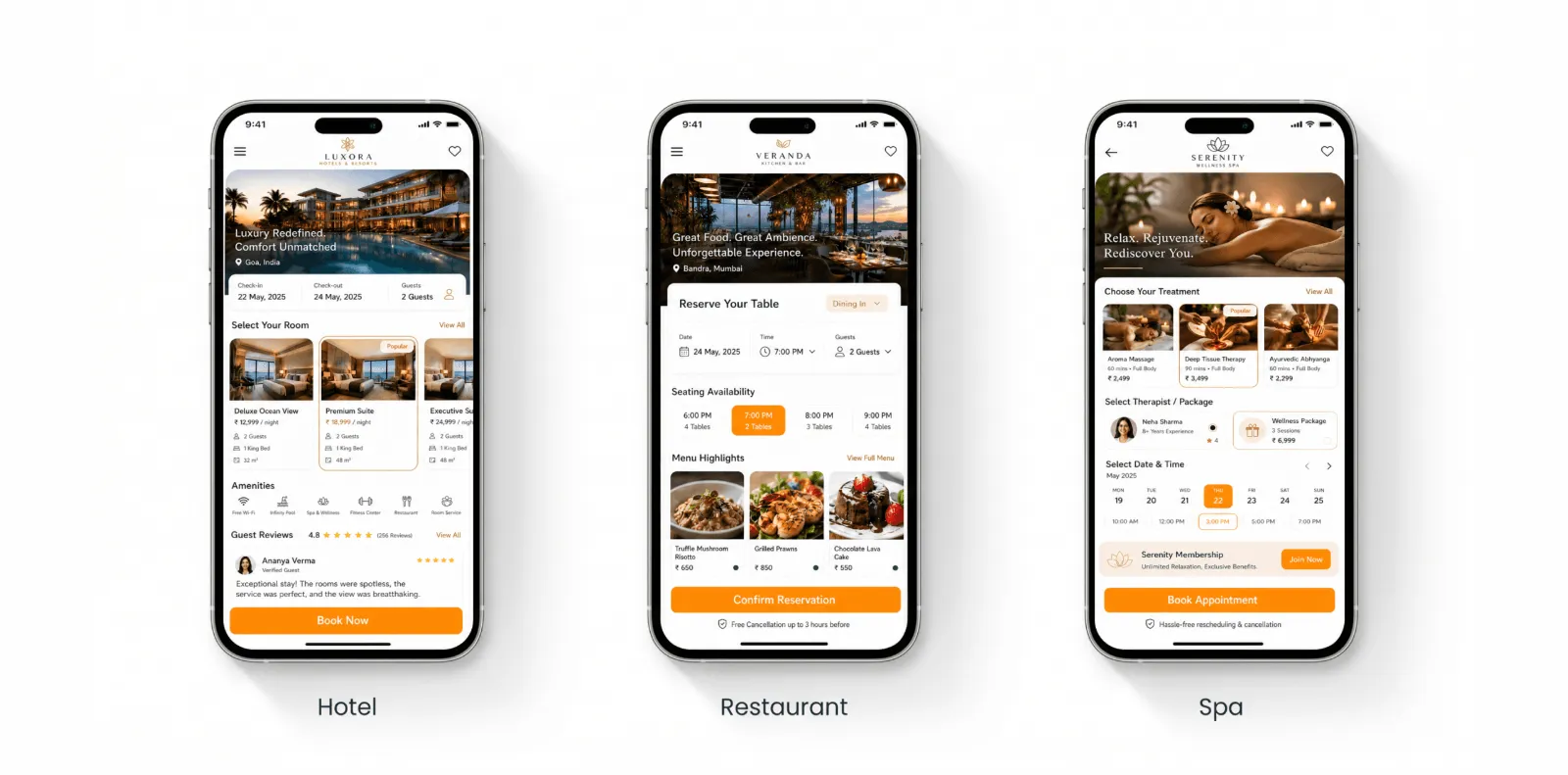
However, the stakes differ by segment. Hotels have the most complex, research-heavy journey, followed by restaurants that run on speed and response. Lastly, the spas are built on trust; these guests want reassurance before they even enquire, so visible credentials matter.
3. Core elements of high-converting hospitality websites
3.1 UX and conversion design
The invisible architecture that differentiates a guest who books from a guest who leaves depends on the three non-negotiable pillars.
- Clear CTAs: CTAs should be visible on every page. “Book Now,” “Reserve a Table,” or “Schedule a Treatment” should be consistently placed.
- Less Friction: Booking flows should have hardly 5 steps; flows having any more than that can lose up to 40% of potential bookings.
- Trust Signals: Reviews, awards, testimonials, and secured payment badges should appear throughout the journey, not just on a specific page.
3.2 Mobile-first design
Start by building your website for small screens first. Integrate thumb-friendly navigation, compressed imagery, and a booking engine that works on mobile. Mobile bookings are projected to touch 75% market share by 2026 (Punch Hospitality). The majority of traffic is on mobile; hence, if a site is not built mobile-first, then it’s built for a shrinking minority.
3.3 Visual and experience design
Photography is not just decoration; it’s sales material. A guest can’t actually experience your rooms, dishes, or services before arrival; your imagery has to do that work. Invest in good-quality professional photography that captures feelings. Use short-form video content for walkthroughs. Show real people having real experiences. Maintain brand consistency with colour, typography, and spacing across every page. Inconsistency signals unreliability.
3.4 SEO-friendly structure
You built a beautiful site, but nobody can find it; you technically wasted money. From the day you start building a website, build it with clean URLs, structured headings, optimised meta titles and descriptions, and local SEO signals.
For surface visibility of star ratings, price range, or availability directly in Google results, schema markup is essential. This also increases click-throughs before the guest even visits your site. Just go through local SEO guides for a deeper dive into this.
3.5 Booking engine integration
The most critical and most commonly ruined element. If your booking system opens in a new tab, it looks disconnected. And if it demands account creation, it’ll destroy conversions. Integrate booking systems seamlessly, avoid iframe-heavy systems, show real-time availability and transparent pricing, and support on-site payment. Every time your website redirects to a third-party platform, it risks drop-off.
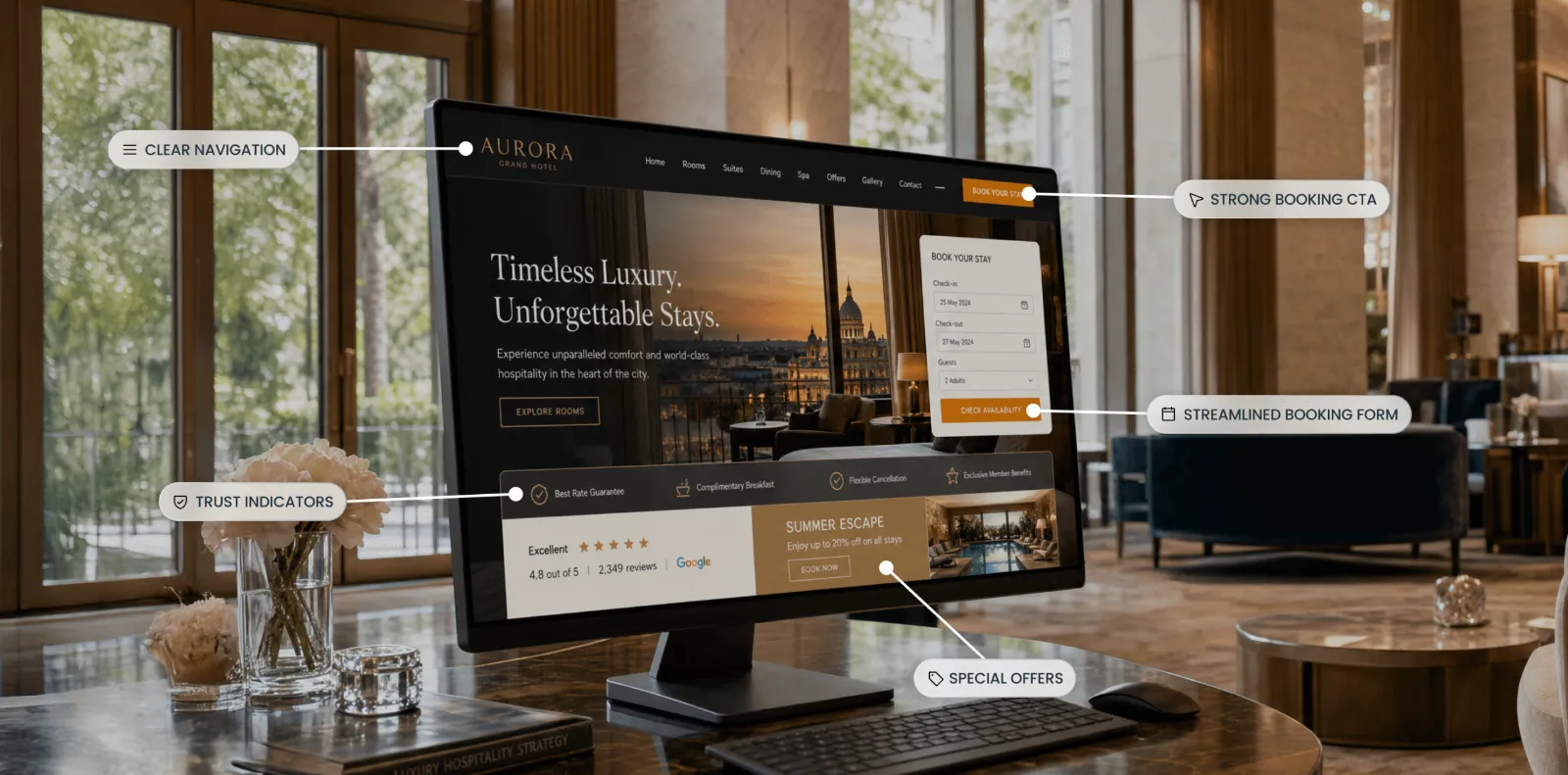
4. Website design by business type
4.1 Hotel website design strategy
Primary goal: Capture direct bookings before your guests reach an OTA.
Focus: Room pages selling the experience with frictionless direct booking UX and upsell-ready offer pages. 80.5% of the UK hotel stays are just one night (SiteMinder), so the revenue depends on maximising value for each stay, not length.
Key elements:
- Visual hero sections for rooms and properties
- Direct booking engine integration
- Real-time availability and transparent pricing
- Interactive galleries with virtual tours
- Location and local attraction
- Trust signals like reviews, awards, certifications, and testimonials
- Upsell opportunities like breakfast, spa, and parking within the booking flow
4.2 Restaurant website design strategy
Primary Goal: Answer the following three questions: what, where, and how to book within 3 seconds.
Focus: Zero friction in accessing menus, immediate location and contact info, embedded reservation system, and no redirects.
Key elements:
- Filterable menu, mobile-optimised, never a PDF
- Embedded table reservation system
- Photography that genuinely sells food and ambience equally
- Event and private dining pages with clearly mentioned enquiry pathways
- Opening and closing hours, map, and parking info on every page
- Delivery or takeaway integration wherever applicable
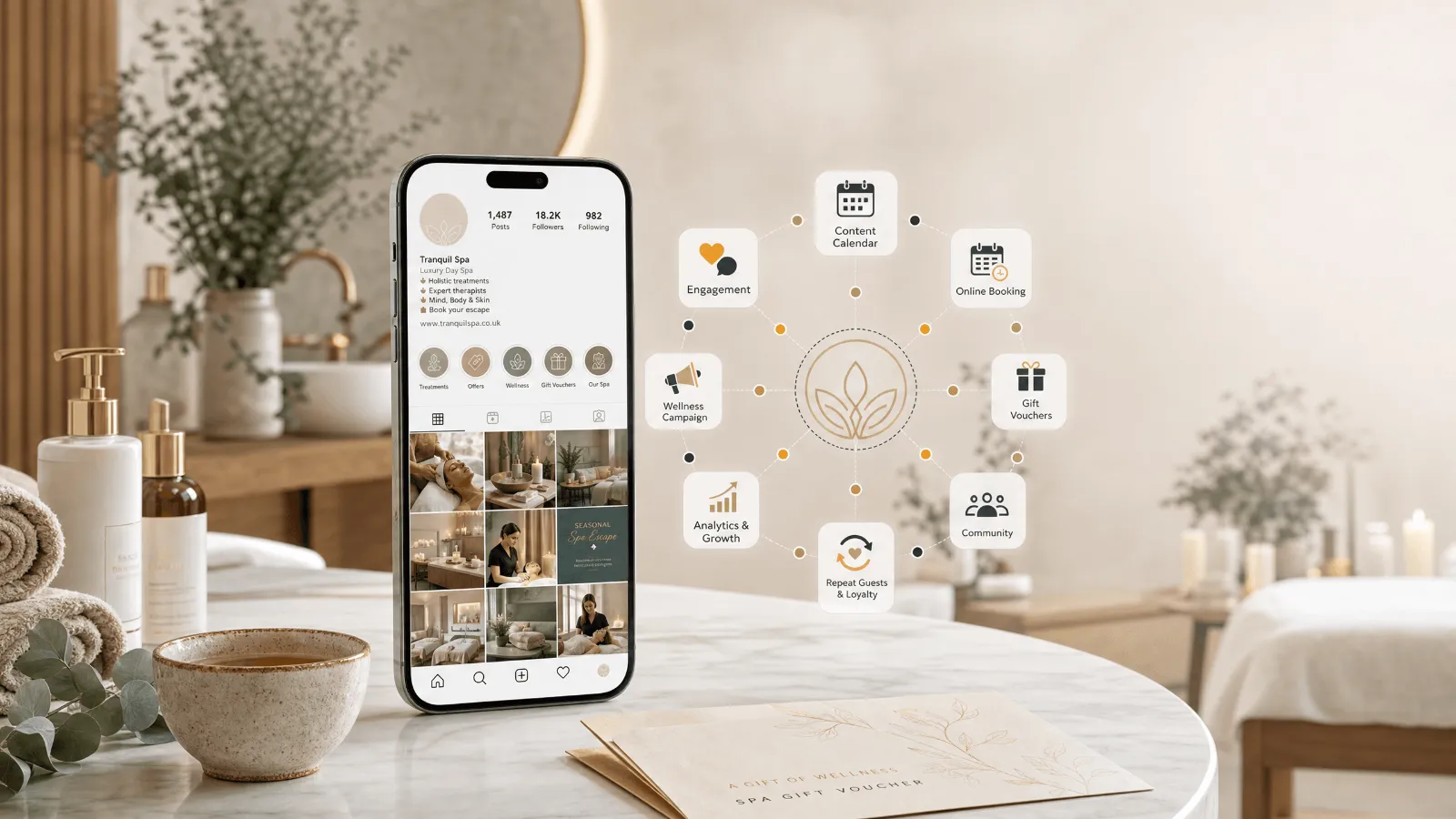
4.3 Spa website design strategy
Primary Goal: Communicate calm authority and reliance, making booking feel as effortless as the treatment.
Focus: Treatment pages that convey the whole experience, not just list services. A design so aesthetically pleasing that it sells tranquillity and a seamless appointment booking system.
Key elements:
- Treatment menus covering descriptions of services
- Online appointment booking with clearly visible time slots
- Gift voucher purchasing system
- Therapists’ profiles with reliable credentials
- Membership and package options
- Wellness blogs for SEO and brand authority
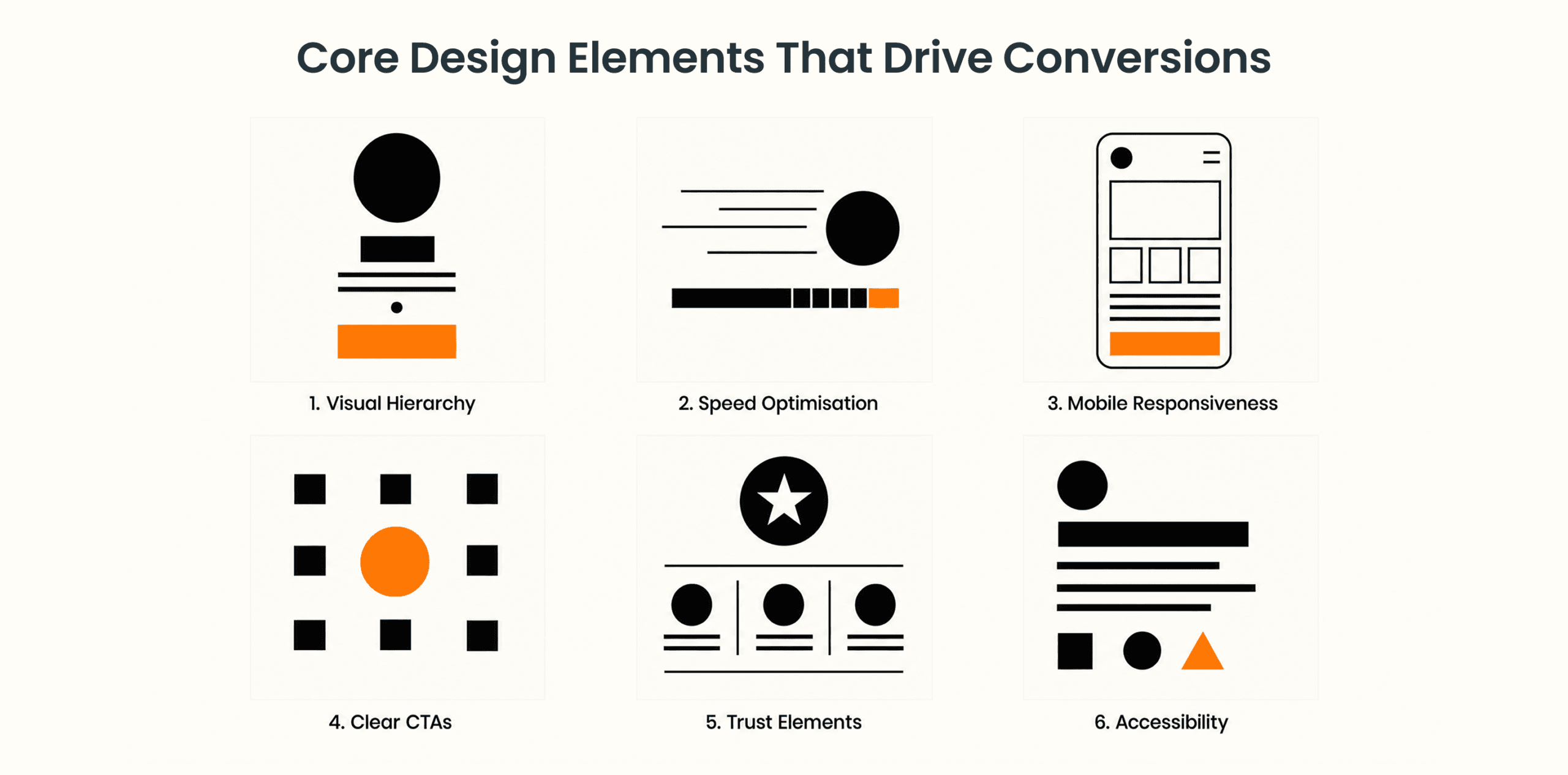
5. Core design elements that drive conversions
Every page should guide the guests from awareness → consideration → action. If a guest has to work out what to do next, your website has failed.
A 2-second load time is non-negotiable. Use WebP images, lazy loading, and CDNs to increase speed. A website’s PageSpeed score below 80 on mobile is a big problem for revenue generation.
Large tap targets, readable text without needing to zoom, and a booking flow that works without a keyboard. Test on real devices, not just on a browser resize.
“Book Now,” “Reserve a Table,” or “Buy Gift Voucher” Such CTAs should appear at natural decision points across pages. Position CTAs after trust signals, at the bottom of the room and treatment pages, or above the fold on the homepage.
Include verified reviews, social proof, secured payment badges, and good-quality, genuine photography. This reduces the anxiety that stops first-time bookers from converting. In the hospitality industry, trust is the only prerequisite for conversion.
WCAG compliance is an ethical obligation. Keyboard navigation, screen reader support, sufficient colour contrast, and descriptive alt text are baseline necessities. An accessible site is also important for better search rankings.
6. Technical must-haves for UK hospitality websites
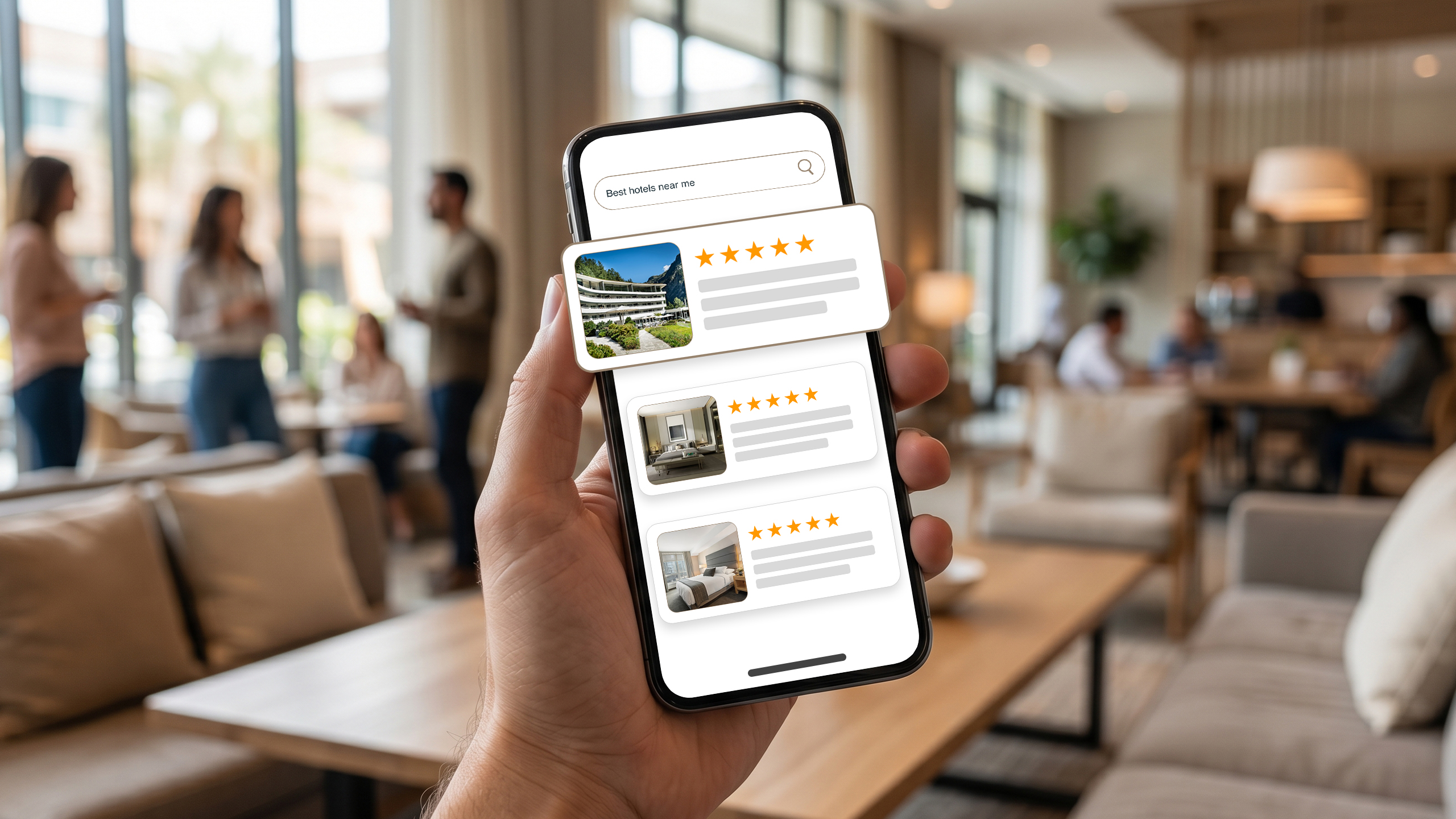
- SEO foundation: From the very start, embed on-page optimisation, local schema markup, and structured data for rooms, menus, and treatments. If your website appears in Google’s local pack for searches like “hotel near me,” it builds trust and drives direct booking traffic.
- Booking system integration: Seamless integration to your PMS or reservation platform. Guests expect real-time availability.
- Analytics setup: Configure Google Analytics 4 to track the full conversion funnel. Understand where guests drop off, which pages convert, and how mobile vs. desktop behaviour differs.
- Security: UK guests are very conscious about their privacy; they’ll never book on a site that feels unsafe. Hence, integrate SSL, GDPR-compliant cookie consent, and secure payment gateways.
- CMS flexibility: Your team must be able to update menus, offers, and imagery without depending on any developer. WordPress and Webflow are both ideal for doing this.
- Multi-language support: A forecast by VisitBritain predicts 45.5 million inbound visits in 2026, up 4% on 2025 (VisitBritain). A significant number of international audiences may not be comfortable booking in English.
7. Essential tools for hospitality website design
7.1 Design and prototyping tools
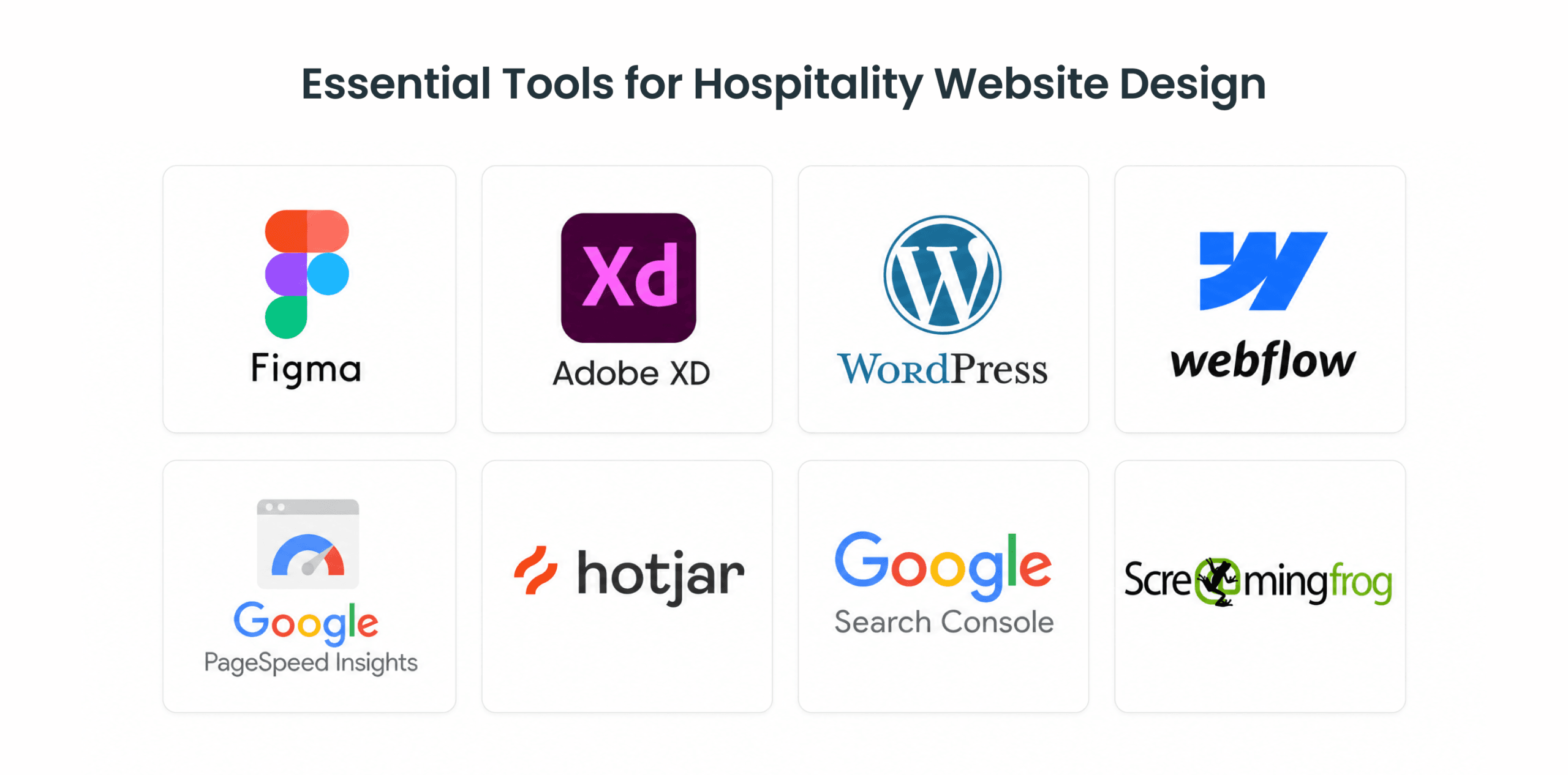
- Figma is one of the best collaborative tools for web design. Teams can review and iterate on layouts before any code is written.
- Adobe XD offers a similar level of prototyping with a deeper Adobe Creative Suite integration.
7.2 CMS and website platforms
- WordPress is the most widely used platform for UK hospitality websites. It has an extensive plugin ecosystem, a strong developer community, and booking engine integrations like Beds24, Cloudsbeds, and OpenTable.
- Webflow is popular among design-first brands because of its pixel-perfect custom layout without sacrificing page speed.
7.3 Performance and UX tools
- Google PageSpeed Insights audits core web vitals and load speeds. These are the metrics that Google uses as ranking signals. Run it regularly on mobile as well as desktop.
- Hotjar provides session recordings and heatmaps that show exactly where visitors click, scroll, and drop off. These are some invaluable gems for optimising the booking flow.
7.4 SEO and technical tools
- Google Search Console tracks your site’s search performance through queries, crawl errors, and click-through rates.
- Screaming Frog SEO Spider crawls through your entire site to surface broken links, duplicate content, missing meta descriptions, and other issues that might be suppressing your rankings.
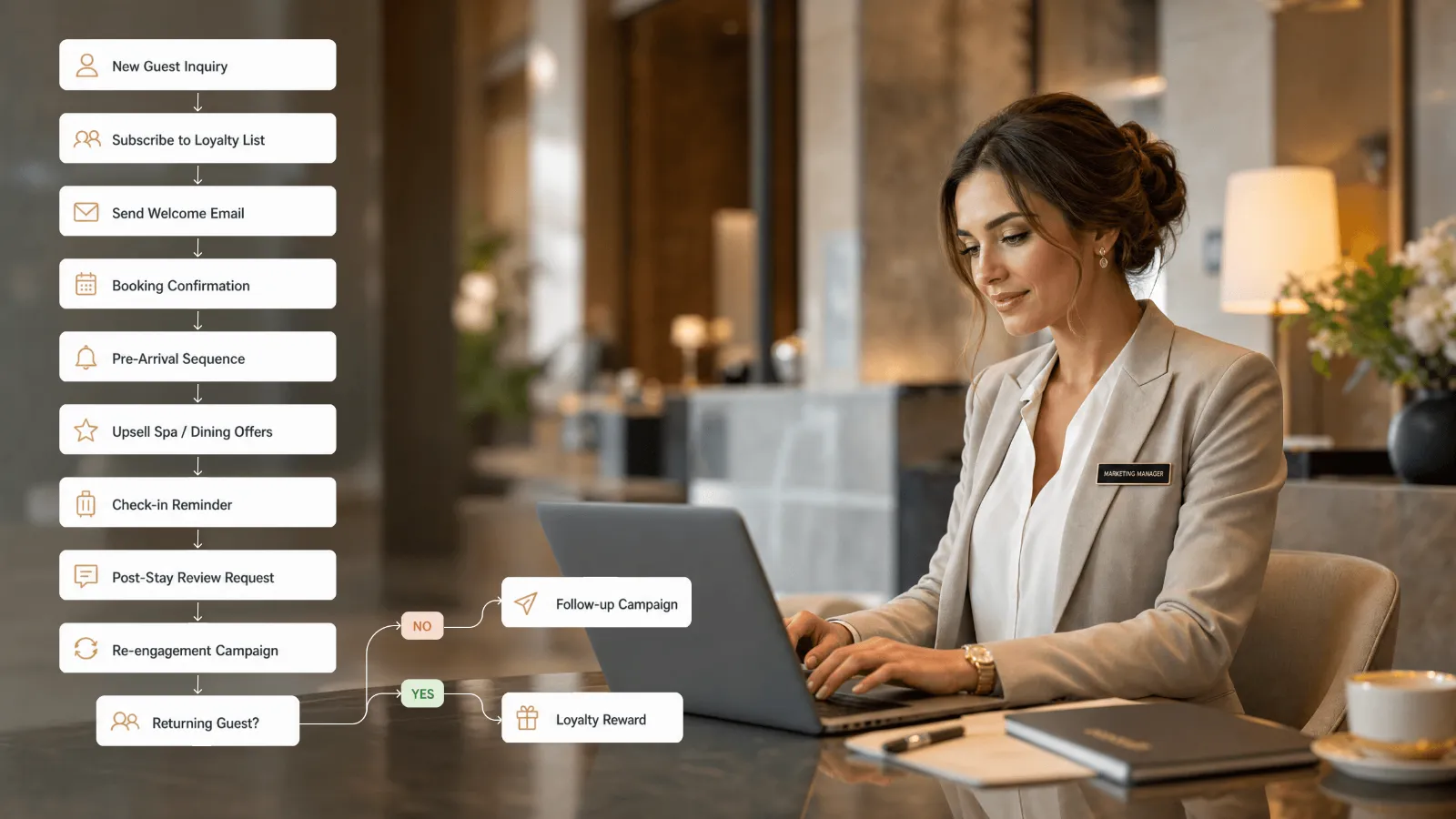
There are numerous digital marketing automation tools that are designed to save your teams 15+ hours a week.
8. Common website design mistakes that cost bookings
- Slow load times: Unoptimised images are most likely to be the common culprits. Gallery pages with full resolution add seconds to load time, which costs bookings.
- Complicated booking flows: If the booking asks for more than 4 steps, then your guests simply abandon it. Every extra unnecessary field or redirect is a drop-off point.
- Hidden pricing: When you withhold returns until checkout, it destroys the guest’s trust. Transparency converts while opacity repels.
- Poor mobile experience: Small buttons, hard-to-read text, and broken layouts degrade the experience of mobile visitors and push them towards OTAs.
- Outdated imagery: If the website shows a blank space where an image once was, guests feel misled on arrival and mention so in reviews.
- No value proposition above the fold: A generic hero image that has no headline answers nothing and converts no one.
- Buried contact information: Your phone number, email, and address belong in the header, not buried deep inside the footer.
9. Results you can expect
- Bounce rate and time on site: A strong visual design and a clear structure keep visitors engaged. A well-designed hospitality site typically achieves bounce rates below 50%.
- Conversion rate: Hotels that are using modern web design best practices are reported to increase their direct booking rates by 20-50% within the first year (Prostay).
- Direct booking ratio vs. OTA referrals: You need to track this monthly. Each percentage point shifted towards direct booking is a measurable commission saved and is also the primary KPI for the website’s ROI.
- Mobile vs. desktop performance: Witnessing a large gap between mobile traffic and mobile conversions clearly signals a UX problem.
- Page Speed scores: Target 80+ score for mobile and 90+ score for desktop in Google PageSpeed Insights. If you score below these thresholds, then it may be a big problem for your revenue.
- User journey drop-off points: Use Google Analytics 4 and Hotjar to know exactly where guests abandon the booking flow. If even one friction point is removed, it can deliver a measurable uplift in completed reservations.
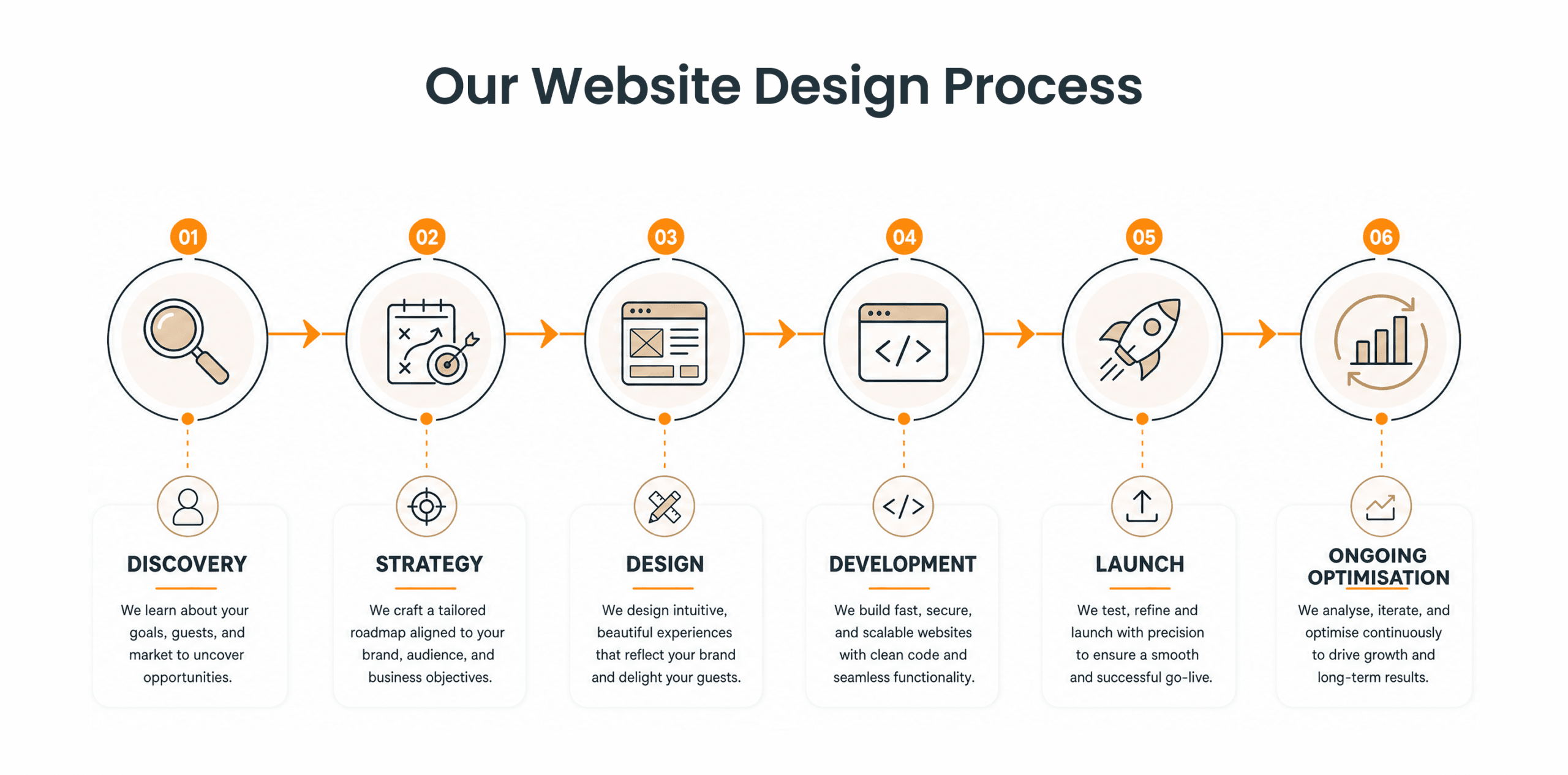
10. Our website design process
- Discovery and Audit: We understand your business, guests, and current digital performance. All the existing sites are audited for conversion barriers, speed issues, and SEO gaps.
- Strategy and wireframing: Mapping the complete user journey before beginning to design. Every page is planned around the guests’ needs to make them move from arrival to booking.
- Design and content creation: We build a hospitality-specific visual identity or work with your existing brand with relevant content, photography direction, and copy aligned to your ideal guest.
- Development and testing: We build and test the websites across all devices and browsers. Booking engine integration, page speed, GDPR compliance, and accessibility are all verified before your website is launched.
- Launch and optimisation: Performance is monitored regularly post-launch, and data-driven refinements are made based on real user behaviour.
- Ongoing maintenance and updates: Updates like seasonal offers, menu changes, and new photography are made. Your site stays current without hiring a developer to manage every edit.
11. Why UK hospitality businesses need specialist web designers
- Industry-specific understanding: Specialists will analyse booking behaviours, seasonal demand, and the OTA vs. direct dynamic. A generalist learns these slowly, at your expense.
- Integration expertise: Integrating PMS, booking engines, and payment gateways requires expertise and hands-on experience with the tools that UK hospitality businesses actually use.
- Hospitality-focused UI/UX: Guest decision journeys are non-linear and emotional in ways that can’t be mapped to e-commerce conventions. Design thinking specific to the sector is essential.
- Ongoing seasonal support: Adding Christmas packages, Valentine’s offers, and summer menus. As your business evolves, your website evolves with it, and your agency needs to understand this well enough to support that without needing to be briefed from scratch every time.
ThisRapt works closely with UK hotels, restaurants, and spas, bringing deeply exclusive industry knowledge to each project we take. Our services sit within fully integrated hospitality marketing, so your website never builds and operates in isolation.
12. Conclusion
When a hospitality website is well-designed, it converts browsers into direct bookers, reduces OTA dependency, and reflects the quality of the experience you deliver. The right website design drives measurable revenue from the very first day, not as a byproduct, but as a primary outcome.
Continuous optimisation always beats one-time builds. The best hospitality websites are the ones that are monitored, tested, and refined based on the evolving guest behaviour and search algorithms. A website that isn’t improving constantly is falling behind.
Ready to turn more website visitors into paying guests?
Whether you’re launching a new hospitality brand or improving an existing site, our team designs high-converting hospitality websites that strengthen your brand, increase direct bookings, and support long-term growth.
13. Website Design FAQs
Boutique hotels and independent restaurants typically invest £3,000 to £10,000. However, the larger properties invest more. The real question is, “What is a 20% increase in direct bookings worth annually?” For most of the UK hospitality businesses, a well-designed website pays back within months.
6 to 10 weeks from starting to launch, covering strategy, design, development, content, and testing. Rushing the strategy or testing phases typically tends to cost more in post-launch fixes than the time saved.
WordPress is best for plugin depth and booking engine integrations. Webflow, on the other hand, is best for design quality and performance. The right choice depends on you and your team’s technical comfort and integration requirements.
Yes, hotels that use modern web design best practices report 20-50% direct booking increases within the very first year. For restaurants, a well-integrated reservation system routinely increases covers.
A basic template can cost £2,000, while a fully custom build with booking engine integration, SEO setup, and content creation can cost up to £15,000+. The ROI calculation matters more than the upfront cost. That said, a 10% shift away from OTAs can save thousands of commission annually.
No. A responsive site that adapts to different screen sizes across devices is more effective and better for SEO than maintaining two different versions. All you need is a site designed mobile-first and not adapted to mobile screens as an afterthought.
Update the content like menus, offers, and photography continuously. Structural design and technology should be updated every 2 to 3 years. A site that looked modern in 2021 might already be underperforming in 2026.
Templates are faster, cheaper, and easier to build, but have limited integration capability, performance optimisation, and brand distinctiveness. Custom sites are built around your business’s needs and guest journey. For most of the UK hospitality businesses competing for direct bookings, the commercial difference is significant.