Someone asks ChatGPT ‘where’s a good spot for a group dinner near King’s Cross with a decent vegetarian menu?’ It doesn’t hand back ten blue links. It names three restaurants, describes what makes each one suitable, and the conversation usually ends there. If your restaurant isn’t one of the three names, you haven’t ranked lower – you were never in the running.
Independent restaurants across the UK have spent years building solid local SEO foundations: a complete Google Business Profile. This menu ranks for the right dishes, with a steady flow of reviews. That work still matters. But a fast-growing share of diners are no longer searching in the traditional sense at all – they’re asking an AI assistant a specific, conversational question and acting on a single synthesised answer, often without ever visiting a search results page.
This is Generative Engine Optimisation, or GEO. This guide explains what it means for restaurants specifically, why the numbers say it can no longer be ignored, and gives independent UK restaurants a practical plan for improving their visibility inside AI-generated recommendations.
1. What is Generative Engine Optimisation (GEO)?
A complete guide to GEO for restaurants, from brand visibility to direct bookings. |
|
Generative Engine Optimisation is the practice of structuring your restaurant’s website, menu, and listings so that AI-powered tools – ChatGPT, Google’s AI Overviews, Gemini, Perplexity, and Microsoft Copilot — can accurately understand your restaurant and choose to recommend it in response to a diner’s question.
Traditional SEO earns you a position in a list of results. GEO earns you a mention inside a single, synthesised answer that typically names only a handful of options. Industry benchmarking of AI-generated restaurant answers has found that AI assistants tend to name only three to five restaurants per query and stop there – which means the difference between appearing and not appearing is far starker than the difference between ranking third and ranking eighth on a traditional results page.
1.1 GEO, AEO, and AIO: Untangling the acronyms
- SEO (Search Engine Optimisation) – optimising for ranking position in traditional search results.
- AEO (Answer Engine Optimisation) – structuring content so it can be extracted as a direct answer, whether a Featured Snippet, a voice response, or an AI Overview.
- GEO (Generative Engine Optimisation) – optimising specifically for generative AI tools that synthesise answers from multiple sources, such as ChatGPT and Gemini.
- AIO (AI Overview Optimisation) – a narrower term some agencies use for visibility inside Google’s AI Overviews specifically.
For an independent restaurant, these four disciplines rest on the same foundations — clear structure, accurate data, and content that answers real questions — so it makes more sense to treat them as one connected effort than four separate projects.
2. Why GEO matters for restaurants right now
Diners are already asking AI where to eat
Around a fifth of diners have already used an AI tool such as ChatGPT or Gemini to choose a restaurant
More broadly, close to half of consumers now use AI tools for local recommendations generally — a sharp rise from a very small base just a year earlier
Among younger diners specifically, well over half say they've used AI for personalised food and drink recommendations
Most restaurants are already invisible
The large majority of restaurant locations - well over 80% — never appear in AI-generated answers at all, according to a 2026 benchmark study of AI-generated restaurant recommendations
This is despite most of those restaurants maintaining an active Google presence
A solid traditional Google listing does very little on its own to guarantee AI visibility — the two are related, but no longer the same thing
AI questions are more specific than search queries ever were
A large majority of citations in AI-generated answers — in the region of 94% — originate from sources outside a business's traditional top-10 organic search ranking
A spa ranking well on Google cannot assume it is also visible in AI-generated answers
The two systems draw on overlapping but distinctly different evidence
Reviews are read for content, not just star rating
AI platforms increasingly read the language inside reviews, not just the star rating, extracting facts about cuisine, atmosphere, service speed, dietary options, and value for money
AI tools tend to favour restaurants sitting above a certain average rating threshold — in the region of the low-to-mid four-star mark, depending on the platform
Restaurants named most often by AI tools tend to carry meaningfully more reviews and photos than those named only once
This suggests depth of evidence acts more as a floor than a fine-grained ranking factor
3. How AI tools decide which restaurants to recommend
AI search tools don’t crawl and index content the way traditional search engines do. They build an understanding of your restaurant from every corner of the web where it’s mentioned, and they favour information that is easy to trust and easy to extract. Four factors matter most.
1. Whether AI crawlers can actually read your site
If your website blocks AI crawlers such as GPTBot in robots.txt – sometimes by accident, through an overly broad rule – you are invisible to that tool by default, regardless of how good your food or your content is. This is the first thing worth checking, and often the easiest to fix.
2. Structured menu and business data
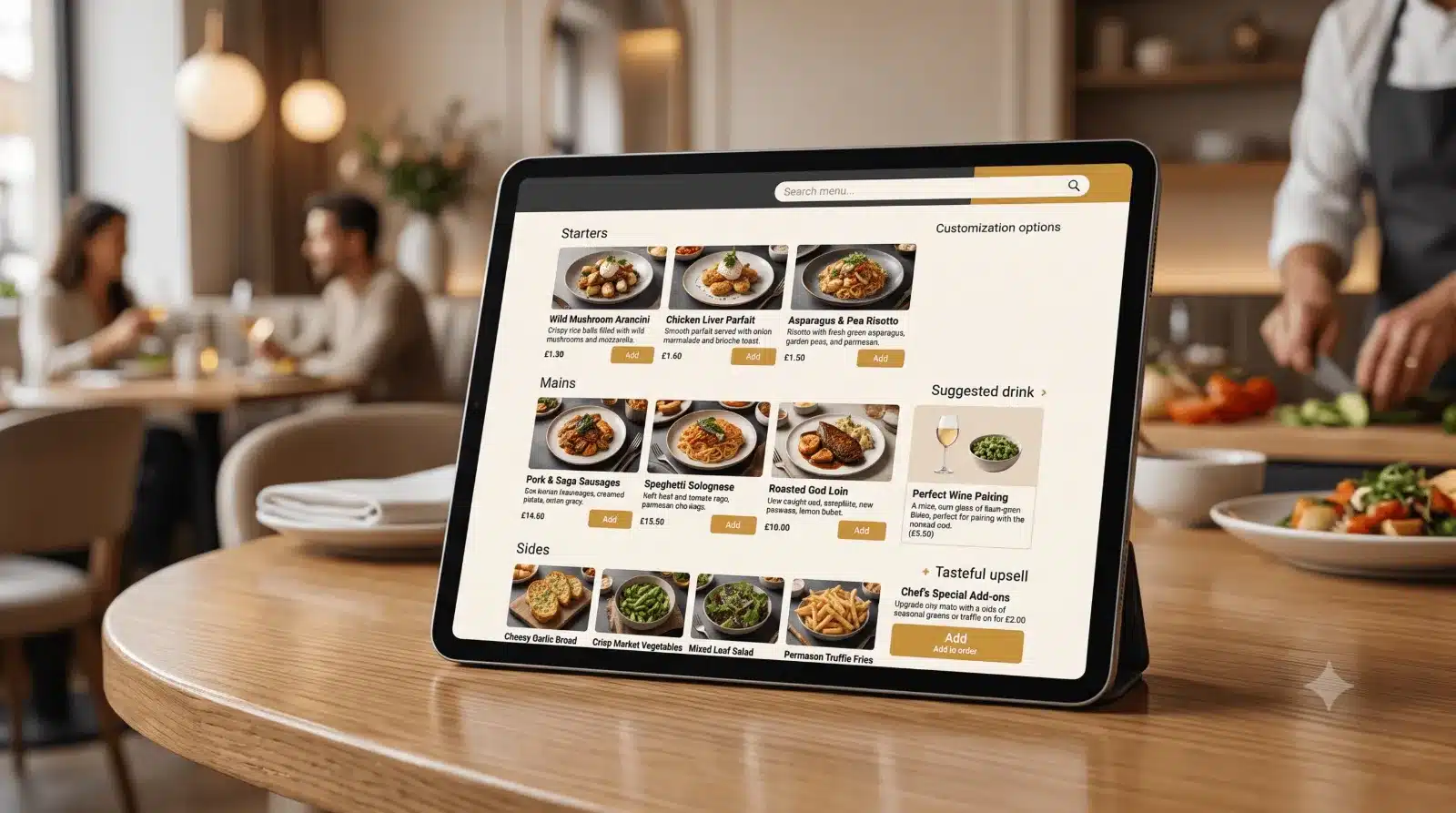
Restaurant, Menu, and LocalBusiness schema give AI systems a machine-readable version of the facts a diner might ask about: cuisine, dishes, dietary options, price range, and opening hours. A menu that exists only as an image or a PDF is effectively invisible to these systems, however attractive it looks on the page.
3. Entity consistency across the web
AI models build a picture of your restaurant from many sources – your website, Google Business Profile, TripAdvisor, OpenTable, delivery platforms, local press. Since 2025, several AI platforms have begun drawing heavily on data partnerships with platforms like Foursquare and Yelp for local answers, which makes consistent listings across these platforms more important than ever. If your restaurant’s name or address differs even slightly between them, AI systems may treat them as different, less trustworthy entities.
4. Review depth, recency, and language
A restaurant with a steady flow of recent, detailed reviews gives AI tools far more to work with than one with a handful of old, generic ones. Reviews that mention specific dishes, occasions, or dietary accommodations are especially valuable because they give an AI tool the exact language it needs to match your restaurant to a specific question.
4. Building a GEO strategy: A practical step-by-step approach
Step 1: Audit what AI tools can actually see
Check your robots.txt file for accidental blocks on AI crawlers. Confirm your menu and key information aren’t locked away in an image or PDF that can’t be read as text, and that your site isn’t hidden behind heavy JavaScript rendering that crawlers struggle with.
Step 2: Add structured data to your key pages
Implement Restaurant, Menu, and LocalBusiness schema across your homepage and menu pages, with individual dishes, prices, and dietary tags wherever possible. Most website providers and booking platforms can add this for a modest cost, and it’s one of the highest-value technical fixes available.
Step 3: Rewrite key pages in an ‘Answer-First’ format
Take the specific, conversational questions diners actually ask — best for a group, good for a quick lunch, suitable for dietary restrictions — and give each one a direct, complete answer near the top of the relevant page, before any atmosphere-building copy.
Step 4: Strengthen entity consistency and review depth
Audit your restaurant’s name, address, and phone number across your website, Google Business Profile, TripAdvisor, OpenTable, and delivery platforms, and make them consistent. Build a steady, ongoing flow of detailed reviews, since AI systems weigh both recency and depth heavily when deciding which source to trust.
Step 5: Optimise for occasion and dietary-specific queries
Build content around the specific occasions and needs diners actually search for — a page on private dining, one on vegan and gluten-free options, one on family-friendly Sunday lunches — rather than relying on a single generic ‘about us’ page to answer every possible question.
Step 6: Monitor your AI visibility over time
Periodically ask ChatGPT, Gemini, and Perplexity the questions your diners would ask – ‘best Italian near [your town]’, ‘good spot for a birthday dinner in [your area]’ – and note whether and how your restaurant is mentioned. Treat this as a quarterly check rather than a one-off task, since AI platforms re-crawl and re-evaluate sources continuously.
5. A practical example: GEO in action for Restaurants
Consider an illustrative example: an independent Italian restaurant in Leeds with excellent food and a loyal following, but a website that leans heavily on atmosphere and branding. Asking an AI assistant ‘best Italian restaurant in Leeds for a group of eight’ returns two competitors – neither with noticeably better food.
The likely explanation isn’t quality; it’s structure. The competitors’ menus are listed as individual dishes with prices and dietary tags rather than a single PDF; their Google Business Profile and OpenTable listings use the same name and address, and their most recent reviews specifically mention hosting large groups. Our example restaurant’s menu exists only as a photographed image, and its address on a delivery platform is subtly different to its website. Neither gap is difficult to close – but until they are, the restaurant is invisible at the exact moment a group of eight is deciding where to book.
6. Common GEO mistakes restaurants make
- Publishing the menu only as an image or PDF, making individual dishes invisible to AI tools
- Treating AI visibility as a future problem rather than something already affecting bookings today
- Focusing entirely on Google while ignoring that ChatGPT and other tools increasingly draw on Yelp, Foursquare, and delivery platform data
- Allowing inconsistent restaurant names or addresses to persist across booking and delivery platforms
- Writing website content around branding and atmosphere only, without directly answering the specific, practical questions diners ask
Make your restaurant the answer AI recommends
As diners turn to AI to discover where to eat, your restaurant needs to be visible in the answers they trust. Our GEO strategies help you build authority, improve discoverability, and attract more high-intent diners.
GEO works best layered on top of the broader fundamentals covered in our guides on fixing flat restaurant sales and the four growth lessons every owner should know.
7. Key takeaways
- GEO is about making your restaurant understandable, trustworthy, and quotable to AI tools – not just visible in a traditional results list
- A large and fast-growing share of diners already use AI tools to decide where to eat, and most restaurants are currently invisible in those answers
- AI tools favour restaurants with accessible websites, structured menu data, consistent listings, and a steady flow of detailed reviews
- A practical GEO strategy starts with a crawler and schema audit, then moves through content restructuring, entity consistency, and ongoing monitoring
- Small, specific fixes – a structured menu instead of a PDF, consistent naming, occasion-specific content — often matter more than a full website rebuild
8. Restaurant GEO FAQs
No. GEO builds on the same foundations as good local SEO – a complete Google Business Profile, consistent listings, strong reviews – and adapts them specifically for how AI tools read and summarise information. A restaurant with strong local SEO already has a head start.
Technical fixes such as structured menu data or removing crawler blocks can take effect within weeks. Being consistently recommended by AI tools tends to build over a longer period, as review depth and entity consistency accumulate.
Yes, often more easily than in paid search. Generative engines reward specific, well-evidenced, trustworthy information rather than advertising budget, which puts a well-run independent restaurant with genuine reviews on a fairly level footing.
Most restaurant websites already have the right information — it usually needs restructuring rather than replacing. Adding schema markup and rewriting key pages to answer questions directly often delivers more impact than a full rebuild.
Replace an image-only or PDF menu with individually listed dishes, and make sure your restaurant’s name and address match exactly across your website, Google Business Profile, and every delivery or booking platform you use.