Today, if guests stumble onto a hotel, restaurant, or spa website, it’s rarely by chance. They land on a website because a search ad caught them, a retargeting banner reminded them to complete their abandoned booking, or because they encountered a paid social post while scrolling, and now they’re craving a visit. Yes, organic visibility matters, but in a market this crowded, it rarely fills any rooms, tables, or treatment rooms. Online advertising is what gets you that control back.
This guide is built for UK Hotel, Restaurant, and Spa operators who are looking for a real working strategy. It deeply focuses on the channel that drives the most immediate, trackable revenue for hospitality businesses, which is Google Ads. Also explains where social advertising, retargeting, and social planning fit around it with real-world examples. Overall, this guide focuses on the paid search foundation, the retargeting layer, and the measurement system that ties all channels together into a single, honest ROI picture.
1. Why online advertising works differently for hospitality
Most of the online advertising playbooks are written for e-commerce, where the product is fixed, the purchase is transactional, and the path from click to checkout is short. Hospitality, on the other hand, does not work like that. A hotel stay, a tasting menu, or a spa afternoon is bought on emotion as much as logic. People are paying for the experience, not just for a bed or a plate of food. Advertising that only lists amenities and prices tends to underperform against advertising that sells the feeling.
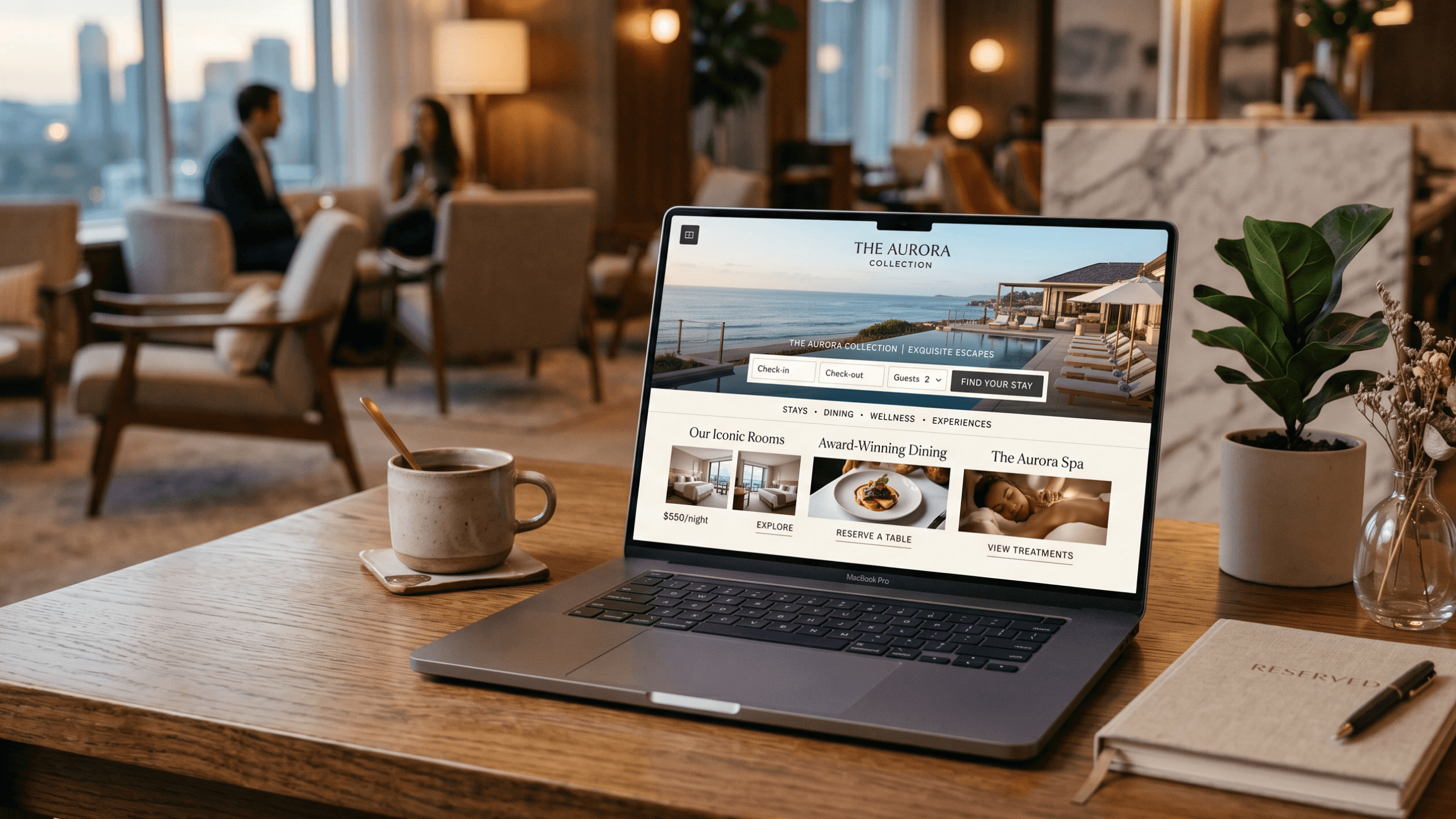
Discover the essential principles, strategies, and best practices for creating a hospitality website that enhances guest experience, strengthens your brand, and drives more direct bookings. |
|
The booking journey in hospitality is also much longer and more staggered than most retail purchases. Hotel stays are typically researched and compared over several weeks before a booking is confirmed.
Restaurant tables are usually booked within a few days of the visit (often same-day for casual dining). And spa treatments and gift vouchers sit somewhere in between, with gift purchases sometimes planned months ahead of an occasion. That spread suggests a single ad format cannot do all the work: each campaign needs a different message for someone dreaming about a trip, someone comparing three shortlisted hotels, and someone who has already added dates to a booking widget and abandoned it.
Hospitality businesses are also fighting for space against very well-funded competitors. Booking.com, Expedia, and other OTAs bid aggressively on the same search terms and typically dominate the top of results pages for generic queries. This behaviour pushes up costs for everyone else. The UK hospitality sector remains a genuinely large market to compete for. The UK Hospitality and the House of Commons Library put the sector’s direct contribution to the economy at close to £70 to £93 billion annually, depending on how the figure is scoped, with wider turnover across food service, accommodation, and leisure estimated at well over £140 billion. That scale shows exactly why paid visibility has become a non-negotiable line item rather than a nice-to-have.
Finally, the hospitality customers are worth pursuing well beyond the first booking. Repeat guests, diners, and spa clients typically cost far less to reach than brand new ones, and word-of-mouth referrals increase the value of every good stay or meal. That lifetime value changes the math on what a business can afford to pay for a first booking, and it is a large part of why retargeting and remarketing to past guests consistently outperforms cold acquisition.
It also helps to think of the guest journey as four distinct stages, each requiring a different kind of advertising and a different share of the budget.
- In the awareness stage, aspirational, lifestyle-led content on Instagram, TikTok, and display introduces the property to people who are not yet actively planning anything.
- In the consideration stage, where the bulk of budget should sit, amenity detail, testimonials, and comparison-friendly content on Facebook, Instagram, and Google Search reach those people who are actively weighing up options.
- In the decision stage, Google Search, Shopping, and retargeting ads with a clear offer or urgency convert people who are close to booking, usually at the highest click-through and conversion rates of any stage.
- Finally, in the retention stage, email and retargeting to past guests drive repeat bookings at a lower cost and often a higher return than any acquisition spend, which is exactly why Section 7 treats retargeting as its own priority rather than an afterthought.
2. The advertising platform landscape for hospitality
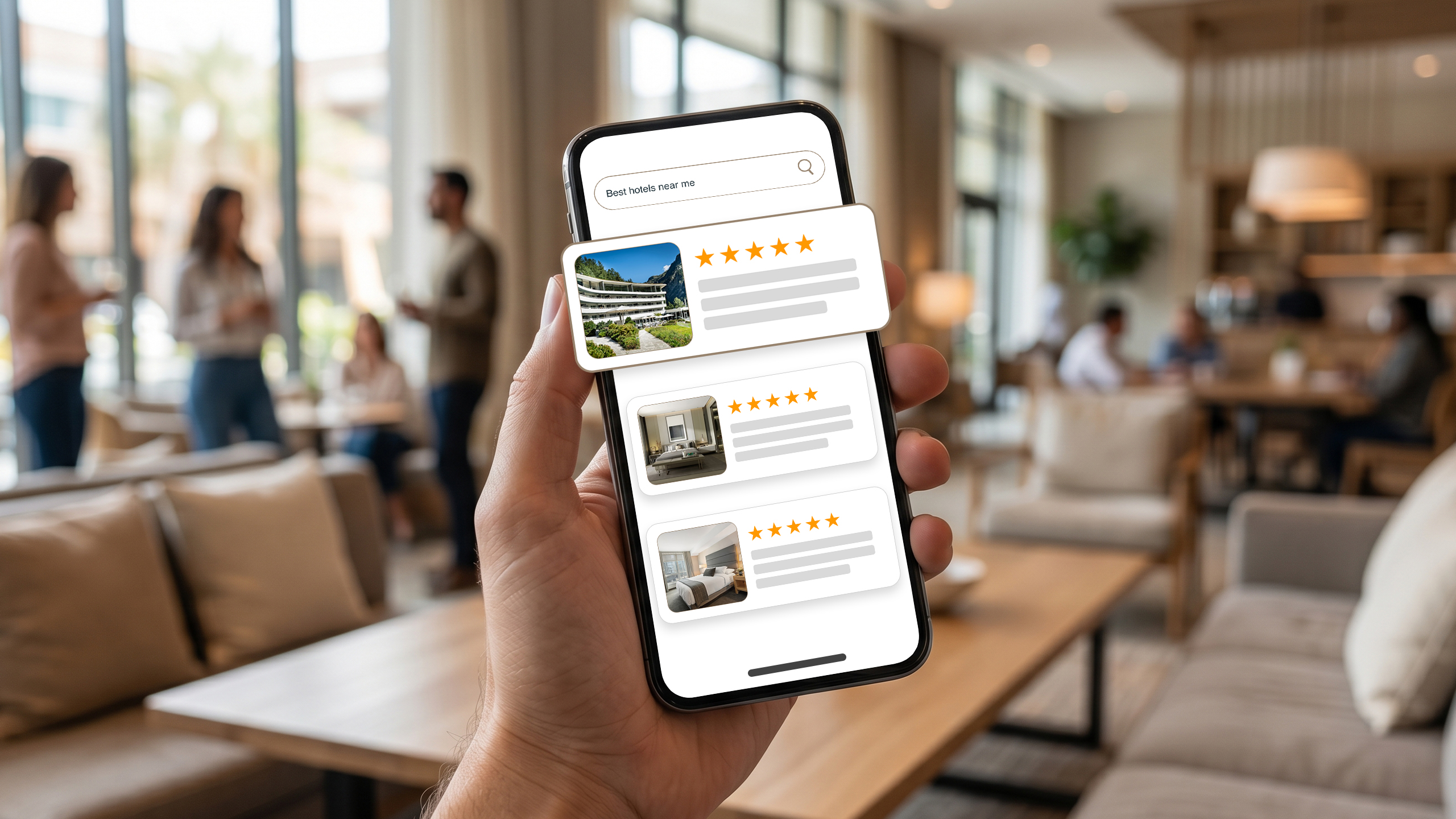
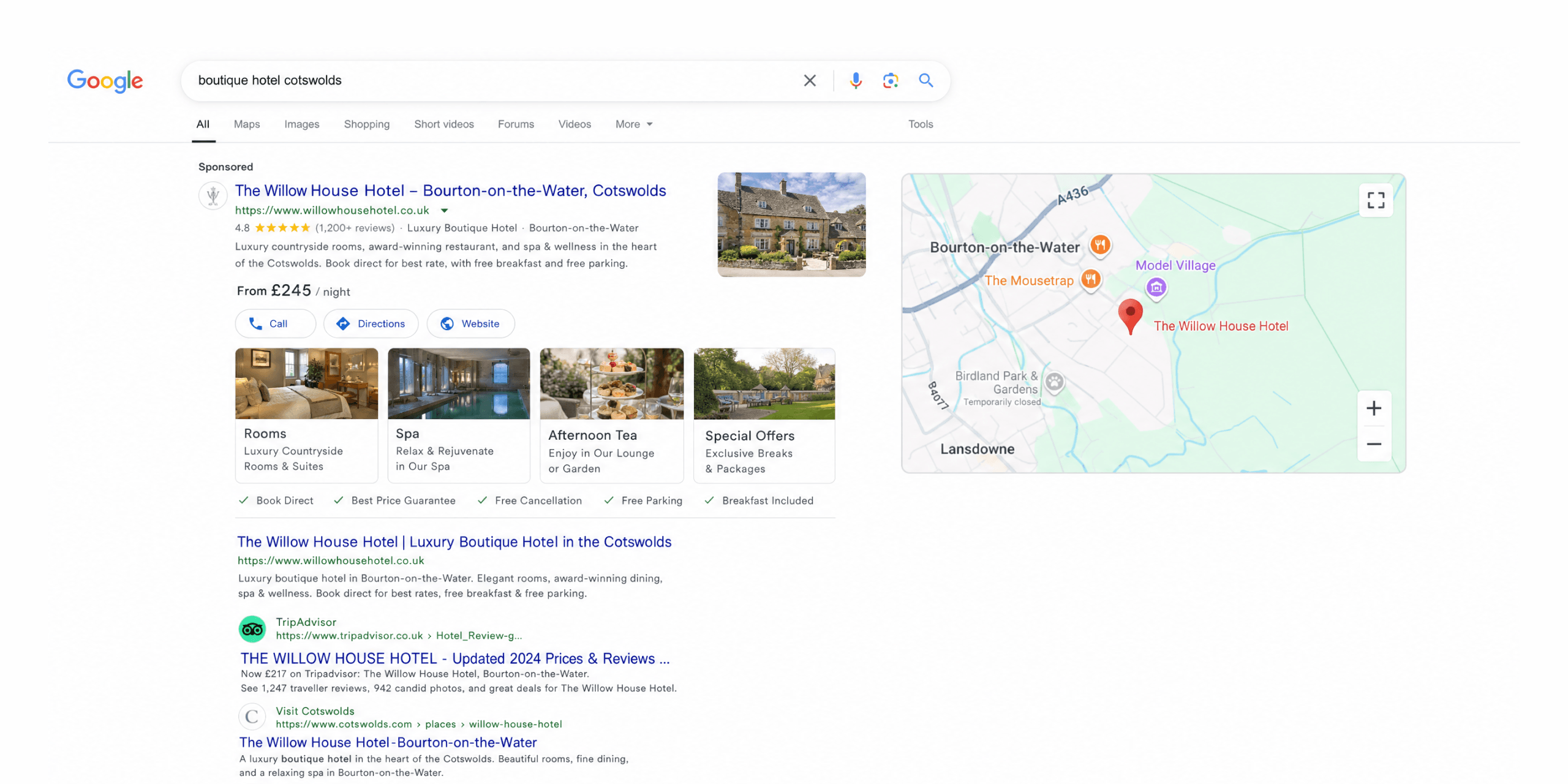
Google Search, as always, remains the highest-intent, most direct-response channel available to hospitality businesses. When someone is typing “boutique hotel Cotswolds pet friendly,” they have already made several decisions. They know roughly where, roughly what kind of property, and roughly when. That’s about as close to a hand-raiser as advertising gets. Expect UK click-through rates of 2-5% on all the well-optimised campaigns, cost-per-click in the region of £0.80-£3.00 for competitive hotel terms and somewhat lower for restaurants, and booking conversion rates of 3-8% from click to completed booking.
Google Display and YouTube sit further up-funnel. These platforms are useful for awareness and for retargeting past website visitors at scale, but with lower click-through rates (0.3-1%) because the audience there isn’t actively searching.
Performance Max and Google Shopping-style formats are worth testing for hotels having dynamic room pricing, since they lean on Google’s own machine learning (ML) to match ads that intent signals you wouldn’t necessarily catch manually.
Facebook still holds around 38-39 million UK users (Metricool), skewed toward an older, higher-income, more established audience. It’s useful for hotel and spa advertisers targeting guests in their late 30s upward. Instagram’s roughly 35 million UK users (SproutSocial) skew younger (18-45) and respond strongly to visual and aspirational content, making it the natural home for lifestyle-driven creatives.
Both platforms share the same real advantage: audience targeting precision. Custom audiences built from an email list or website visitors consistently convert at 2-8%, versus 0.1-1% for cold interest-based targeting. That gap is the single most important number in this guide. It’s the entire argument for building an email list and a retargeting pixel (a tiny invisible code added to a website) before spending heavily on cold audiences.
Expect average CPMs of £3-£8 on Facebook and £4-£10 on Instagram, with booking conversion typically in the 1-4% range for well-optimised campaigns. Creative quality matters more here than on any other platform. A flat, poorly lit image will underperform a well-shot one even with identical targeting and budget.
Building organic reach is all about a good content strategy across these platforms, and for that, following a dedicated social media marketing guide for hotels, restaurants, and spas is the best way out.
TikTok’s UK audience skews younger, with the majority of the active users being under 35. For boutique hotels, trend-driven restaurants, and wellness-positioned spas targeting a younger guest, it can deliver a genuinely low-cost discovery and a viral upside that no other platform offers. For a business whose actual guest base is 45+, TikTok is largely a wasted spend regardless of how good the creative is. CPMs run higher than you’d expect for a “cheap” platform (£5-£12) because the demand for ad inventory has caught up with the audience size, and conversion should be judged as top-of-funnel awareness (0.5-2%) rather than a direct booking driver.
Pinterest doesn’t convert quickly. Expect a two-to-three-month lag between a pin being seen and a booking happening. But on the bright side, pins have an unusually long shelf life (6-12 months) compared to a Facebook ad that’s dead in days. That makes it a strong and underused channel for spa gift vouchers around Mother’s Day and Christmas, and for early-stage destination inspiration for hotels. Its audience is heavily skewed female (65%+), which lines up well with the gift-voucher buying behaviour specifically.
LinkedIn is a poor fit for consumer leisure advertising. CPMs of £8-£15 make it the most expensive platform on this list. However, it’s genuinely useful for one specific job: reaching corporate event planners and HR decision-makers for business hotel bookings and corporate wellness packages. If that’s not part of your business, don’t hesitate to skip it entirely.
3. Building a Google Ads strategy that doesn’t waste money
a. Structure the account around intent, not convenience
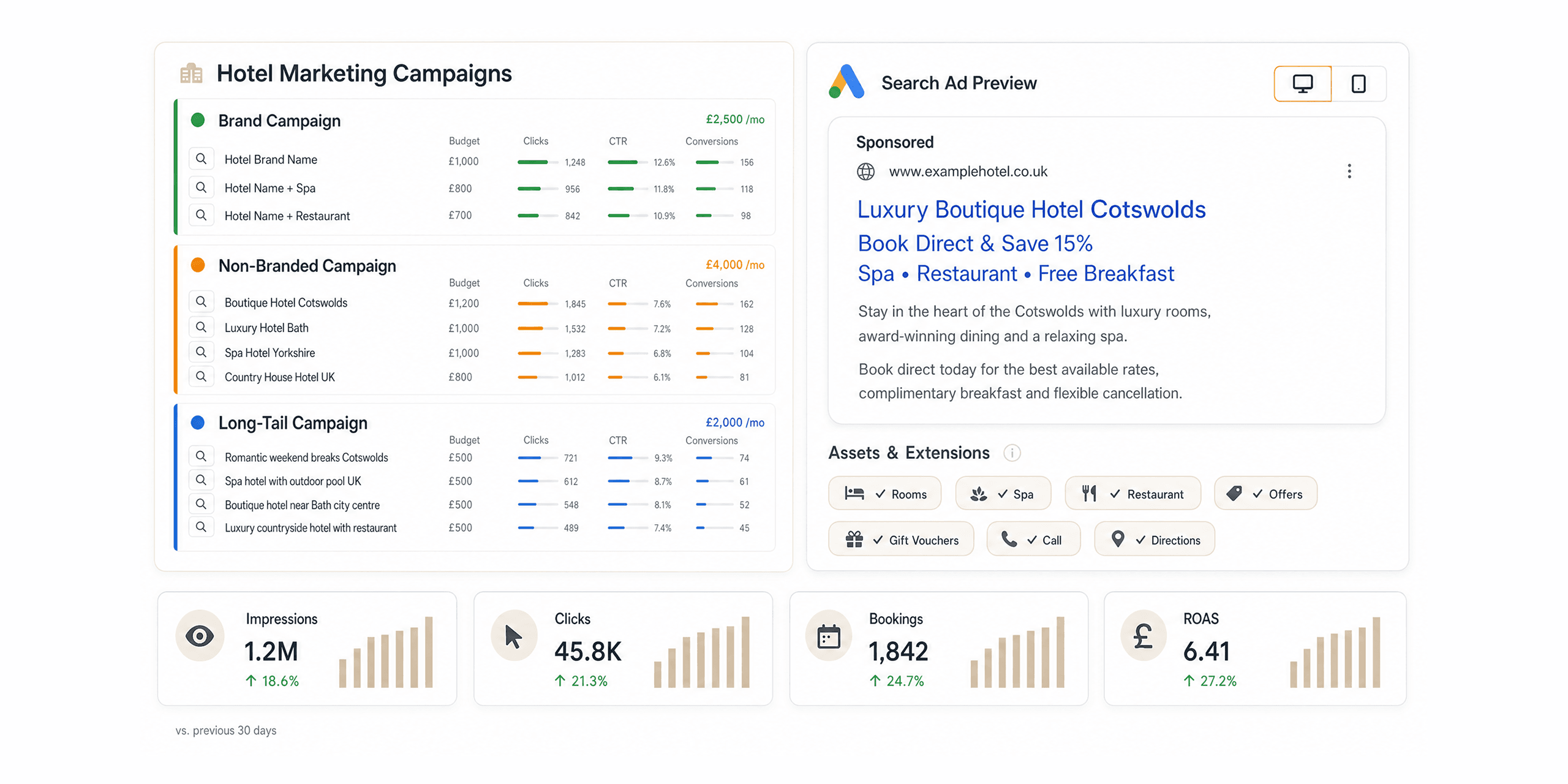
The single most common Google Ads mistake in hospitality is choosing to run one campaign for everything. Branded searches (people typing your hotel’s name), non-branded location searches (“hotels in [town]”), and long-tail amenity searches (“pet-friendly hotel with a pool near [area]”) behave in a completely different manner and need separate campaigns with separate budgets and bidding strategies:
- Branded campaigns should be the first thing funded, not an afterthought. Conversion rates of 5-12% are typical because these searchers already know you and just need a fast, well-optimised path to book direct instead of clicking through to an OTA.
- Location-based non-branded campaigns carry more competition and higher cost-per-click, but this is where new-to-brand demand lives, typically converting at 2-4%. Eg:- (“[Town] hotels,” “[Area] accommodation”).
- Long-tail amenity campaigns (“dog-friendly hotel Cornwall,” “spa hotel with hot tub Peak District”) have lower search volume but also lower competition. It often converts at 1-3% for a fraction of the cost-per-click of the broader terms.
b. Match types and negative keywords protect the budget
Exact match on branded terms gives maximum control where control matters the most. Phrase match is the workhorse for non-branded, intent-driven keywords; it balances reach with relevance. Broad match can surface genuinely useful, unexpected search terms, but only if it’s paired with an actively maintained negative keyword list. If used carelessly, it could be the fastest way to burn a monthly budget on searches that were never going to convert.
c. Ad copy and extensions do more work than most people expect
A well-structured hotel ad puts the target keyword in the first headline, a genuine point of difference in the second, and a clear call-to-action in the third. Ad extensions (sitelinks to specific room types, a click-to-call number, location and price information) aren’t optional polish. Properties running a full set of extensions typically see 25-40% higher click-through rates than those running text ads alone.
d. Bidding strategy should shift with the season
Manual CPC still has a place for branded campaigns where the goal is control and predictability. For non-branded, revenue-focused campaigns, “Maximise Conversion Value” tends to outperform “Maximise Conversions” because it accounts for booking value, not just booking count. For example, a £400 suite booking and a £90 room booking shouldn’t be treated as equally valuable conversions. Bidding should also be flexible with the calendar. That said, more aggressive during peak season when the pool of ready-to-book searchers is at its widest, and more conservative and test-oriented during the shoulder months.
e. What “Good” looks like, by category
Realistic ROI benchmarks vary meaningfully by keyword type and business:
| Category | Typical cost per click (search) | Typical ROI |
| Hotels (branded keywords) | £0.80–£3.00 | 200–400% |
| Hotels (non-branded, high-intent) | £0.80–£3.00 | 100–200% |
| Restaurants | £0.50–£1.50 | 3–8x ROAS |
| Spas | £0.50–£2.00 | 3–6x ROAS |
Restaurants should specifically weight phone-call tracking heavily; click-to-call frequently accounts for 30-50% of total ad clicks, since many restaurant bookings still happen by phone rather than online form. Spas should plan for 2-3x normal ad spend around Mother’s Day and Christmas gift-voucher season, since the buying pattern (and the buyer, often not the eventual guest) changes completely during those windows.
4. Social media advertising: Turning warm audiences into bookings
a. Structure campaigns around temperature, not platform
Whether you’re running Facebook, Instagram, or both, the same three-tier structure applies. Awareness campaigns to cold audiences (20-30% of social budget), consideration campaigns to warmer, engaged audiences (40-50%), and conversion campaigns aimed squarely at people like website visitors, email subscribers, and past guests (20-30%), who’ve already shown interest.
b. Audience quality is the real lever, not just creative
The gap in conversion rate between a custom audience (past guests, email list, website visitors: 2-8% conversion) and a cold interest-based audience (0.1-1% conversion) is large enough that it should shape budget allocation before any creative decisions do. The lookalike audiences built from your best customers sit in between, typically converting at 0.5-3%. In practice, this means: build the email list and install the pixel before scaling cold-audience spend.
c. Creative that actually earns attention
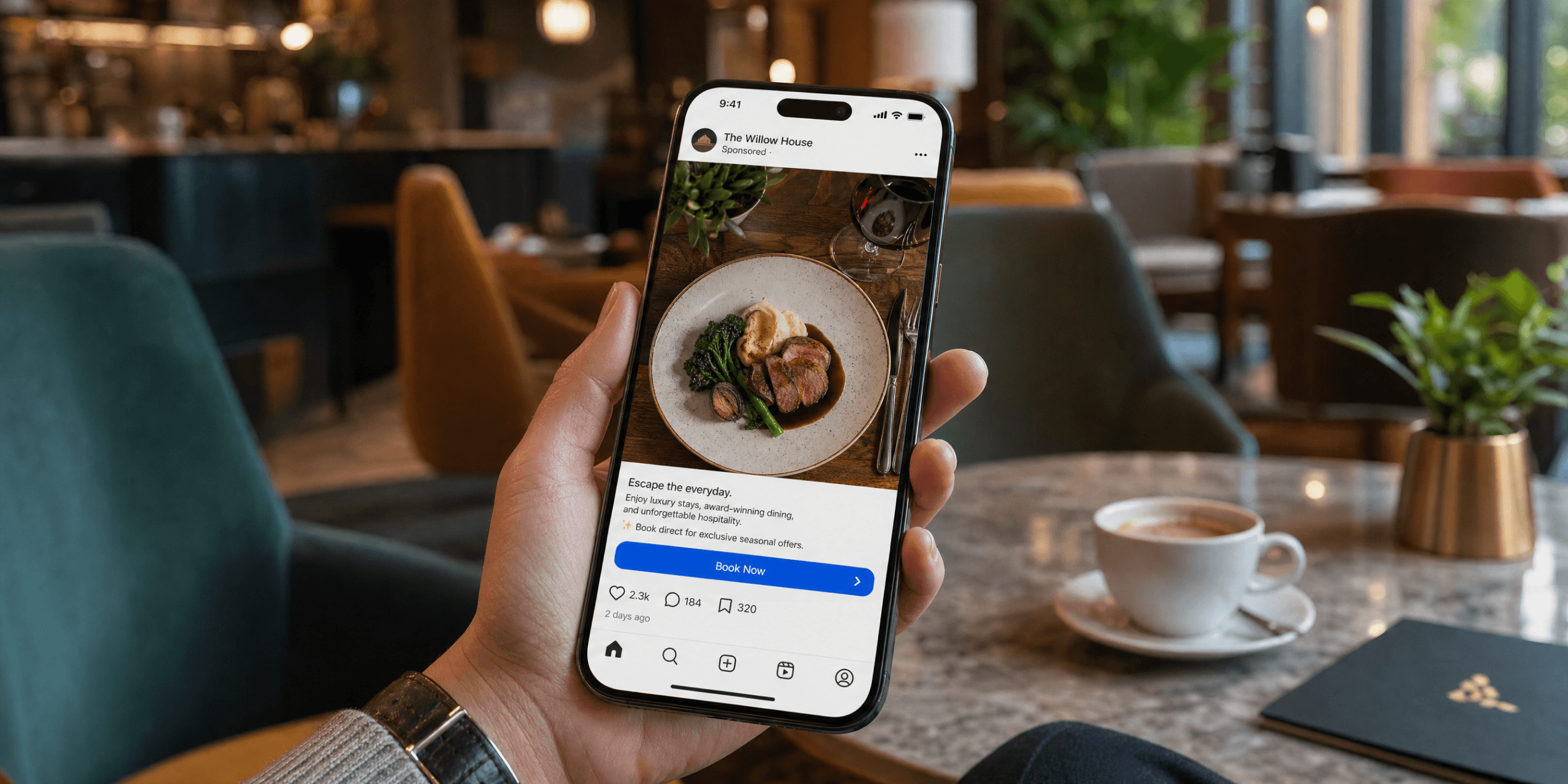
Short vertical video (15-30 seconds, 9:16 format) consistently outperforms static images for engagement, particularly since a widely cited industry figure puts silent viewing at around 85% of social video views (Digiday). Which means captions aren’t optional. The first three seconds need to grab attention and earn the rest of the watch time. Carousels work well for showing room-type variety, tasting menus, or a sequence of spa treatments, and stories/reels placements tend to feel less interruptive than traditional feed ads.
d. What works for each business type
For hotels, the strongest-performing creative leans into lifestyle and location. For example, seasonal imagery (a pool in July, a fireplace in December), couple or family framing depending on the target guest, and nearby attractions that extend the story beyond the four walls of the property work wonders.
For restaurants, food photography is the hero, and the atmosphere is the supporting cast. The urgency-driven offers (“book this week, first course on us”) consistently outperform generic brand-awareness posts because the decision window is so short.
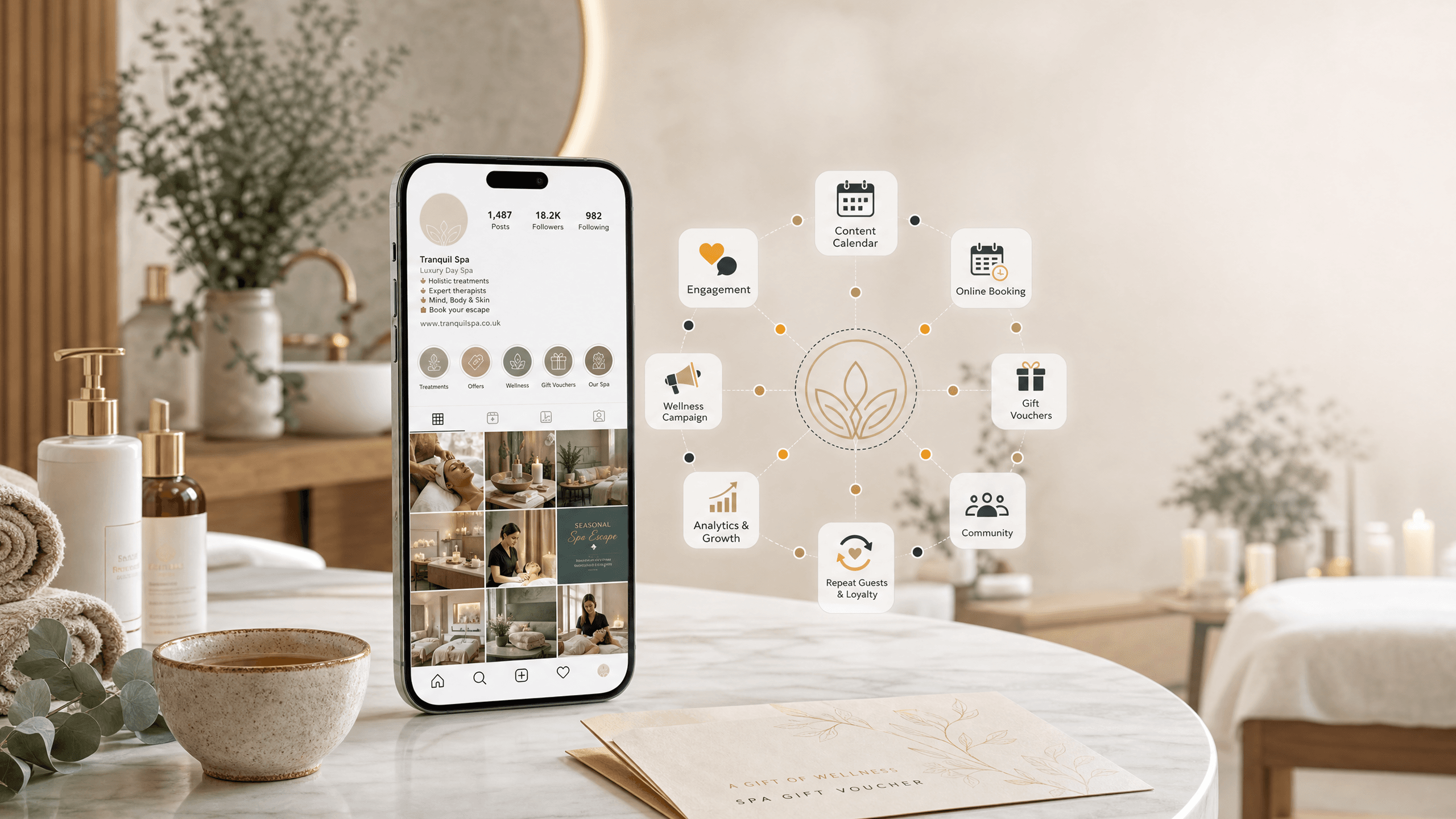
For spas, serene, unhurried imagery and genuine therapist credibility do more than any discount ever can. Additionally, gift-voucher promotion deserves its own creative and its own budget line around Mother’s Day and Christmas, since it’s a different buyer with a different motivation than someone booking a treatment for themselves.
e. TikTok and Pinterest, used deliberately
TikTok rewards authenticity over polish. Posting behind-the-scenes content, staff personalities, and trend participation often outperforms anything that looks like a traditional advert. It’s worth a monthly minimum of roughly £1,000 to generate enough delivery for meaningful results, and it should be judged as an awareness channel, not a direct-response medium. Pinterest is worth dedicating specifically to gift-voucher and inspirational campaigns rather than trying to force it into a direct-booking role it isn’t built for.
f. Retargeting: The highest ROI channel most properties underuse
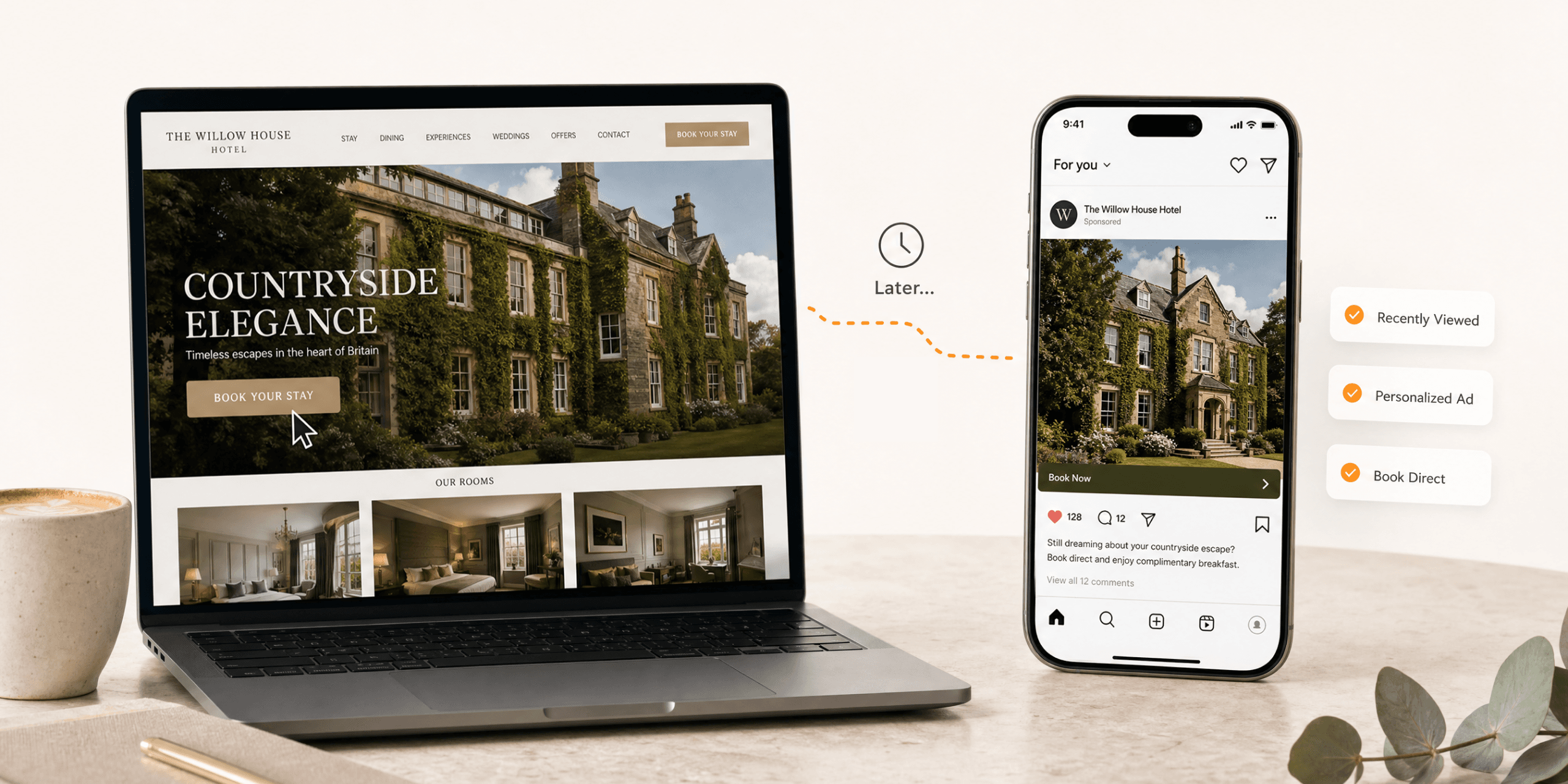
Here’s the number that should reshape most hospitality ad budgets: a widely cited retargeting benchmark holds that 97-98% of website visitors don’t convert on their first visit (Mailchimp). Every one of those visitors represents a person who was interested enough to click through, look around, and leave. And retargeting is the best way to reach them again without paying full price for a cold audience’s attention twice.
Retargeting audiences typically convert at 2-8%, against 0.5-2% for cold traffic. This is a gap that translates into 300-400% higher ROI in most accounts. That’s not a marginal optimisation; it’s frequently the single highest-return line item in an entire advertising budget. It’s also the first thing worth fixing in an account that’s underperforming.
g. Segment by behaviour and recency
Not all site visitors are equally warm. Someone who reached the booking page and left is a very different retargeting target from someone who bounced off the homepage after five seconds. The first needs a “complete your booking” nudge, ideally with a small, time-limited incentive, while the second needs a reason to come back and look properly. Recency matters too: a visitor from the last 24 hours is worth a more urgent message than one from 60 days ago. Older visitors might even need reminding of what the property even looks like before anything else.
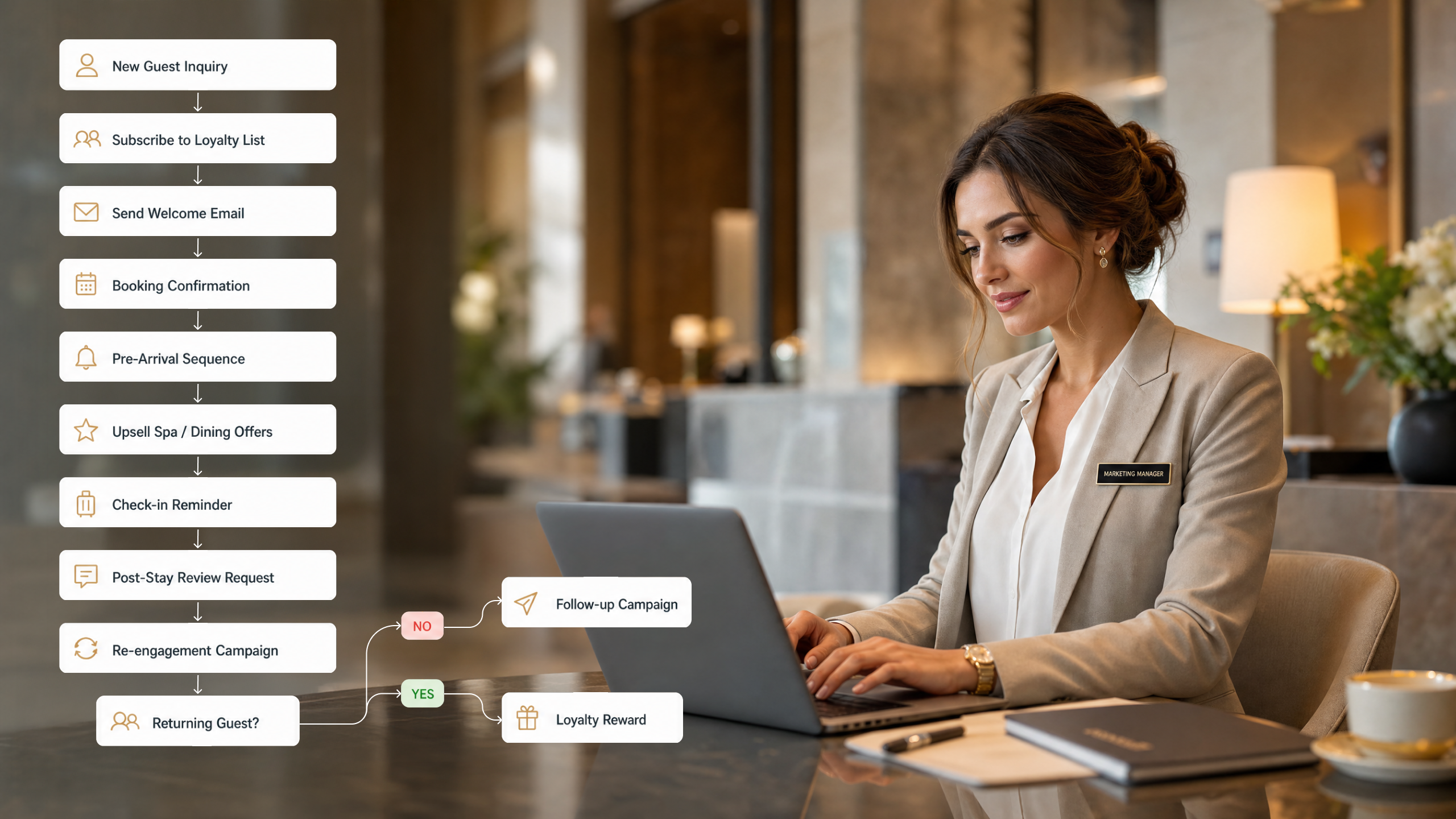
h. A simple multi-touch sequence
A practical starting sequence looks something like: a general reminder in the first few days, a specific amenity or feature highlight around day three, social proof (reviews, testimonials) around day seven, and an urgency-driven offer by day fourteen if they still haven’t converted. Frequency capping matters here; the goal is a gentle, well-paced reminder, not fifteen impressions a day that start to feel like harassment and get reported for spamming.
Given the ROI gap, retargeting reasonably deserves 30-50% of total advertising budget in most hospitality accounts. That is a higher share than new-customer acquisition, which is the opposite of how many properties currently allocate spend.
5. Planning a seasonal advertising budget
One of the biggest mistakes hotels make is spending the same amount on advertising every month. Guest demand changes throughout the year, so your ad budget should change too.
Roughly, the calendar breaks down like this:
- February (Valentine’s and half-term) and June through August (peak summer) are the two biggest demand spikes, alongside November-December (Christmas parties, gift vouchers, New Year’s Eve).
- March brings a secondary peak around Mother’s Day and Easter planning.
- January and September are genuine shoulder/off-season months where aggressive spend rarely pays back. Here, budget is better used testing new creative or audiences at lower stakes.
A practical rule of thumb: peak months (February, March, June-August, November-December) should absorb around 60% of the annual budget, shoulder months (April-May, and October) around 25%, and the true off-season (January and September) the remaining 15%. Just as importantly, spend needs to start well before the peak time; approximately six to eight weeks ahead for Valentine’s and Mother’s Day and ten to twelve weeks ahead for the summer season. This is because the research window for hotel bookings alone runs to a month or more, and a campaign that only starts in June is already behind the guests who are probably booking their July trip in April.
6. Measuring what actually matters
It’s very easy to drown in advertising metrics that feel important. But they don’t answer the only question that matters: is this profitable?
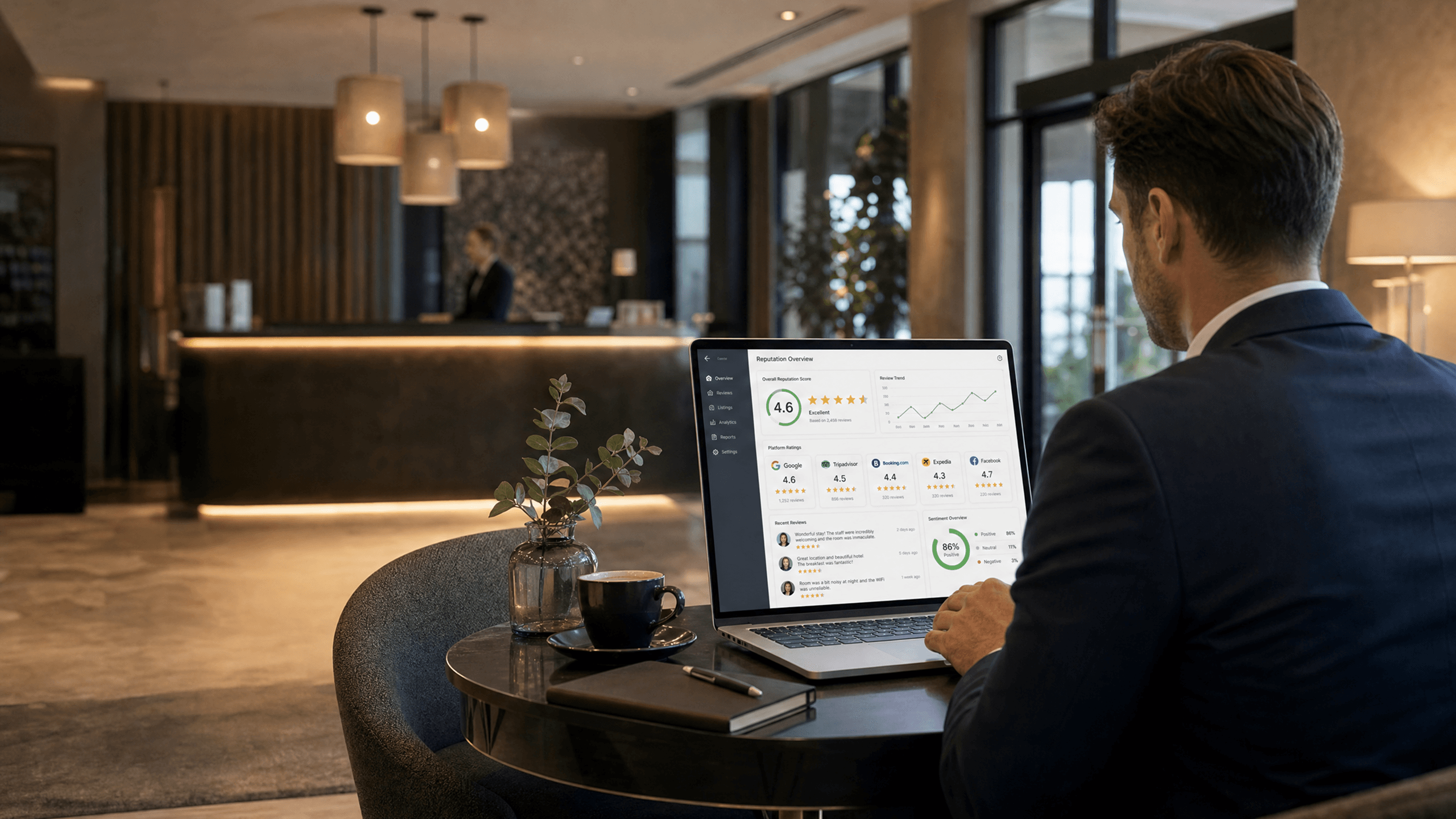
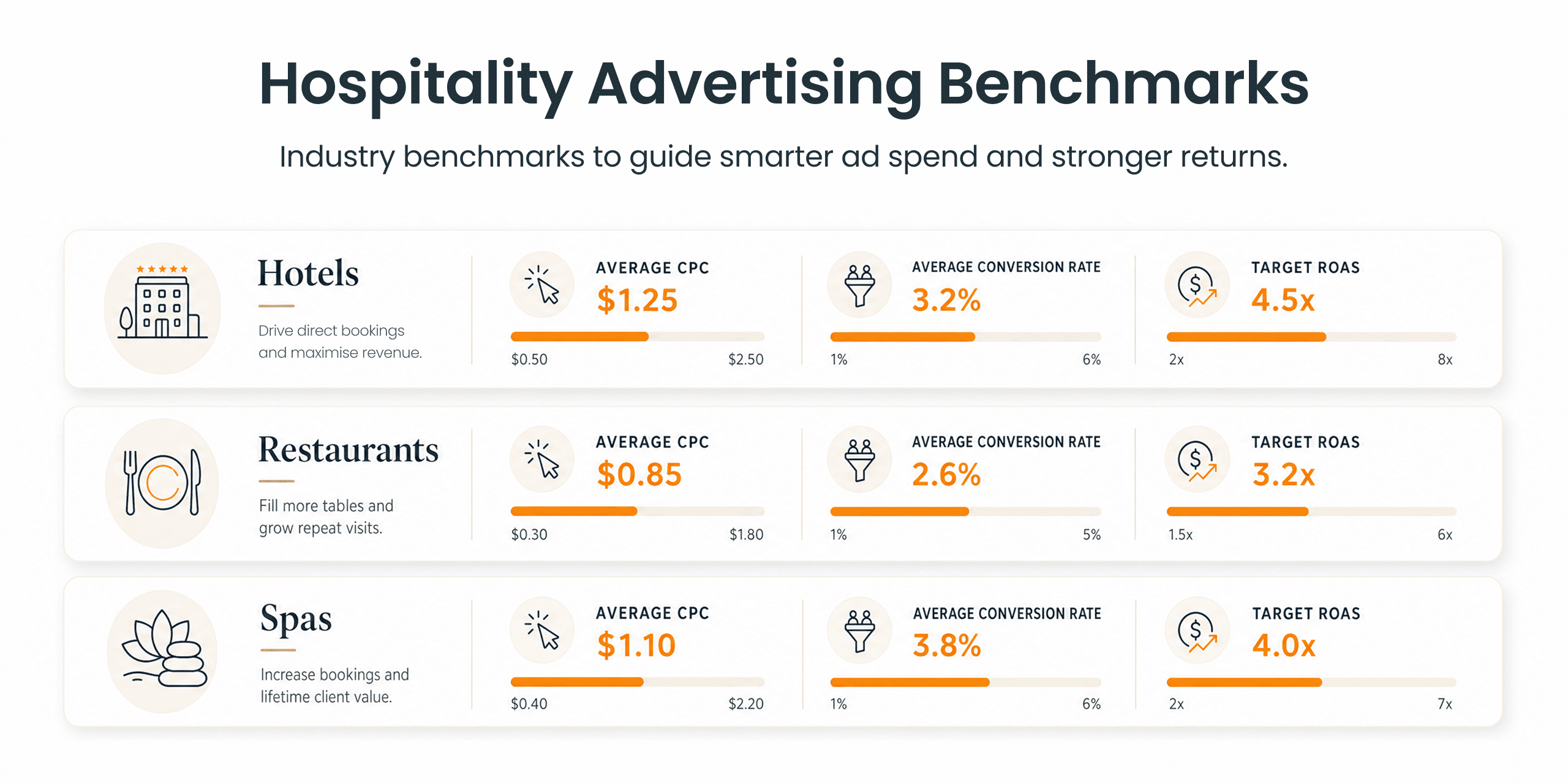
Cost per booking and return on ad spend (ROAS) are the two metrics that demand a dashboard. Realistic benchmarks vary by category; hotels typically see 2-5x ROAS and a cost per booking of £40-150 depending on the average room rate. Restaurants often see a stronger 3-8x ROAS due to higher margins relative to booking value, with a cost per reservation in the £5-25 range. Spas sit around 3-6x ROAS, with meaningful seasonal swings tied to gift-voucher periods.
A quick sanity check worth running before scaling any campaign: multiply your booking volume by your average booking value to get attributed revenue, then apply your actual profit margin (not revenue) before comparing it to ad spend. A campaign that looks break-even on revenue can be quietly unprofitable once a 40-60% margin is applied. At the same time, a campaign that looks marginal on revenue can be genuinely profitable once retained. Repeat-guest value is factored in over 12 months rather than judged on the first booking alone.
Attribution is imperfect by nature; most guests interact with a brand multiple times before making any bookings, so neither “first click gets all the credit” nor “last click gets all the credit” tells the full story. Google’s data-driven attribution models handle this case reasonably well once an account has six months or so of conversion history, but even a rough multi-touch view is better than none.
7. Common mistakes worth avoiding
A few commonly committed mistakes show up repeatedly across hospitality advertising accounts:
- Running one undifferentiated campaign for branded and non-branded terms instead of separating them
- Using broad match without a maintained negative keyword list
- Skipping ad extensions and losing 25-40% of possible click-through rate for free
- Having no conversion tracking at all, which makes every other decision a guess
- Keeping a flat budget year-round despite wildly uneven seasonal demand
- Putting the bulk of the budget into acquiring new, cold traffic while barely funding the retargeting audience that would convert at three to four times the rate for a fraction of the cost
8. Do it yourself, or bring specialists?
Managing paid advertising well takes ongoing attention. Bid adjustments through the season, refresh creatives before fatigue sets in, search regularly through query reports to catch wasted spend, and keep enough platform fluency to keep up with changes to Google’s and Meta’s ad products. If you’ve been dealing with the following issues: ad spend is going out the door without a clear, measurable return, account structure has become genuinely confusing to manage, or competitors are consistently outbidding you during your most important weeks, that’s usually the signal to bring in specialist support rather than keep testing yourself in different ways.
ThisRapt’s Online Advertisement Service is built specifically around the patterns mentioned in this guide: Google Ads strategy and management across search, display and shopping; Facebook, Instagram, TikTok and Pinterest advertising; retargeting and conversion optimisation; seasonal campaign planning that matches spend to the calendar above rather than a flat monthly figure; and transparent, ROI-led monthly reporting.
Despite its competence, paid advertising sits alongside SEO, email marketing, and marketing automation as it performs best as one part of a joined-up strategy, not a single channel running in isolation.
For most hospitality businesses starting or resetting a paid strategy, a realistic minimum effective spend sits around £1,500-2,500 a month combined across Google and one or two social platforms. This amount is enough to generate the volume of data needed for genuine optimisation. The first month is mostly data collection; measurable improvement tends to show up between eight weeks and twelve weeks, with cost per booking typically falling 20-40% and ROAS improving 50-100% over a six-month optimisation cycle.
9. Final thoughts
Online advertising isn’t optional for UK hospitality in 2026. It’s the core mechanism that decides whether your own guests book direct with you or book through an OTA that’s happy to take a cut for showing them an ad you could have shown them first. The businesses winning this aren’t necessarily spending huge amounts; they’re spending less but in the right places at the right time of year, on the audiences already warmest to them, with tracking and monitoring in place to know what’s actually working.
Ready to build a paid advertising strategy around your own seasonal calendar and guest data? Get in touch with ThisRapt to talk through where your current spend is working, where you’re stuck, and where it’s quietly leaking.
Turn Every Ad into Measurable Growth
Reach the right guests at the right time with data-driven advertising campaigns. From increasing direct bookings to driving more reservations and enquiries, we help your ad spend deliver real business results.
10. Online Advertisement FAQs
Most hotels need a minimum of £800-1,500 a month on Google Ads alone to generate enough data for meaningful optimisation. With a further addition of £600-1,000 per social platform if they want to run Facebook or Instagram alongside it. Spend should flex significantly with the season rather than staying flat year-round.
Both of them do different jobs. Google Search captures people already searching with high intent and tends to convert fastest. On the other hand, Facebook and Instagram are better for building awareness and nurturing people earlier in a long research window. Most well-performing accounts run both, with Google weighted toward decision-stage spend and social weighted toward awareness and consideration stages, respectively.
Yes! In fact, it can be even more valuable for small businesses. Retargeting shows ads to people who have already visited your website, so they’re more likely to book than someone seeing your business for the first time. Since small businesses usually have fewer website visitors, the retargeting audience stays small and affordable, helping you get better results without spending a lot.
Start promoting seasonal offers before people begin planning their trips or meals. A good rule is 6-8 weeks before Valentine’s Day or Mother’s Day, and 10–12 weeks before the busy summer season. If you start advertising for summer in June, it’ll be too late, and many people may have already booked their July plans.
Yes. Many people search on Google and tap the Call button to book a table. Google Ads can help bring in those phone calls, and with call tracking, you can also see which ads and search terms are leading to reservations.