

How UK hotels, restaurants and spas can generate authentic reviews, respond to feedback, protect their brand and increase booking confidence
1. Why your online reputation is one of your most valuable assets
Your online reputation can influence whether a potential guest discovers your business, trusts it and completes a booking. Reviews across Google, TripAdvisor, booking platforms and social media provide visible evidence of the experience your hotel, restaurant or spa delivers.
Online reputation management brings review monitoring, guest feedback, response management, and service improvement into a single organised process. For UK hospitality businesses, it can influence local discovery, booking confidence, repeat visits and long-term brand perception.
In this guide, we’ll show UK hospitality businesses how to track reviews, respond more effectively, encourage honest feedback, handle reputation crises, measure results, and create a culture that puts reputation first.
2. Why online reputation management matters in UK hospitality
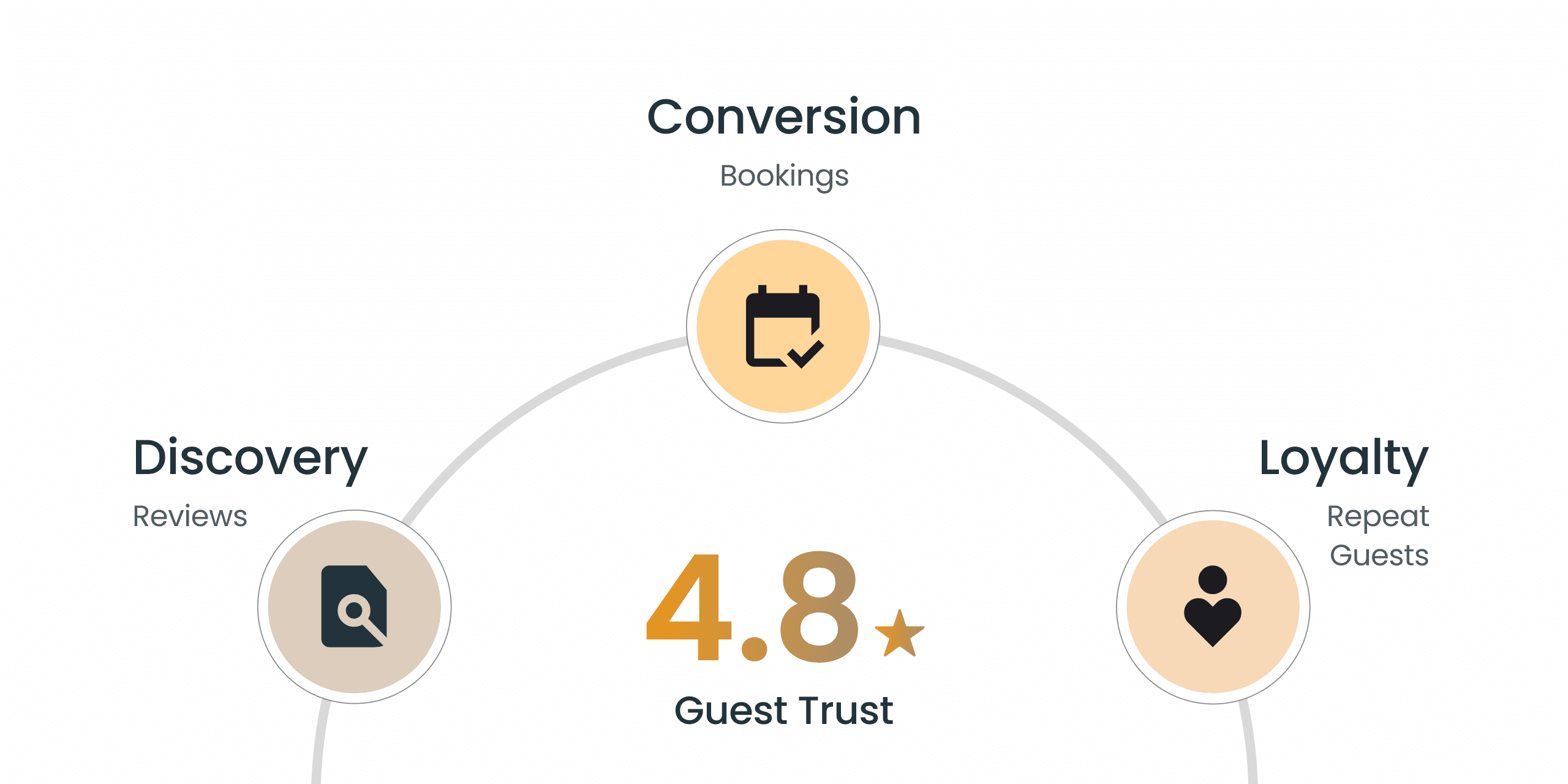
Online reputation shapes three connected outcomes: discovery, conversion and loyalty.
Reviews appear in Google Search, Google Maps, travel platforms, reservation websites and social channels. A guest may see the same hotel, restaurant or spa several times before booking. Each appearance can either strengthen or weaken their confidence.
2.1 The reputation economy in 2026
Hospitality customers often compare Google ratings, TripAdvisor comments, OTA feedback, social content, photographs, and direct-booking pages before deciding where to stay, dine, or book a treatment.
Because reputation appears throughout the guest journey, outdated information, unanswered complaints, and inconsistent descriptions can erode trust even when in-person service is strong.
Reviews Influence Local Discovery
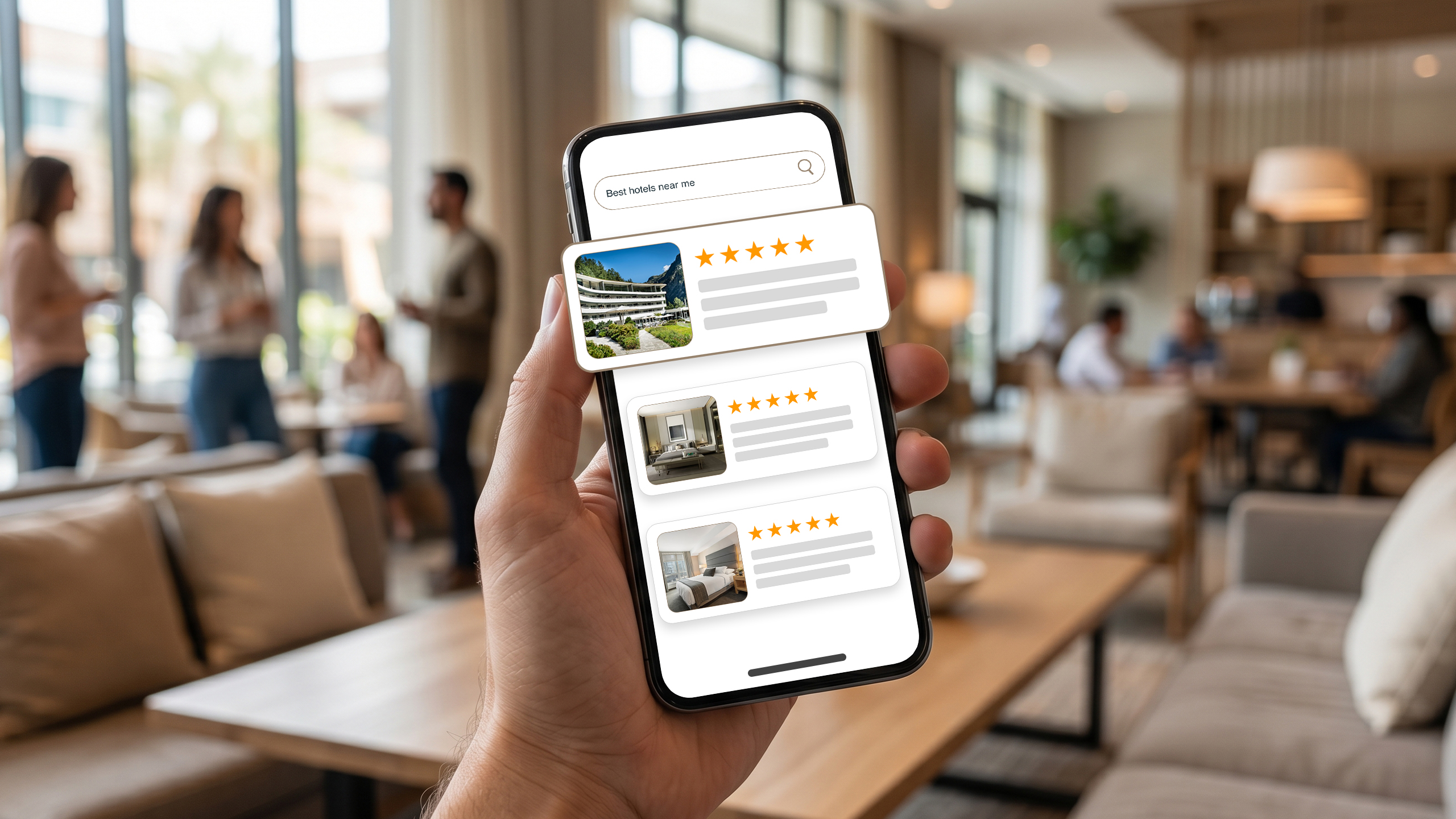
Google Business Profile reviews are visible when people search for a hotel, restaurant, spa, or “near me” service.
Review quantity, quality, and freshness can support local visibility, but they work alongside relevance, distance, profile completeness, website quality, and other signals.
Think of reviews as one part of your overall local reputation and SEO plan, not just a quick way to boost your rankings.
Ratings Affect Click and Booking Confidence
A higher rating can make a listing more appealing, but the number alone does not explain the entire customer experience.
Guests also examine:
- How recent the reviews are
- Whether comments mention issues that matter to them
- How management responds when something goes wrong
- Whether similar complaints appear repeatedly
- Whether the reviews feel genuine and detailed
Review Themes Reveal Operational Problems
Reviews are a continuous source of customer feedback.
Repeated comments about slow check-in, noise, long wait times, treatment pressure, room temperature, or unclear pricing often indicate a process issue rather than an isolated complaint.
Strong customer feedback management connects guest comments to staff training and operational improvements.
Reputation Supports Direct Bookings
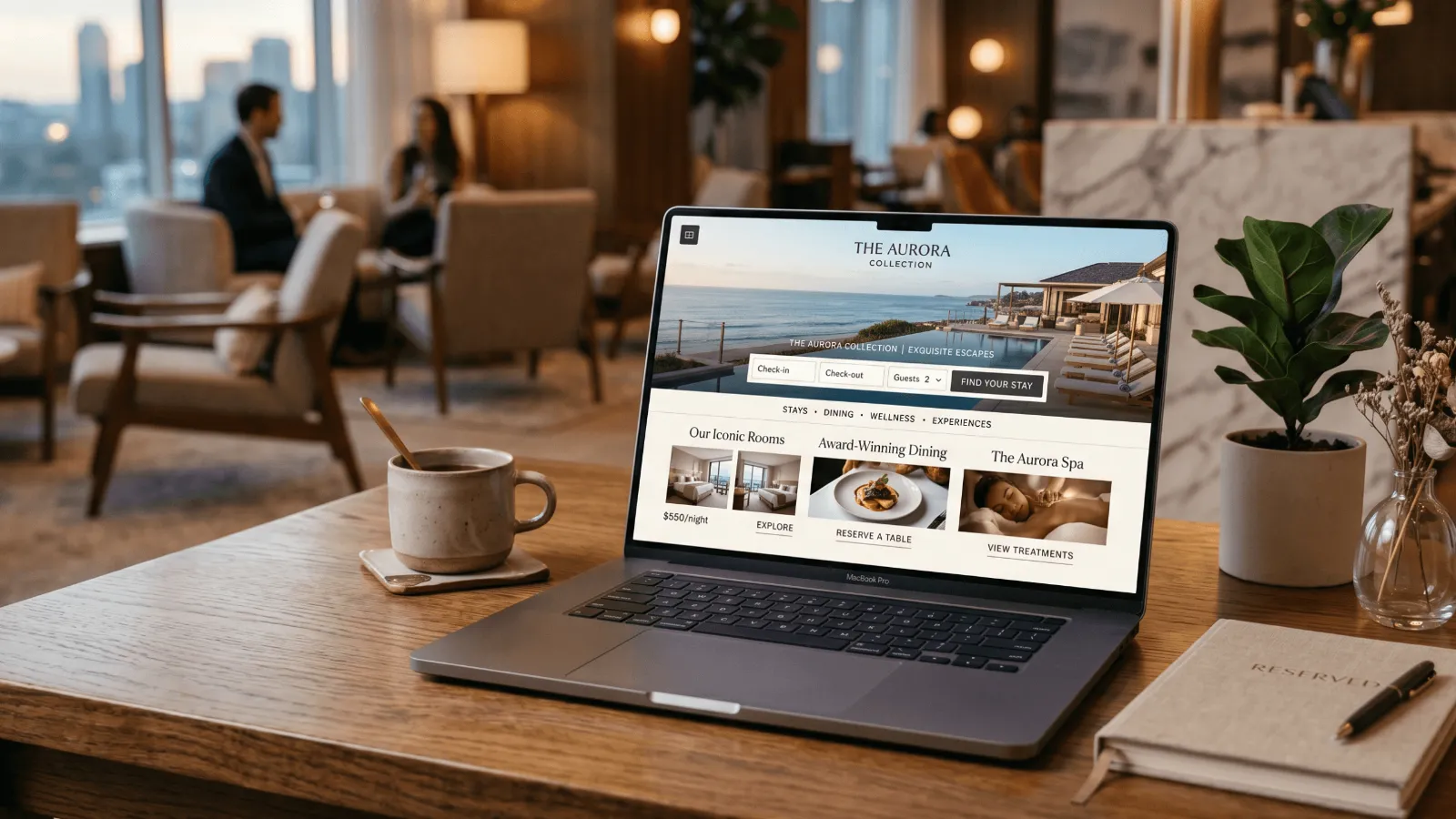
When guests trust the brand, they may be more willing to book directly instead of relying entirely on an online travel agency or third-party marketplace.
Direct-booking pages should reinforce that trust with:
- Current guest testimonials
- Clear cancellation and payment policies
- Authentic property or venue photography
- Visible contact information
- Accurate room, menu or treatment descriptions
- Consistent branding across every touchpoint
Reputation marketing works best when social proof is carried from search results through to the booking journey.
3. Illustrative revenue sensitivity example
The following examples do not claim that a specific rating automatically causes a fixed revenue loss.
They show how even a small change in booking demand can impact a hospitality business, helping managers see why protecting conversion rates matters.
| Scenario | Annual Baseline | Assumed Demand Change | Illustrative Annual Impact |
| 50-room hotel at £100 ADR and 70% occupancy | £1,277,500 | 5% lower room demand | Approximately £63,875 less revenue |
| 60-cover restaurant at £35 average spend, six nights weekly | £655,200 | 5% lower cover demand | Approximately £32,760 less revenue |
These are sensitivity models, not guaranteed outcomes. The actual effect will depend on demand, location, seasonality, pricing, competition and booking-channel mix.
4. The hospitality reputation lifecycle
Hospitality reputation management usually develops through three stages. The right priorities depend on the maturity of the business’s review profile.
Stage 1: Reputation Building
Typical period: The first 0–6 months of a structured programme
Main focus: Building a credible base of recent and authentic reviews
Key actions:
- Claim and complete priority platform profiles
- Introduce compliant review-request journeys
- Train staff to ask for honest feedback
- Respond consistently to new reviews
- Correct inaccurate or outdated listing information
Main challenge: Getting enough recent feedback to build trust, without making guests feel pressured or offering rewards.
Stage 2: Reputation Management
Typical period: After the basic review system has been established
Main focus: Maintaining review quality, response consistency, and operational follow-up
Key actions:
- Monitor all important hospitality review platforms
- Track rating trends and recurring themes
- Respond within an agreed service-level target
- Escalate serious complaints
- Fix repeated operational problems
Main challenge: Stopping one-off service issues from turning into ongoing public problems.
Stage 3: Reputation Leadership
Typical period: Once the business has a mature and active review profile
Main focus: Using reputation as a competitive and marketing advantage
Key actions:
- Publish approved guest testimonials
- Use reputation insights in campaigns and direct-booking pages
- Benchmark performance against comparable competitors
- Highlight improvements inspired by guest feedback
- Integrate reputation data with booking and retention reporting
Main challenge: Keeping standards high and staying alert as you get more reviews.
5. Hospitality review platform priority matrix
The right platform mix depends on the business model.
Don’t try to cover every website equally. Focus on the review platforms that have the biggest impact on how guests find and book your business.
Tier 1: Critical Platforms
| Platform | Best For | Why It Matters | Priority Action |
| Google Business Profile | All hospitality businesses | Appears prominently in Google Search and Maps and is often the first review profile customers see | Keep details accurate, add current images and respond consistently |
| TripAdvisor | Hotels, restaurants and attractions | Provides hospitality-specific reviews used during travel and venue research | Maintain a complete profile and respond to positive and negative feedback |
| Treatwell | Spas and salons | Combines service discovery, appointment booking and customer reviews | Keep services, prices, availability and therapist information current |
Tier 2: Supportive Platforms
| Platform | Best For | Recommended Use |
| Business hotels, corporate events and venue hire | Build professional credibility and promote B2B hospitality services | |
| Destination hotels, spas and visually led venues | Support travel, wedding, wellness and gift-planning inspiration | |
| YouTube | Hotels, spas, resorts and experiential venues | Publish tours, service demonstrations and approved testimonial videos |
| Local and industry directories | Location-specific hospitality businesses | Maintain accurate contact details, citations and relevant customer feedback |
Tier 3: Important Platforms
| Platform | Best For | Why It Matters | Priority Action |
| Booking.com and Expedia | Hotels and accommodation providers | Reviews appear close to the final booking decision | Monitor category-level ratings and correct repeated property or service concerns |
| OpenTable and Resy | Restaurants | Connect reservations with diner feedback | Keep menus, pricing, opening times and availability accurate |
| Most hospitality businesses | Supports reviews, recommendations, community engagement and customer messages | Monitor reviews, comments and messages regularly | |
| Instagram and TikTok | Visual hospitality brands | Shape perception through tagged posts, comments and guest-created videos | Monitor mentions, respond to public concerns, and obtain permission before reusing content |
Google Business Profile
Hospitality businesses need a structured approach to Google review management that combines accurate profile information, regular monitoring, compliant review requests, and personalised responses.
Your profile should include:
- Correct opening hours
- Accurate address and contact details
- Current booking or reservation links
- Updated photographs
- Clear service categories
- Regular review responses
- Accurate accessibility and amenity information
Inconsistent or outdated information can weaken trust before a customer reaches your website.
TripAdvisor
Effective TripAdvisor review management requires an accurate profile, consistent responses, and operational follow-up on repeated guest concerns.
Make sure your descriptions, photos, and amenities are always up to date. When responding to reviews, focus on providing helpful context and fixing issues rather than arguing with the reviewer in public.
Booking.com and Expedia
Monitor the overall score and category-level feedback, including:
- Cleanliness
- Location
- Comfort
- Facilities
- Staff
- Value for money
- Wi-Fi quality
If the same problems keep coming up, talk them through with your operations team instead of treating them as just a marketing issue.
OpenTable and Resy
Even a high rating won’t help if your reservation platform has outdated menus, unavailable times, or confusing venue details.
Treatwell
Customers usually review both their treatment and the booking process. So, how you handle appointments, greet guests, and provide aftercare all play a role in your reputation.
Social Media Platforms
Facebook, Instagram, and TikTok may not function exactly like traditional review platforms, but public comments, tagged content, and guest-created videos can still influence trust.
Monitor:
- Public comments
- Direct messages
- Story mentions
- Location tags
- User-generated videos
- Creator content
- Viral complaints
Acknowledge public concerns where appropriate, then move detailed discussion to a private channel.
6. How to monitor your online reputation
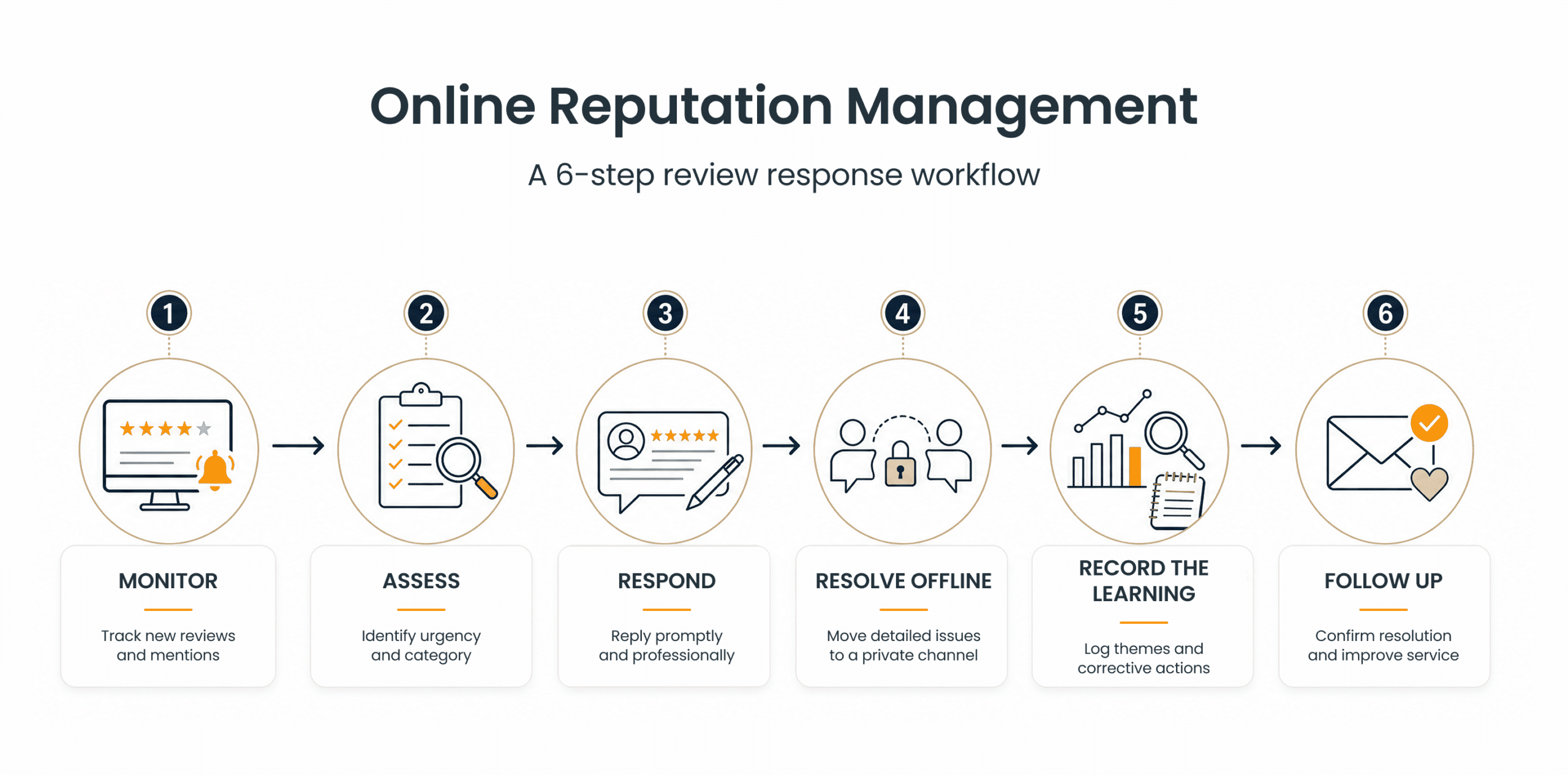
Effective online reputation monitoring gives hospitality teams a consistent way to identify new reviews, social mentions, and emerging service concerns.
The aim is not to constantly watch every mention. It is to identify important feedback early enough to respond to it, resolve the issue, and learn from it.
A practical monitoring system should include:
Weekly checks of lower-priority platforms
One named person responsible for review triage
A trained backup for weekends, holidays, and staff leave
Daily checks of priority platforms
Native notifications from Google, TripAdvisor, booking platforms, and social accounts
A shared log containing the review, response date, category, resolution and operational action
Immediate escalation of safety, hygiene, injury, discrimination, criminal or personal-data concerns
A monthly summary of ratings, review volume, response rate, response time and recurring themes
Multi-location hotels and restaurant groups may benefit from a central dashboard that combines reviews across locations.
A small independent venue can start with platform notifications and a disciplined spreadsheet. The process matters more than buying the most expensive software.
7. How to generate more genuine reviews without breaking the rules
A reliable review generation strategy creates a consistent flow of genuine feedback without incentives, pressure, or review gating.
Google requires reviews to reflect real experiences and prohibits incentives, selective review solicitation, and attempts to influence ratings or content.
UK consumer law also places responsibility on businesses to prevent fake or misleading review practices.
Do not offer:
- A discount for leaving a Google review
- A complimentary room upgrade
- Loyalty points
- A free treatment
- A free drink or meal
- Entry into a prize draw
- Any other benefit in exchange for a review
Do not invite only satisfied customers to post publicly while directing dissatisfied customers into a private-only process.
You can collect private feedback, but the public review invitation should remain neutral and available to all genuine customers.
8. Why review volume and recency matter
A small number of old reviews may not provide enough information for a customer to judge the current experience.
Use the following ranges as planning guidance rather than fixed credibility rules:
- Fewer than 20 reviews: The profile may look new or underdeveloped.
- 20–50 reviews: The business begins to show a broader range of experiences.
- 50–100 reviews: Service themes and management responses become easier to assess.
- 100+ reviews: The profile may provide stronger social proof, provided the reviews remain recent and genuine.
Review quality and recency matter as much as total volume. A large number of outdated reviews should not replace a consistent flow of current feedback.
9. A compliant review request workflow
- Ask at a natural time after the experience.
- Use neutral wording such as, “We value honest feedback about your visit.”
- Provide a direct review link or QR code.
- Make the request optional.
- Avoid pressuring the customer while they are still on the premises.
- Do not tell the customer what rating to leave.
- Do not suggest what words to use.
- Keep email and SMS frequency reasonable.
- Include required privacy and opt-out information.
- Use private feedback to resolve concerns without blocking access to public review options.
10. Review generation strategy for hotels
Effective reputation management for hotels covers Google, TripAdvisor, OTA platforms, direct booking pages, and on-property service recovery.
Hotels can build a consistent review-generation process around the post-stay journey.
10.1 Post-Stay Sequence
Immediately after checkout: Send a thank-you message and invite the guest to provide honest feedback.
Within 24–48 hours: Send the main review request with a direct link to Google or TripAdvisor.
After 5–7 days: Send one polite reminder if the guest has not responded and has agreed to receive follow-up communication.
Send no more than one polite reminder after the initial request.
10.2 In-Property review touchpoints
Hotels may use:
- QR code cards in guest information folders
- Review links on digital checkout pages
- Post-stay emails
- Wi-Fi portal follow-ups
- Reception desk cards
- Direct review links in guest apps
- Verbal requests at checkout where appropriate
Staff should ask for honest feedback rather than requesting a five-star review.
10.3 Hotel Review Request Template
Subject: Thank you for staying at [Hotel Name]
Thank you for choosing [Hotel Name]. We hope you had a comfortable and enjoyable stay.
Your honest feedback helps our team improve and helps future travellers make informed decisions. You can share your experience using the links below.
[Google review link]
[TripAdvisor review link]
11. Review generation strategy for restaurants
Restaurants can request feedback shortly after the dining experience while the details are still fresh.
Useful touchpoints include:
- QR codes on receipts
- Post-booking emails
- Reservation-platform follow-ups
- Thank-you emails
- Table cards placed discreetly near the payment area
- Follow-up messages after private dining or group events
- Review links in digital receipts
Avoid inviting only customers who gave positive private feedback to post a public review.
11.1 Restaurant review request template
Thank you for dining at [Restaurant Name].
We would value your honest feedback about the food, service, and atmosphere. Your comments help our team improve and help future guests know what to expect.
Share your experience here: [review link]
12. Review generation strategy for spas and salons
Spas can request feedback after the treatment once the customer has had time to reflect on the experience.
Useful touchpoints include:
- Same-day thank-you emails
- Follow-up SMS messages where consent exists
- Appointment-system automations
- QR code cards at reception
- Post-treatment emails
- Therapist or reception-team verbal requests
- Follow-up messages after treatment packages or spa days
Keep the request optional, neutral, and focused on honest feedback.
12.1 Spa review request template
Thank you for visiting [Spa Name].
We hope your treatment met your expectations. Your honest feedback helps our therapists and guest services team continue to improve the experience.
Share your feedback here: [Google or Treatwell link]
13. Using review automation responsibly
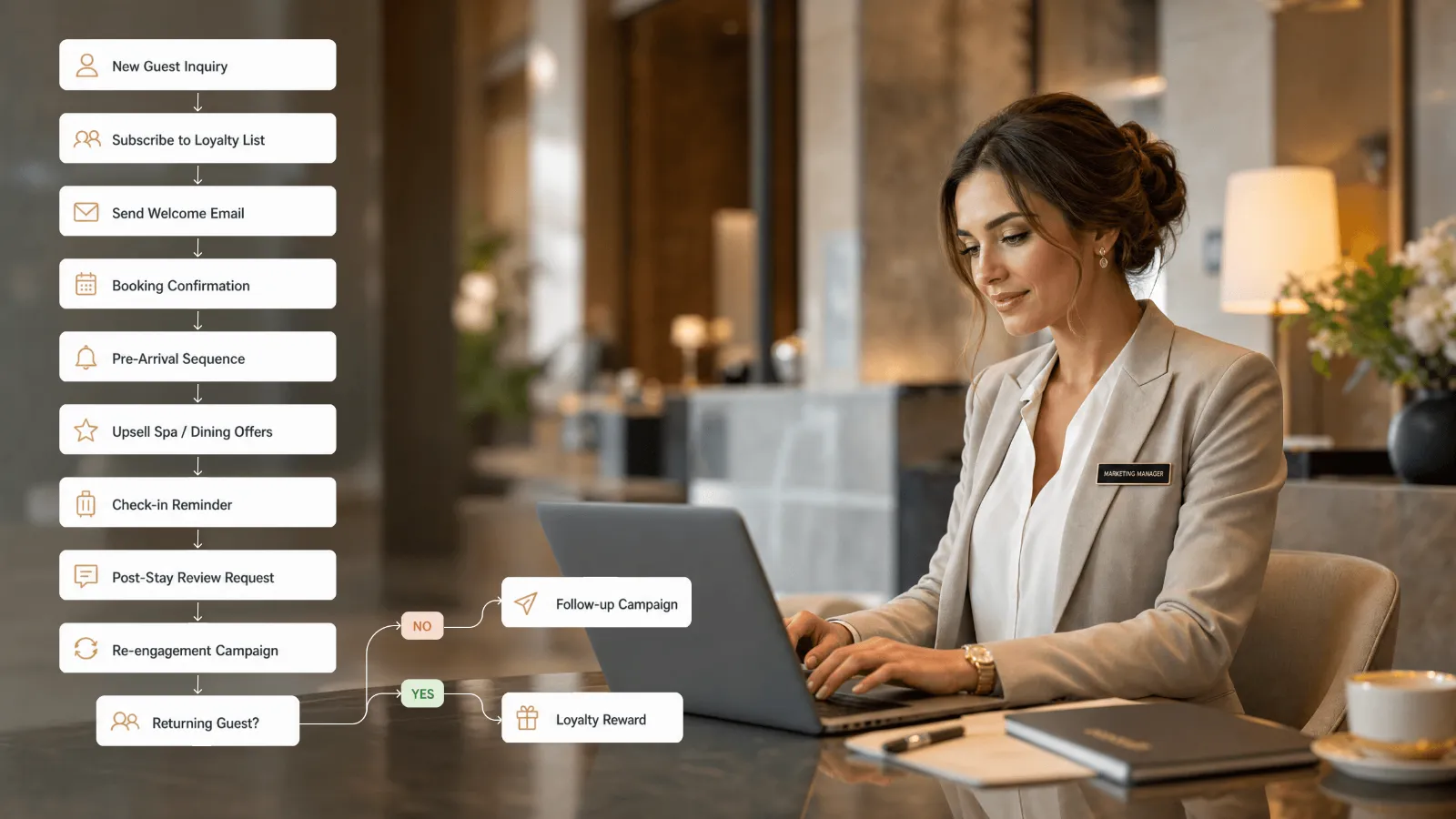
Review automation can improve consistency by sending requests after a completed stay, meal, or appointment.
Common tools include:

HubSpot, Mailchimp and ActiveCampaign for email workflows

Twilio and Klaviyo for consent-based SMS messages

Birdeye, Reputation.com and Reviews.io for review workflows and monitoring
Booking, reservation and property-management systems with built-in feedback features
Automated messages should still be reviewed for brand tone, privacy, accuracy and platform compliance.
Review automation should never be used to filter out dissatisfied customers or automatically publish generic replies to sensitive complaints.
14. How to respond to positive reviews
Positive review responses should feel warm, specific, and natural.
Thank the guest, mention a detail from the review, and invite them to return. Avoid turning every response into a sales message.
A useful structure is:
- Thank the guest.
- Mention a specific part of the experience.
- Recognise a team member if mentioned.
- Invite the guest back.
- Keep the response concise.
For a deeper look at building a consistent review response strategy, see this guide on hotel reputation management and review strategies.
15. Positive review response examples
Poor Response
Thanks for your review!
This response is generic and does not show that the business read the guest’s comments.
Good Response
Thank you for staying with us. We are delighted that you enjoyed the sea-view room and breakfast service.
This acknowledges specific details but could be more personal.
Best Response
Sarah, thank you for sharing your experience. We are delighted that you enjoyed the sea-view room and breakfast service, and we will pass your kind comments to the restaurant team. We hope to welcome you back to Edinburgh soon.
Templates can provide structure for high-volume locations, but every response should still be edited.
16. How to respond to negative reviews
A documented negative review response strategy prevents emotional replies and helps teams respond consistently.
The purpose of a negative review response is not to win an argument. It is to show the reviewer and future customers that the business listens, acts professionally, and takes appropriate steps.
16.1 Negative review response examples
Poor Response
We are sorry you feel this way. We normally receive excellent feedback about our service.
This sounds defensive and does not address the concern.
Good Response
We’re sorry your experience fell short. Thank you for sharing your feedback—we’d welcome the chance to understand what happened and speak with you directly.
This acknowledges the concern and moves towards resolution.
Best Response
John, we are sorry your stay fell short of the standard you expected. We are looking into the issue with the team involved and would like to understand the situation in more detail. Please contact [manager/contact details] so we can discuss what happened and work towards a suitable resolution.
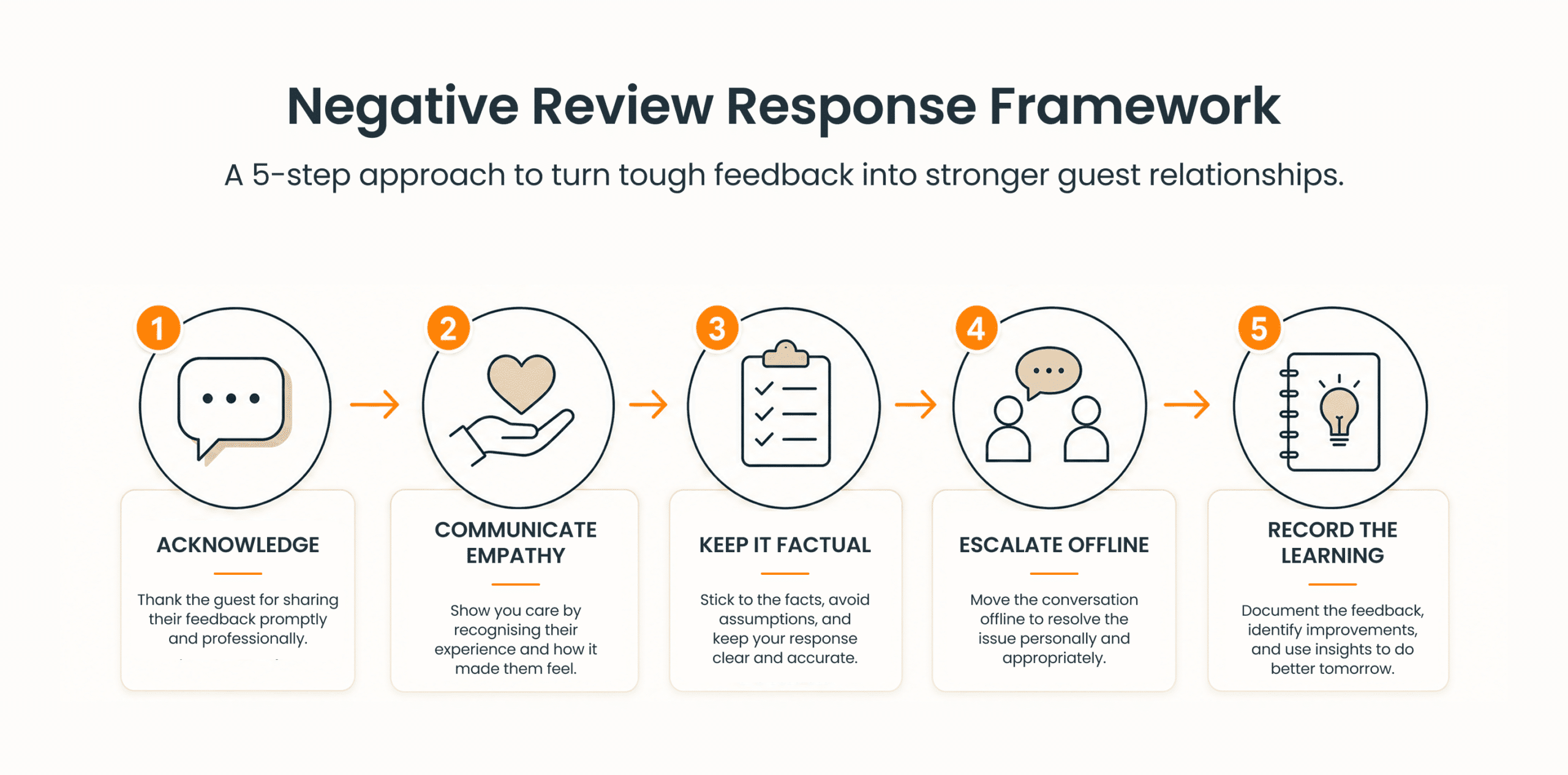
16.2 Use the ACKER framework
Acknowledge
Acknowledge the specific concern without repeating private or sensitive details.
Communicate Empathy
Recognise the effect the experience had on the guest.
Keep It Factual
Avoid defensiveness, speculation, and emotional language.
Escalate Offline
Move the detailed discussion to a private channel when personal information or a full investigation is required.
Record the Learning
Document the complaint and any corrective action that can safely be shared.
16.3 General negative review response template
[Name], we are sorry that [specific aspect] did not meet expectations during your visit. Thank you for raising it.
We’re looking into the issue with the team involved and would like to understand your experience in more detail. Please contact [manager or contact method] and include [reference, if relevant] so we can review the matter properly and determine the best way forward.
16.4 Service complaint example
Sarah, we are sorry that the welcome at reception felt abrupt. That is not the experience we want guests to have. We have shared your feedback with the front-of-house manager and would appreciate the opportunity to learn more. Please contact [details] so we can review the check-in and respond properly.
16.5 Cleanliness or maintenance example
Michael, we are sorry that the bathroom issue affected your stay. Our maintenance team has inspected the room and completed the required repair. Please contact [details] so we can review your booking and discuss the appropriate next step.
16.6 Expectation mismatch example
Jennifer, thank you for sharing your feedback about the room size. We are reviewing the description and photography to ensure they set clear expectations. Our team would be happy to discuss the room categories available for a future stay.
17. Competitor comparison or unavailable feature
Robert, thank you for sharing your feedback. We understand that the facilities differed from those available at the property you previously visited. While we do not currently offer a swimming pool, our spa and restaurant remain central parts of the guest experience. We will also review whether our listing makes the available facilities sufficiently clear.
Take Control of Your Online Reputation
Your online reputation can influence whether a guest chooses your hotel, restaurant, or spa. Build trust, manage reviews, and protect your brand with a proactive reputation management strategy.
James, we are sorry that the delay between courses affected your evening. We have shared your comments with the restaurant manager and kitchen team so we can understand what caused the delay. Please contact [details] if you would be willing to discuss your visit further.
Never publish:
- Personal booking information
- Health details
- Payment details
- Private contact information
- Unverified accusations
- Claims about the reviewer’s motives
- A promise of compensation before the facts are confirmed
- Legal admissions without appropriate advice
- Staff disciplinary details
- A demand that the reviewer remove or change the review
A public response should protect both the guest and the business.
18. A practical hospitality reputation crisis plan
It is an issue that may create significant risk to guests, staff, or the business, including:
- A food-safety allegation
- An injury
- A discrimination claim
- Staff misconduct
- A data breach
- A security incident
- A viral social media post
- A serious cleanliness allegation
- Criminal accusations
- Media attention
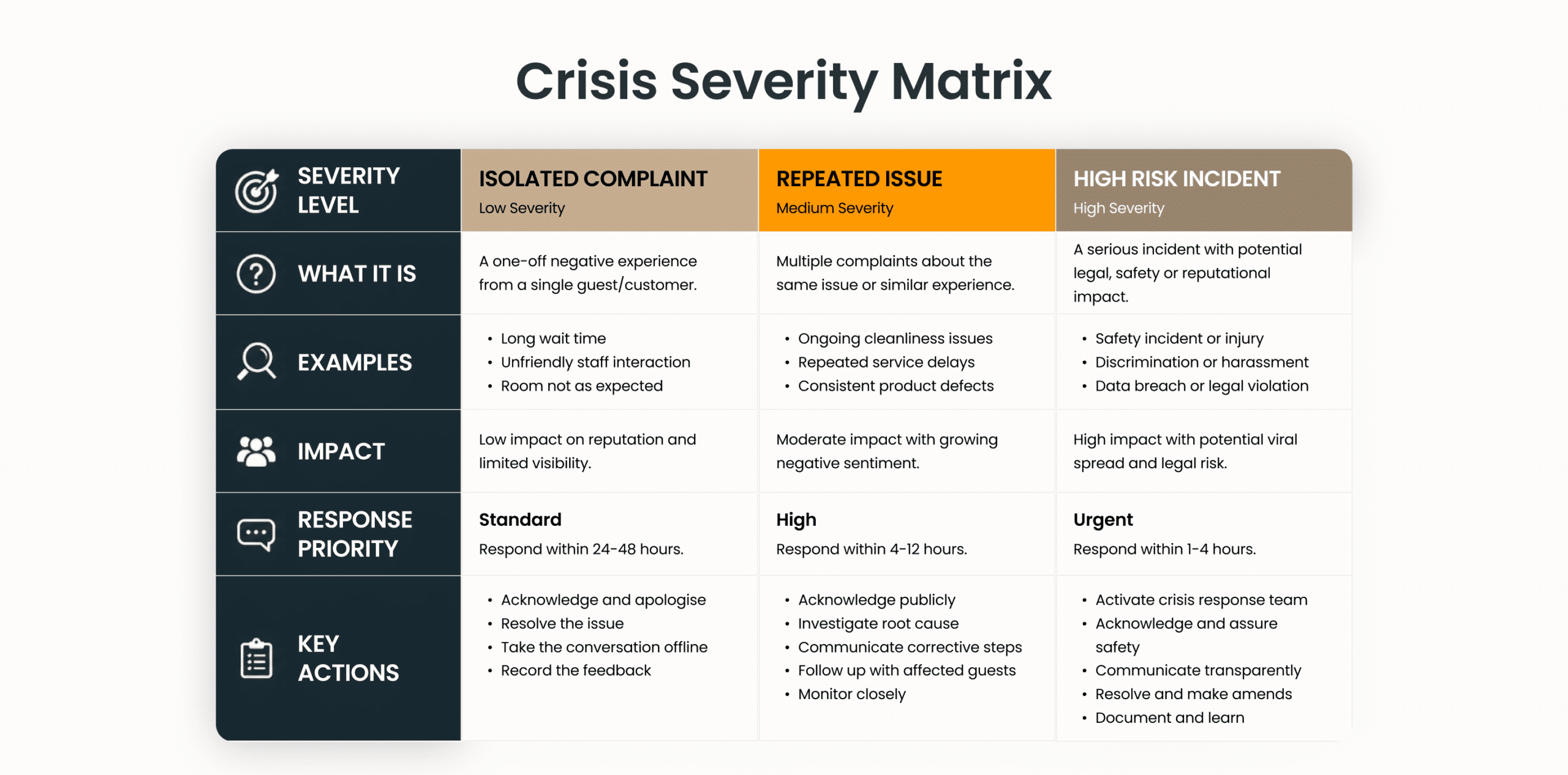
19. Crisis severity matrix
| Level | Example | Response Target | Owner |
| Level 1: Routine | One isolated complaint about a minor issue | Within 24–48 hours | Duty manager or review owner |
| Level 2: Pattern | Several complaints about the same issue | Same-day triage | General manager and department lead |
| Level 3: High Risk | Safety, hygiene, discrimination, injury, criminal allegation or media attention | Immediate escalation | Senior management with legal, insurer or PR support where required |
20. Seven crisis-response steps
1. Assess the Facts
- Confirm what is known, what is alleged, and who may be affected.
- Preserve relevant records and do not speculate publicly.
2. Protect People First
- Take immediate action for safety, welfare, hygiene, or security before focusing on publicity.
3. Assign Decision-Makers
- Nominate one operational lead and one communications lead.
4. Acknowledge Promptly
- Use a brief holding response that conveys concern and confirms the issue is under investigation.
5. Contact Affected Guests
- Move detailed discussion to a secure private channel.
- Listen to the guest’s account before proposing a resolution.
6. Correct the Root Cause
- Document findings, actions, training and process changes.
- Involve regulators, insurers, legal advisers or communication specialists where required.
7. Update and Monitor
- Share an appropriate factual update when possible.
- Continue monitoring reviews, social media and direct enquiries.
21. Example holding response
We are concerned to hear about this experience and are reviewing the details as a priority. Our management team has contacted the guest directly to understand what happened and take appropriate action. Guest safety and wellbeing remain our immediate focus.
22. Example follow-up crisis response
We have now completed our initial investigation into the reported incident. Based on the findings, we have introduced [specific corrective action], reviewed [relevant procedure] and provided additional guidance to the team involved. We remain in direct contact with the affected guest and will continue to cooperate with any relevant authorities or advisers. Guest safety and wellbeing remain our priority.
Only publish a follow-up response when the facts and corrective actions have been confirmed.
23. When to involve external PR or legal support
Consider specialist public-relations support when:
- Several media outlets are covering the incident
- A complaint is spreading quickly on social media
- The business is receiving a high volume of enquiries
- Multiple locations need coordinated messaging
- The incident threatens wider brand trust
- Senior management lacks crisis-communication experience
Consult a qualified legal adviser when the issue involves:
- Personal injury
- Food safety or public health
- Criminal allegations
- Discrimination or harassment
- Data protection
- Employee misconduct
- Insurance claims
- Regulatory investigation
- A possible admission of legal liability
24. Building a reputation-first culture
Reputation improves most reliably when marketing is connected to operations.
Review management cannot compensate for repeated service failures. Hotels, restaurants, and spas need a culture in which feedback reaches the people who can act on it.
24.1 Staff training and accountability
Every member of the hospitality team influences reputation, even if they never respond publicly to a review.
A practical accountability system should include:
- Documented service standards
- Review and complaint handling in staff induction
- Quarterly refresher training
- Clear escalation responsibilities
- Defined limits for frontline service recovery
- Recognition for employees praised by guests
- Coaching where repeated concerns appear
- Review themes in team performance discussions
- Mystery visits or service-quality checks
- Follow-up checks to confirm corrective actions worked
Avoid evaluating employees solely by the number of positive reviews mentioning them. This can create pressure to solicit favourable feedback.
24.2 Turn feedback into operational action
When the same issue appears repeatedly, management should ask:
- Which part of the guest journey is failing?
- Is the problem caused by staffing, training, systems or facilities?
- Does the website or listing create the wrong expectation?
- Is the issue appearing across more than one location?
- What corrective action has already been attempted?
- How will the business confirm that the issue has been resolved?
This turns reputation management into a business-improvement process rather than a reply-writing exercise.
25. Turning guest feedback into reputation marketing
Positive reviews can support marketing when they are used accurately and with appropriate permission.
Hospitality businesses can:
- Display approved guest testimonials on booking and service pages
- Create social graphics from genuine reviews
- Publish video testimonials with written consent
- Highlight staff members praised by guests
- Share improvements introduced after customer feedback
- Feature review themes in email campaigns
- Add relevant social proof near booking calls to action
- Publish case studies about customer-experience improvements
- Use verified awards and platform badges according to the issuer’s rules
Do not edit a testimonial in a way that changes its meaning. Avoid publishing names, photographs, or identifiable details without permission.
Make Every Review Work For Your Brand
Your reputation is built across every review, rating, and online conversation. Our online reputation management strategies help hospitality brands protect trust, respond with confidence, and turn customer feedback into a competitive advantage.
26. Reputation metrics hospitality businesses should track
A useful dashboard should connect public feedback with operational and commercial outcomes.
Reputation dashboard analytics should show rating trends, review volume, response performance, sentiment, and recurring issues.
| Metric | What It Shows | How to Use It |
| Average rating by platform | Current public perception | Compare trends by location and platform |
| Review volume and recency | Whether feedback is current and representative | Maintain a consistent, compliant request process |
| Response rate | How consistently the business engages | Identify locations or teams missing reviews |
| Median response time | Operational responsiveness | Set service-level targets and weekend cover |
| Sentiment and themes | What guests praise or criticise | Prioritise training and investment |
| Issue recurrence | Whether corrective action is working | Escalate repeated failures |
| Direct-booking conversion | Commercial performance alongside reputation changes | Look for correlation rather than automatic causation |
| Competitor benchmark | Relative market position | Compare similar properties, prices and locations |
Review the dashboard:
- Weekly for urgent concerns
- Monthly for trends
- Quarterly for strategy
- Annually for planning and target setting
A fall in rating may be caused by one unusual event, a change in guest mix or a genuine service decline. Read the comments before making decisions based only on the headline score.
27. Setting realistic reputation targets
Targets should reflect guest volume, the current review profile, business type, and competitive set.
27.1 Rating targets
Rather than treating one score as universally acceptable, compare the business with similar local competitors.
As internal planning guidance:
- Below 4.0 may require closer investigation.
- A rating around 4.3–4.5 may be competitive in many hospitality markets.
- A 4.5+ rating can be a strong trust signal when backed by sufficient recent reviews.
These are management benchmarks, not guaranteed ranking or booking thresholds.
27.2 Review-volume targets
Set review targets based on actual customer volume.
For example:
- Small independent venue: 2–4 new reviews per week
- Established hotel, restaurant or spa: 5–10 per week
- Large or multi-location business: targets based on each location’s transaction volume
Do not pressure staff or guests to reach an arbitrary number.
27.3 Response-time targets
A practical service-level structure is:
- High-risk complaint: immediate escalation
- Serious negative review: same-day assessment
- Routine negative review: within 24–48 hours
- Positive review: within 48–72 hours where resources allow
- Monthly response rate: 90%+ initially, moving towards consistent coverage
28. Common online reputation management mistakes
Avoid these common errors:
Ignoring negative reviews
Reusing identical responses
Offering rewards for reviews
Asking only satisfied customers to post publicly
Publishing private guest information
Failing to escalate safety, hygiene or legal-risk complaints
Tracking ratings without analysing recurring themes
Treating reputation management as a marketing-only responsibility
Each mistake has already been explained earlier, so no additional paragraphs are needed.
29. Trying to remove legitimate criticism
A negative review does not automatically violate a platform policy.
Report reviews only when there is a genuine policy issue, such as spam, fake engagement, prohibited personal information, or irrelevant content.
- Publishing Guest Information: Do not reveal private details while attempting to prove the business is correct.
- Failing to Escalate Serious Complaints: Safety, hygiene, injury, discrimination, and legal-risk complaints require immediate escalation.
- Tracking Ratings Without Tracking Themes: The rating shows the result. The comments explain the likely cause.
- Treating Reputation as a Marketing-Only Task: Marketing teams can monitor and communicate, but operational teams must fix the service issues behind repeated complaints.
30. Review management tools: What do you actually need?
Small hospitality businesses can begin with free platform alerts, a shared response log and a simple monthly report.
Larger or multi-location businesses may need centralised software for approvals, workflows, analytics and governance.
30.1 Native platform tools
Use the dashboards available through:
- Google Business Profile
- TripAdvisor
- Booking.com
- Expedia
- OpenTable
- Resy
- Treatwell
- TikTok
These may be enough for a small business managing a limited number of profiles.
30.2 Monitoring tools
Brand24, Mention, and social media management tools can help identify wider brand mentions.
They are useful when customers discuss the business without tagging the official account.
30.3 Reputation management platforms
Platforms such as Birdeye, Reputation.com and Reviews.io may support:
- Multi-location management
- Centralised alerts
- Response workflows
- User permissions
- Review analytics
- Sentiment analysis
- Reporting
- Approval processes
30.4 Email and CRM tools
HubSpot, Mailchimp and booking-system automations can support neutral post-visit review requests.
Any automation should comply with privacy, consent and platform rules.
30.5 Reporting tools
Hospitality businesses may use:
- Looker Studio
- Business intelligence software
- CRM reports
- Booking-system data
- A structured spreadsheet
- A custom reputation dashboard
31. Indicative reputation management software costs
Software pricing varies by the number of locations, review volume, features, and contract length.
| Solution Type | Indicative Cost | Typical Use |
| Native platform tools | Free | Small businesses monitoring platforms manually |
| Basic monitoring tools | Approximately £50–£300 per month | Brand mentions, social listening and basic alerts |
| Review-management platforms | Approximately £200–£800 per month | Monitoring, workflows, analytics and automation |
| Enterprise reputation platforms | £1,000+ per month | Multi-location groups needing governance, integrations and advanced reporting |
Confirm current pricing directly with the provider.
Before buying software, check:
- Which platforms it integrates with
- How user access is controlled
- Whether responses can be approved centrally
- How guest data is stored
- Whether sensitive complaints can be escalated
- Whether reporting supports multiple locations
- Whether automation includes human oversight
Your Reputation Is Your Most Valuable Marketing Asset
Guests trust what others say about your brand. With the right reputation management strategy, you can build credibility, respond to feedback, and create the confidence that turns potential guests into customers.
32. When to hire a hospitality reputation management specialist
Professional support is useful when reputation management becomes too complex, inconsistent, or high-risk for the internal team.
Common warning signs include:
- A declining rating
- Unanswered reviews
- Repeated complaints across locations
- Weak reporting
- Too few recent reviews
- Inconsistent brand voice
- Slow response times
- No escalation process
- A serious incident requiring coordinated communication
- Limited internal time or expertise
32.1 What to look for in an agency
A specialist hospitality reputation agency should understand platform policies, guest service operations, and UK compliance requirements.
Choose a partner with:
- Experience with hotels, restaurants or spas
- Knowledge of UK consumer rules and data protection
- A clear monitoring and escalation process
- A documented approval workflow
- Crisis-handling experience
- Human review of automated content
- Safeguards for sensitive complaints
- Reporting beyond headline star ratings
- Transparent case studies
- An approach connecting reputation, local SEO, direct bookings and guest retention
Avoid providers that promise guaranteed five-star ratings or claim that every negative review can be removed.
33. How ThisRapt supports online reputation management for UK hospitality
ThisRapt is a hospitality marketing agency focused on hotels, restaurants and spas.
Its broader service model integrates reputation management with search visibility, social media, email marketing, automation, digital PR, and direct-booking growth.
That matters because a review programme works best when it is integrated with the complete guest journey rather than managed in isolation.
ThisRapt’s hospitality reputation management support may include:
- Reputation audits across priority platforms
- Multi-platform online reputation monitoring
- Structured review-response workflows
- Compliant email and SMS review-request journeys
- Personalised review response templates
- Escalation processes for sensitive complaints
- Crisis communication support
- Monthly reporting on ratings, volume, response performance and sentiment
- Competitor benchmarking
- Guest testimonial and social-proof content
- Operational insight based on recurring review themes
- Staff training and reputation culture development
The objective is not to manufacture a perfect score.
It is to create a credible, current and well-managed public record of the guest experience while helping the business identify concerns early and communicate with confidence.
34. What hospitality reputation management support may cost
The cost of professional support depends on the number of locations, review volume, response responsibility, reporting requirements and whether crisis management, automation or staff training is included.
Indicative planning ranges may include:
- Small independent business: approximately £400–£800 per month
- Established hotel, restaurant or spa: approximately £800–£1,500 per month
- Multi-location group: from approximately £1,500 per month
These are broad market-planning estimates, not confirmed ThisRapt prices. Final pricing should be based on the agreed scope.
34.1 Typical implementation timeline
Months 1–2: Reputation audit, profile corrections, response processes and review-request setup
Months 2–3: More consistent monitoring, faster responses and clearer escalation
Months 3–6: A larger base of recent reviews, improved operational insight and more reliable trend reporting
After six months: Ongoing reputation development, benchmarking and stronger use of testimonials and social proof
Do not promise a fixed increase in rating, review volume or bookings. Results depend on the existing profile, guest volume, service quality, platform mix and implementation consistency.
35 A Practical 90-Day Implementation Checklist
- Claim and complete priority profiles.
- Record baseline ratings and review counts.
- Measure current response rates and response times.
- Identify recurring positive and negative themes.
- Respond to recent unanswered reviews where useful.
- Create escalation rules.
- Develop response templates.
- Correct inaccurate listing information.
- Replace outdated imagery.
- Assign review ownership and backup cover.
- Launch neutral post-visit review requests.
- Train staff to ask for honest feedback.
- Introduce a review log or dashboard.
- Set evening and weekend response ownership.
- Begin monthly theme reporting.
- Test review links and QR codes.
- Check email and SMS privacy requirements.
- Formalise sensitive complaint escalation.
- Act on the most common service issues.
- Publish approved testimonials on relevant website pages.
- Compare performance with similar local competitors.
- Refine templates using genuine review themes.
- Connect reputation reporting with direct-booking metrics.
- Track customer retention where possible.
- Check whether corrective actions reduced repeated complaints.
- Plan the next quarter’s priorities.
36. Your online reputation is a long-term marketing asset
Online reputation influences how UK hospitality businesses are discovered, evaluated and trusted.
Systematic reputation management helps hotels, restaurants and spas:
- Generate authentic and current customer feedback
- Respond professionally to positive and negative reviews
- Identify service problems before they become repeated complaints
- Prepare for serious reputation risks
- Use approved testimonials in marketing
- Measure reputation alongside bookings and retention
- Build a service culture that protects the brand over time
Reputation improvement is cumulative. Consistent monitoring, compliant review requests, operational follow-up and clear staff ownership produce stronger results than one-off campaigns or generic response templates.
This approach supports local reputation management, reputation marketing and long-term brand reputation protection.
Explore ThisRapt’s Online Reputation Management Service to build and protect one of your hospitality business’s most valuable assets.
37. Online Reputation Management FAQs
Online reputation management for hospitality involves monitoring reviews, responding to guest feedback, resolving complaints, encouraging genuine reviews, and tracking reputation trends. It covers platforms such as Google, TripAdvisor, booking sites, reservation platforms, and social media.
Hotels and restaurants should respond consistently, especially to negative, detailed, or high-risk reviews. Positive reviews can receive shorter personalised replies. High-volume businesses should follow a clear response policy rather than posting rushed or repetitive answers.
No. Google prohibits discounts, free services, or other incentives in exchange for reviews. Hospitality businesses should request honest feedback from genuine customers without influencing the rating, wording, or decision to leave a review.
Most routine negative reviews should be acknowledged within 24-48 hours. Complaints involving safety, hygiene, injury, discrimination, staff misconduct, or viral attention should be escalated immediately and handled through a controlled response process.
A review may be reported if it violates platform rules, such as spam, fake engagement, harassment, irrelevant content, or prohibited personal information. A negative opinion usually cannot be removed simply because the business disagrees with it.
Google is the main priority for most UK hospitality businesses because reviews appear in Search and Maps. Hotels and restaurants should also monitor TripAdvisor and booking platforms, while spas may prioritise Treatwell and restaurants may use OpenTable or Resy.
Faster responses and operational fixes can begin immediately, but building a stronger review profile usually takes several months. Progress depends on guest volume, existing reviews, seasonality, service quality, and the consistency with which the business requests and responds to feedback.
A reputation dashboard should track ratings by platform, review volume, recency, response rate, response time, sentiment, recurring themes, competitor performance, and relevant booking trends. Always review the comments behind the numbers before deciding what action to take.





Emma, we are sorry that the treatment did not match your expectations. We take treatment feedback seriously and would like to understand the details privately. Please contact our spa manager at [details] so we can review your appointment and discuss the appropriate next step.