Manual marketing continues to limit growth across the hospitality industry, especially as guest expectations rise. Many UK hotels, restaurants, and spas struggle with inconsistent communication, missed follow-ups, and low retention due to a lack of scalable systems.
Hotels miss post-stay follow-ups. Restaurants depend on manual reminders. Spas struggle to re-engage past guests. These inefficiencies highlight why hospitality marketing is not scalable using traditional approaches.
As bookings increase, manual workload increases too, leading to inconsistent campaigns and missed opportunities. This makes it difficult to answer key challenges like how to automate hotel bookings and follow-ups or how to reduce manual marketing efforts.
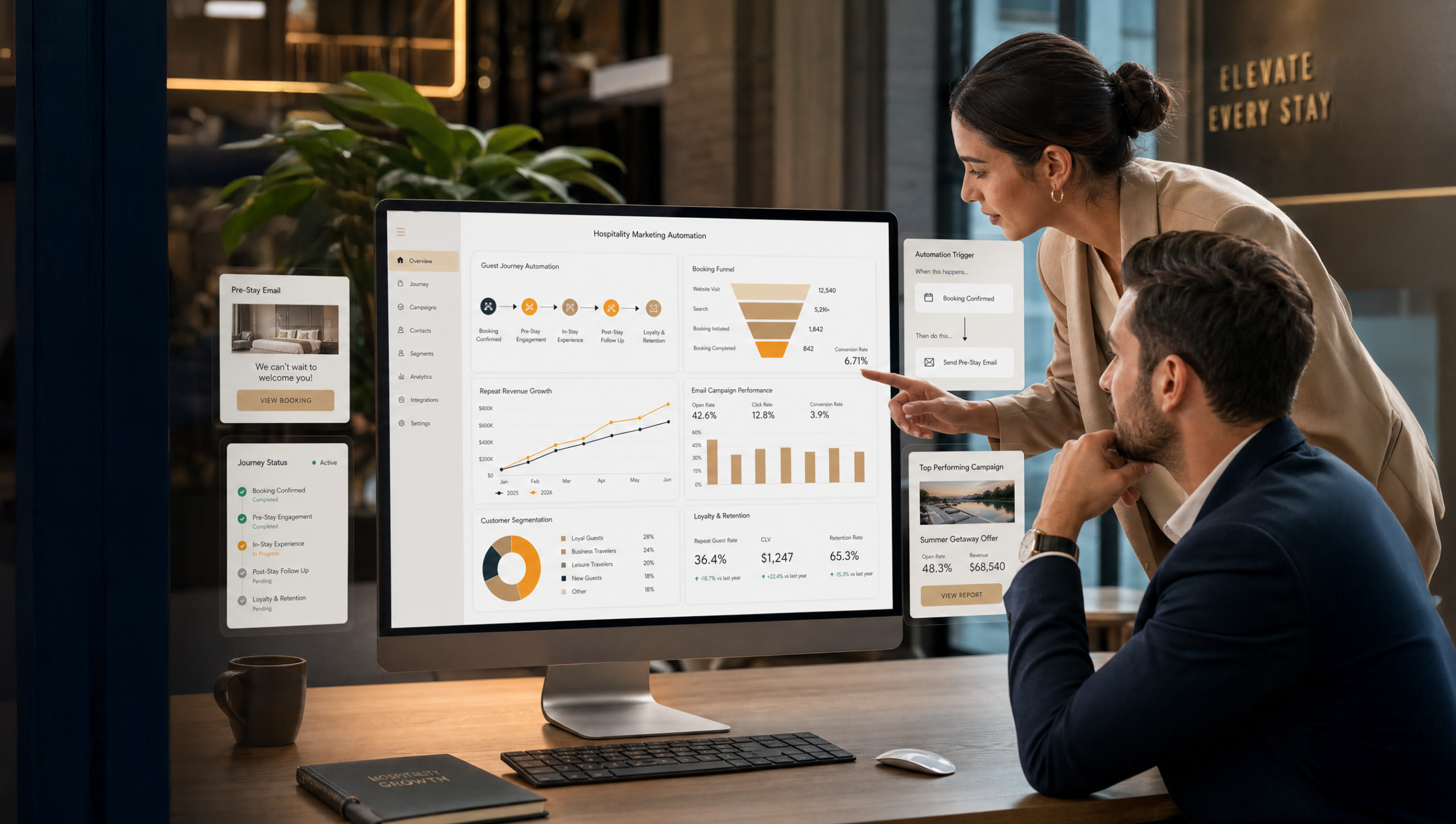
Hospitality marketing automation solves this by turning guest data into automated, personalised communication that drives bookings and retention across the entire lifecycle.
It enables:
- Automated guest communication
- Lead nurturing automation
- Email automation workflows in hospitality
- Customer journey automation
Instead of reacting to guest actions, your system starts guiding them, automatically and consistently.
UK hospitality businesses using structured automation systems report up to 30%+ higher repeat bookings and improved customer lifetime value.
If your marketing still relies on manual processes, you are not just inefficient; you are limiting growth potential. The real opportunity lies in building a system that scales communication, improves retention, and drives predictable revenue automatically.
From guest segmentation to automated journeys—discover the complete roadmap to drive more bookings and build lasting guest loyalty. |
|
1. What is hospitality marketing automation?
Hospitality marketing automation is a system that uses guest data and behaviour to trigger automated, personalised communication across the entire customer lifecycle.
Unlike traditional campaigns, marketing automation for the hospitality industry creates continuous workflows that respond to guest actions in real time.
For example:
- Booking → confirmation + upgrade offers
- Pre-arrival → travel details + recommendations
- In-stay → service promotions
- Post-stay → review request + rebooking
- Inactive guest → re-engagement campaign
This creates a connected system in which every guest interaction automatically triggers relevant communication.
1.1 Automation vs Email Marketing
Understanding the difference between email marketing and automation is critical, as many businesses rely on campaigns without realising the limitations of this approach.
Email marketing = one-time campaigns
Marketing automation = triggered, behaviour-based workflows
Automation focuses on:
- Personalisation
- Timing
- Lifecycle engagement
This shift transforms marketing from isolated campaigns into a continuous system that builds relationships and drives long-term value.
1.2 Role in the hospitality customer lifecycle
Automation delivers maximum value when applied across the entire guest journey, ensuring no stage is overlooked.
Supports:
- Discovery and lead capture
- Booking and confirmation
- Pre-arrival engagement
- In-stay experience
- Post-stay retention
- Long-term re-engagement
This is powered by CRM automation and hospitality systems that connect guest data across platforms.
This lifecycle approach is what enables consistent engagement and improved retention at scale.
By supporting every stage of the journey, automation ensures that no opportunity is missed. It turns fragmented communication into a structured system that continuously improves guest experience, engagement, and long-term revenue.
2. Why marketing automation is critical in 2026
Hospitality marketing has evolved significantly, and manual processes can no longer keep up with increasing guest expectations and operational complexity. Automation has become essential for delivering personalised, timely, and scalable communication across the entire customer journey.
2.1 Guest lifecycle complexity
The modern guest journey is no longer linear and involves multiple touchpoints across different channels.
Search → website → booking → stay → review → return
Managing this manually leads to delays, missed follow-ups, and inconsistent experiences. This is a key reason why hospitality marketing is not scalable without automation. Automation ensures each stage is supported with structured communication, creating a seamless and consistent guest experience.
2.2 Personalisation at scale
Guests now expect communication that reflects their preferences and behaviour, not generic promotions.
Automation enables:
- Behaviour-based messaging
- Dynamic content
- Personalised offers
Powered by email automation workflows in hospitality, this ensures relevance at every touchpoint.
This level of personalisation increases engagement, improves conversion rates, and strengthens long-term customer relationships.
2.3 Time efficiency
Hospitality teams spend significant time managing repetitive marketing tasks, which limits their ability to focus on growth.
Automation removes:
- Manual confirmations
- Follow-ups
- Campaign execution
This directly solves how to reduce manual marketing efforts.
By automating repetitive tasks, teams can shift focus from execution to strategy, improving overall efficiency and performance.
2.4 Data-driven decisions
Modern marketing success depends on measurable insights rather than assumptions.
Automation tracks:
- Engagement
- Conversions
- Campaign performance
This enables continuous optimisation through lead nurturing automation.
Decisions become data-driven instead of guesswork.
With clear insights, businesses can refine strategies, improve performance, and maximise return on marketing efforts.
2.5 Direct booking growth
Reducing reliance on OTAs is a major priority for UK hospitality businesses looking to improve margins.
Automation helps by:
- Nurturing direct leads
- Retargeting visitors
- Re-engaging past guests
This is central to any hotel marketing automation strategy 2026.
By increasing direct bookings and improving retention, automation strengthens profitability and gives businesses greater control over the customer relationship.
3. Hospitality marketing automation strategy for 2026
A successful hospitality marketing automation strategy in 2026 is not about using more tools; it is about building a structured system that aligns guest behaviour, communication, and revenue goals.
The most effective approach is to automate high-impact moments in the customer journey first.
For most businesses, this includes:
Booking confirmations and follow-ups
Pre-arrival communication and upselling
Post-stay review and rebooking workflows
Re-engagement campaigns for inactive guests
This directly solves key challenges, such as how to automate hotel bookings and follow-ups, and how to improve customer retention automatically.
Channel selection also plays a critical role. A balanced system combines:
- Email automation workflows in hospitality
- SMS reminders for time-sensitive updates
- Retargeting ads for abandoned bookings
Together, these create a complete customer journey automation system.
Rather than focusing on short-term campaigns, automation should be treated as a long-term growth system. Over time, it improves retention, increases customer lifetime value, and reduces reliance on paid acquisition.
The goal is not just to generate bookings, but to build a system that continuously drives repeat revenue.
4. How hospitality marketing automation works (Framework)
To implement automation effectively, it is important to understand how the system works behind the scenes. This framework connects guest data, workflows, and communication channels to create a structured and scalable marketing engine.
Customer journey mapping
Every successful automation strategy begins with mapping the customer journey to understand how guests interact with your business.
Typical journey: Awareness → Booking → Experience → Retention
This helps identify:
- Drop-off points
- Missed follow-ups
- Revenue opportunities
This is the foundation of customer journey automation.
By clearly mapping each stage, businesses can apply automation where it delivers the highest impact and improves the overall guest experience.
Lead capture & data collection
Automation relies on accurate data to trigger relevant communication and personalise the guest experience.
Data sources include:
- Website forms
- Booking systems
- CRM platforms
- POS systems
This powers CRM automation, hospitality systems, and enables segmentation.
Data is the backbone of all automation workflows.
With structured data collection, businesses can build more accurate segments and deliver communication that is relevant, timely, and effective.
Automation workflows
Automation workflows are the core engine that executes communication based on predefined triggers.
Workflows are triggered by:
- Guest actions (booking, browsing)
- Time events (pre-arrival, post-stay)
- Behaviour (abandoned booking)
Includes:
- Email automation workflows in hospitality
- SMS reminders
- Retargeting ads
This enables consistent automated guest communication.
These workflows ensure that communication happens automatically, reducing manual effort while improving consistency and engagement.
Personalisation at scale
Personalisation is what makes automation effective, ensuring that each guest receives relevant communication.
Automation uses:
- Behaviour-based triggers
- Segmentation automation
This supports:
- Lead nurturing automation
- Targeted messaging
Personalisation improves engagement and conversions.
By delivering tailored communication at scale, businesses can enhance guest experience while maintaining efficiency.
Integration across channels
Automation works best when all marketing and operational systems are connected into a unified ecosystem.
Integrates:
- Website
- CRM
- Ads
This creates a seamless communication system across channels.
When systems are fully integrated, automation becomes more accurate and effective, ensuring consistent messaging and a smooth experience across every guest touchpoint.
In simple terms, hospitality marketing automation works by capturing guest data, triggering personalised workflows, and delivering consistent communication across every stage of the customer journey.
5. Core automation workflows for each business type
Different hospitality businesses have unique customer journeys, but all benefit from structured automation workflows that improve engagement, increase bookings, and maximise retention through consistent and personalised communication.
5.1 Hotel automation strategy
Hotels have multi-stage guest journeys, making automation essential for managing communication effectively.
Key workflows:
- Pre-arrival → confirmation, upgrades, guides
- In-stay → dining, spa, upsells
- Post-stay → review, rebooking
- Re-engagement → inactive guests
- Abandoned booking recovery
- Seasonal campaigns
Core of hotel marketing automation services
A structured hotel automation strategy ensures consistent communication across the entire lifecycle, improving guest experience while increasing revenue from both new and returning customers.
5.2 Restaurant automation strategy
Restaurants operate on shorter booking cycles but still benefit significantly from automation-driven engagement.
Key workflows:
- Reservation confirmation
- Pre-visit reminders
- Post-dining follow-up
- Birthday/anniversary campaigns
- Loyalty program nurture
- Event promotion
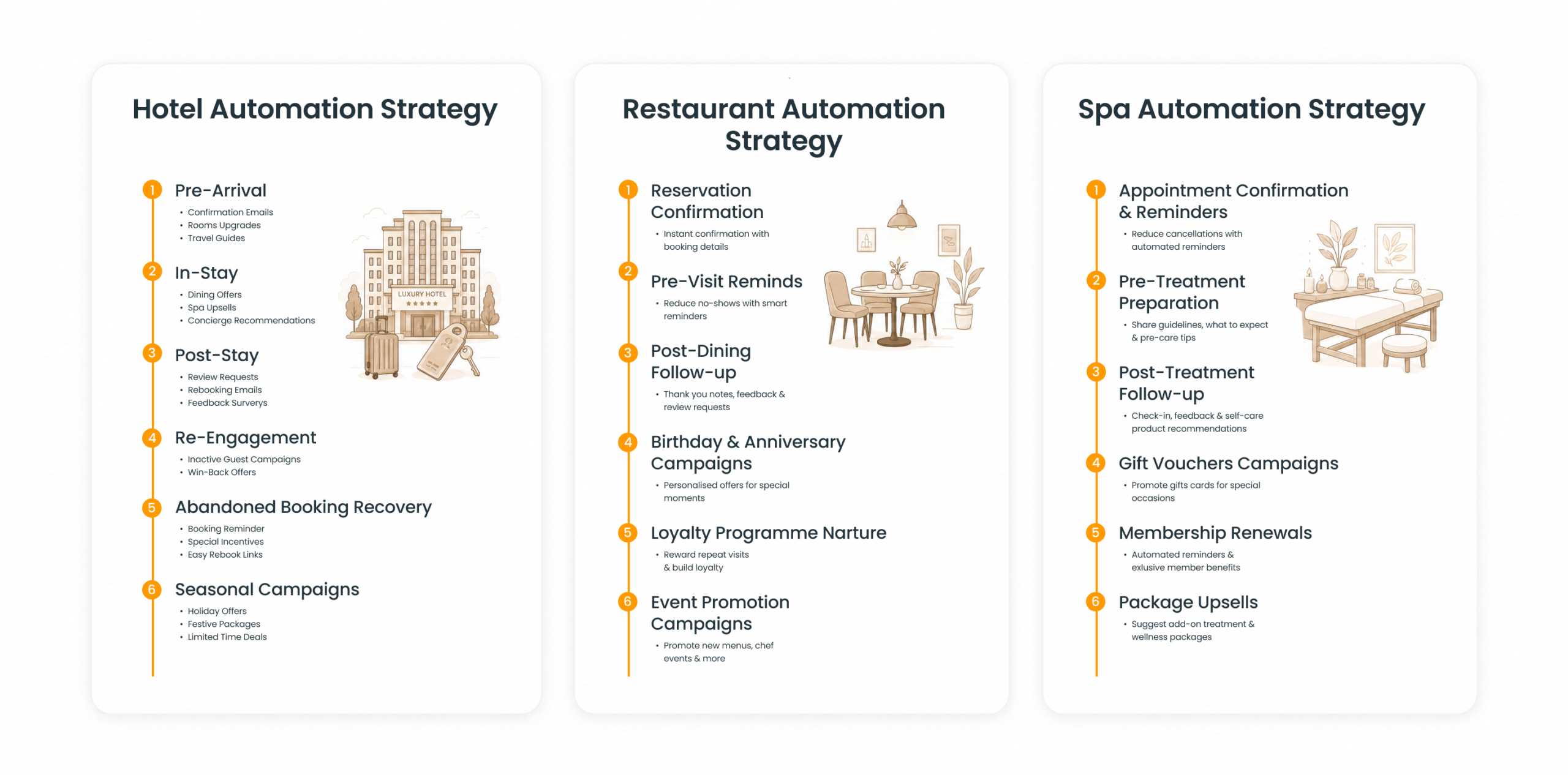
Powered by restaurant marketing automation services
Automation helps restaurants reduce no-shows, improve engagement, and drive repeat visits by maintaining consistent communication before and after each dining experience. Master the six-figure restaurant business strategy with our in-depth guide.
5.3 Spa automation strategy
Spas rely heavily on repeat bookings, making automation essential for retention and revenue growth.
Key workflows:
- Appointment confirmation and reminders
- Pre-treatment preparation
- Post-treatment follow-up
- Gift voucher campaigns
- Membership renewals
- Package upsells
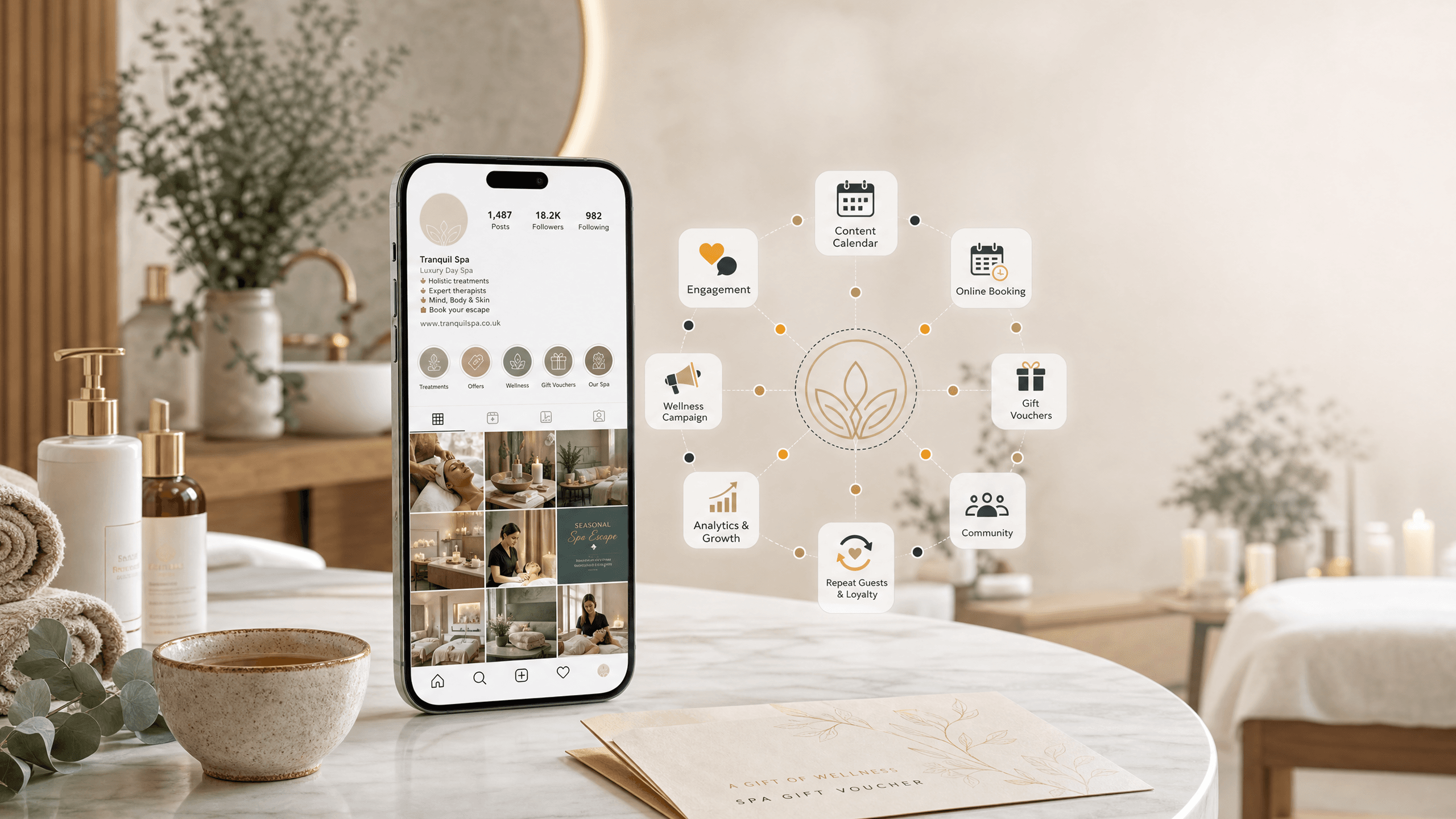
Driven by spa marketing automation services
Automation enables spas to build long-term relationships with guests, increase rebooking rates, and maximise customer lifetime value through consistent and personalised engagement.
6. High-impact automation use cases
Certain automation use cases deliver immediate and measurable impact by capturing missed opportunities and improving retention. These workflows focus on maximising existing demand rather than relying solely on new customer acquisition.
Key use cases:
- Abandoned booking recovery
- Review and feedback automation
- Birthday and anniversary campaigns
- Re-engagement campaigns
These directly solve how to automate hotel bookings and follow-ups, and improve retention.
6.1 Guest segmentation and personalisation
Segmentation is the foundation of effective automation, ensuring that communication remains relevant and targeted.
Segmentation types:
- Behavioural (new vs repeat guests)
- Demographic (families, couples, business travellers)
- Engagement (active vs dormant)
- Transactional (spend levels, frequency)
- Preference-based triggers (room type, dietary needs)
Dynamic content adapts messaging based on the guest profile.
Powered by CRM automation hospitality systems
Effective segmentation ensures that every message is personalised and relevant, improving engagement, conversion rates, and overall guest experience at scale.
6.2 When should you start marketing automation?
Many hospitality businesses delay automation, assuming it is only necessary at scale. In reality, automation becomes valuable as soon as manual processes start creating inconsistency or missed opportunities.
You should start marketing automation when your business can no longer manage communication consistently across bookings, follow-ups, and guest engagement.
Common signs include:
- Missed follow-ups after stays or visits
- Low repeat booking rates
- Increasing manual workload
- Inconsistent communication
Starting early allows you to build a system that compounds results over time, rather than reacting to growth challenges later.
Automate your guest journey, amplify your results
Stop losing bookings to manual follow-ups and missed opportunities. Our marketing automation delivers personalised guest experiences at scale – from pre-arrival to post-stay – driving higher engagement, repeat bookings, and revenue while you focus on hospitality.
7. Essential tools for hospitality marketing automation
A successful automation system is built on the right combination of tools working together seamlessly. These tools manage data, automate workflows, deliver communication, and track performance across the entire customer journey.
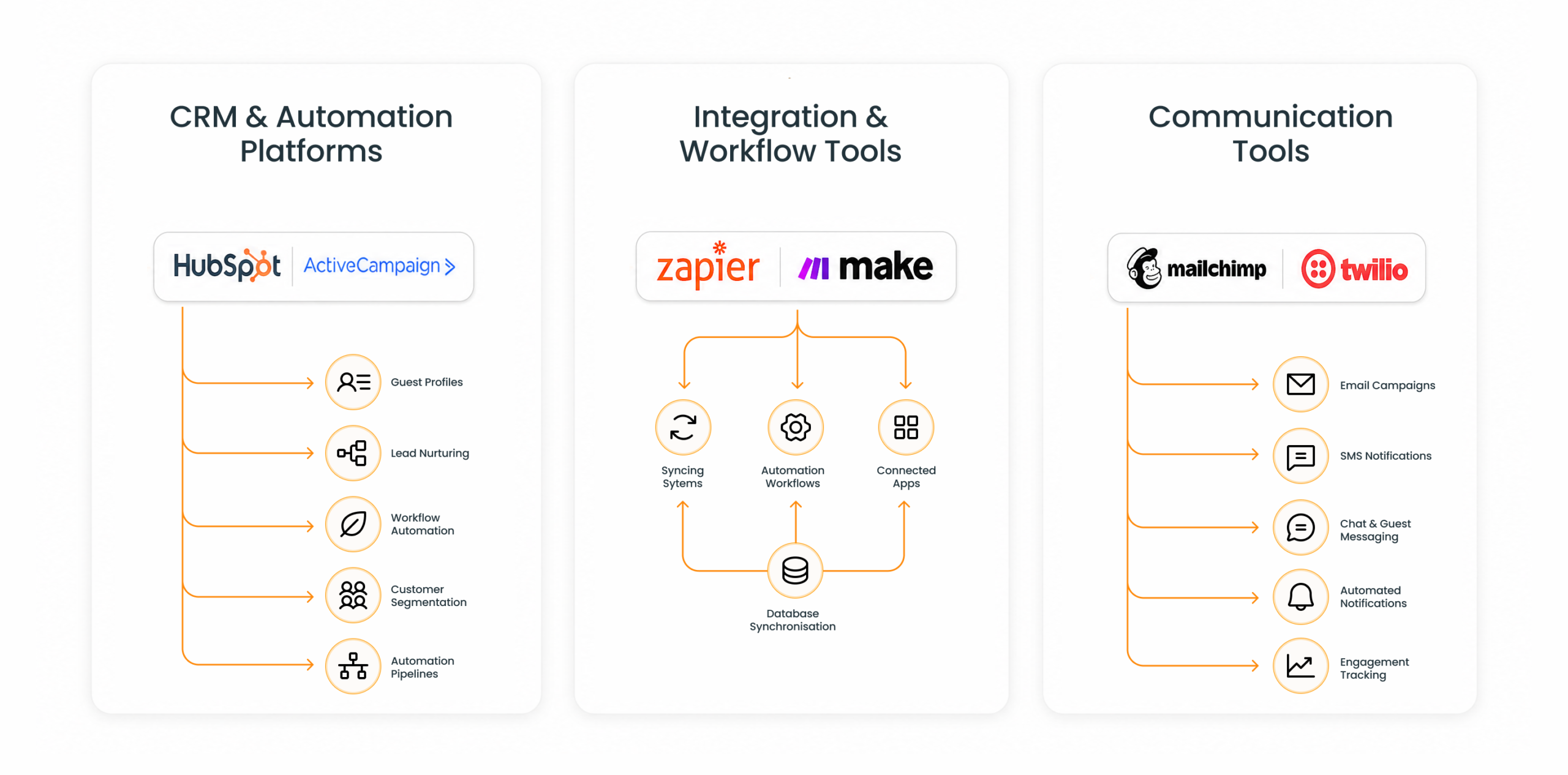
With clear insights, businesses can continuously refine their automation strategies and improve overall performance.
When combined, these tools create a complete ecosystem that supports marketing automation for the hospitality industry, enabling businesses to manage data, automate communication, and optimise performance efficiently. Read more: 5 Essential Digital Marketing and Automation Tools
8. Essential features of hospitality marketing automation
The effectiveness of any automation system depends on its features. These capabilities ensure that communication is personalised, workflows are scalable, and performance can be measured and improved over time.
Key features:
- Trigger-based workflows
- CRM integration
- Segmentation capabilities
- A/B testing
- Analytics and reporting
- Multi-channel automation
- GDPR compliance
Trigger-based workflows ensure that communication is automatically sent based on guest actions or timelines.
Supports:
- Email automation workflows in hospitality
- Behaviour-based messaging
Ensures timely and relevant communication.
This allows businesses to maintain consistent engagement without relying on manual campaign execution.
Integration with PMS, booking systems, and POS ensures accurate and real-time guest data.
Supports:
- CRM automation hospitality
Data sync enables better targeting.
Seamless integration ensures that communication is always based on the latest guest data.
Segmentation allows businesses to group guests based on behaviour, preferences, and engagement.
Supports:
- Lead nurturing automation
Improves the relevance of communication.
Better segmentation leads to higher engagement and improved conversion rates.
A/B testing helps optimise campaigns by comparing variations in messaging and timing.
Tests:
- Subject lines
- CTAs
- Send times
Improves campaign performance.
Continuous testing ensures that automation workflows remain effective and optimised.
Analytics provide visibility into performance, enabling data-driven decisions.
Tracks:
- Engagement
- Revenue
Supports customer journey automation optimisation.
Insights allow businesses to refine strategies and maximise ROI.
Automation across multiple channels ensures broader reach and better engagement.
Channels:
- SMS
- Retargeting
Enhances automated guest communication.
Multi-channel strategies increase visibility and improve response rates.
Compliance ensures that all communication follows UK data protection regulations.
Includes:
- Consent management
- Data protection
Builds trust and reduces risk.
Maintaining compliance protects both the business and the guest experience.
These features ensure that hospitality marketing automation systems are scalable, efficient, and compliant, enabling businesses to deliver personalised communication while maintaining control over performance and data.
9. Common automation mistakes
While this Hospitality Marketing Automation Guide highlights the potential of automation, poor implementation can limit its effectiveness.
Many businesses adopt marketing automation for the hospitality industry but fail to see results due to avoidable mistakes. These issues reduce engagement, impact guest experience, and limit performance.
Understanding these pitfalls is essential to building a system that scales effectively.
a. Over-automating and losing the personal touch
Automation should not replace human connection.
Excessive automated guest communication can feel robotic and impersonal. Guests still expect relevance, warmth, and authenticity.
Automation should enhance personalisation while maintaining a human tone.
b. Poor segmentation (Blasting everyone with the same message)
Sending the same message to all guests reduces relevance and engagement.
Without segmentation:
- Offers become irrelevant
- Engagement drops
- Unsubscribe rates increase
Effective segmentation ensures targeted communication across email automation workflows in hospitality, improving conversions.
c. Ignoring data hygiene and list cleaning
Automation depends on accurate data.
Poor data quality leads to:
- Incorrect personalisation
- Irrelevant messaging
- Lower performance
Regular cleaning of duplicate, outdated, and inactive contacts ensures effective lead nurturing automation.
d. Not testing before launching workflows
Launching workflows without testing leads to errors such as broken triggers or duplicate messages.
A/B testing and pre-launch checks are essential, especially for complex setups like hotel marketing automation services or spa CRM automation workflows.
Testing ensures smooth and reliable guest communication.
e. Setting up workflows and never optimising
Automation is not a one-time setup.
Without optimisation:
- Performance declines
- Messaging becomes outdated
- Opportunities are missed
Continuous improvement ensures customer journey automation stays effective and aligned with guest behaviour.
f. Sending too frequently (Automation fatigue)
Too many messages can overwhelm guests.
This leads to:
- Lower engagement
- Higher unsubscribe rates
Focus on delivering relevant communication rather than increasing frequency.
g. Neglecting mobile optimisation
Most guests interact via mobile devices.
If communication is not mobile-friendly:
- Emails are harder to read
- CTAs become less effective
All automated email campaigns for hotels, restaurants, and spas must be optimised for mobile performance.
h. Forgetting to update seasonal campaigns
Hospitality marketing is highly seasonal.
Outdated campaigns can:
- Reduce relevance
- Promote expired offers
Regular updates are essential, especially for hotel marketing automation strategy 2026 campaigns and seasonal promotions.
9.1 Why Avoiding These Mistakes Matters
These mistakes reduce the effectiveness of your automation system and limit results.
Avoiding them ensures that automation:
- Improves guest experience
- Increases engagement
- Drives consistent revenue growth
It also directly supports goals like how to reduce manual marketing efforts and how to improve customer retention automatically.
10. Results you can expect
One of the biggest advantages of implementing a structured system from this hospitality marketing automation guide is that the results are not vague; they are measurable, trackable, and directly tied to revenue growth.
When executed correctly, marketing automation for the hospitality industry delivers consistent improvements across both marketing performance and operational efficiency.
Instead of relying on guesswork, businesses gain clear visibility into what is working and where to optimise.
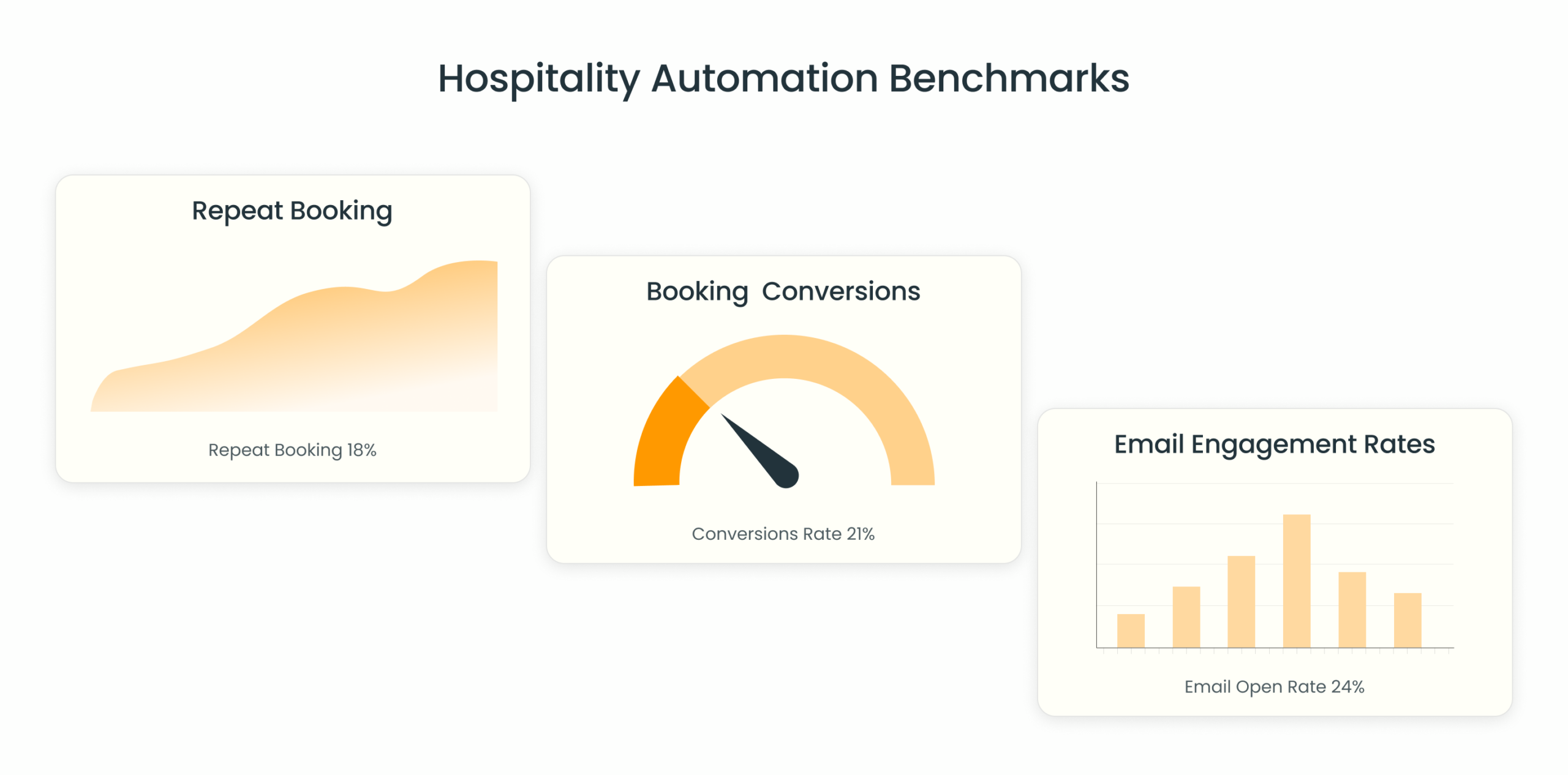
10.1 Key metrics that improve with automation
A well-implemented system impacts multiple performance indicators:
- Email open and click rates by campaign type: Personalised and behaviour-based campaigns significantly outperform generic messaging.
- Conversion rate (Email to Booking): Automated workflows guide guests through the journey, increasing the likelihood of conversion.
- Revenue per email sent: With automated email campaigns for hotels, restaurants, and spas, each communication becomes a revenue opportunity.
- Customer Lifetime Value (CLV): Through lead nurturing automation and re-engagement campaigns, guests return more frequently and spend more over time.
- Repeat booking rate: One of the most important metrics, automation ensures guests stay connected to your brand.
- Time saved on manual marketing tasks: Tasks like confirmations, reminders, and follow-ups are fully automated, improving efficiency.
- Direct booking percentage growth: By nurturing guests directly, businesses reduce reliance on OTAs and increase margins.
- ROI of automation vs manual effort: Automation systems consistently outperform manual marketing in both cost efficiency and scalability.
Most businesses begin seeing measurable improvements within 30–60 days, with significant gains in repeat bookings and customer lifetime value within 90 days.
10.2 Typical performance improvements
While results vary based on implementation quality, most UK hospitality businesses see measurable improvements within the first 60–90 days.
These gains come from consistent, behaviour-driven communication rather than one-time campaigns.
For example, a simple abandoned booking recovery workflow can recover a portion of lost reservations without any additional marketing spend. Similarly, post-stay follow-ups combined with re-engagement campaigns help convert one-time guests into repeat customers.
These improvements compound over time, making automation one of the highest ROI strategies in the hospitality industry.
10.3 Why these results matter
These improvements are not isolated; they compound over time.
For example:
- Higher engagement → better conversion
- Better conversion → more revenue
- More revenue → higher retention investment
This is how customer journey automation transforms marketing from a cost centre into a predictable growth engine.
11. Our marketing automation process
A structured implementation process ensures that automation delivers consistent results. Without a clear approach, businesses risk building disconnected workflows that fail to achieve meaningful impact across the customer journey.
Process:
1. Audit current marketing processes
2. Uncover Top Automation Potential
3. Choose platforms and integrations
4. Build foundational workflows
5. Segment guest database
6. Test and launch campaigns
7. Monitor and analyse performance
8. Optimise and scale workflows
Turn every guest touchpoint into revenue
Transform scattered emails and manual tasks into a seamless automation engine that nurtures guests from browsing to booking to loyalty. Deliver the right message at the perfect moment—automatically—and watch your direct bookings soar.
This process ensures that automation is both effective and scalable from the start.
By following a structured process, businesses can implement automation efficiently while ensuring continuous improvement. This approach turns automation into a long-term growth system rather than a one-time setup.
12. Why UK hospitality needs automation specialists
While automation tools are widely available, implementing them effectively requires both technical expertise and industry understanding. Many hospitality businesses struggle with setup, integration, and optimisation, which limits the potential impact of automation systems.
Key challenges:
- Platform selection (HubSpot, ActiveCampaign, etc.)
- Integration with PMS and booking systems
- Workflow design aligned with guest behaviour
- Ongoing optimisation and performance tracking
Execution, not tools, is where most businesses struggle. This is where a hospitality automation agency in the UK becomes valuable.
ThisRapt focuses on:
- Building end-to-end automation systems
- Implementing revenue-driven workflows
- Optimising performance continuously
Working with specialists ensures faster implementation, better results, and reduced risk.
13. Conclusion
Hospitality marketing automation is no longer a future investment—it is a present-day requirement for businesses that want to grow efficiently and stay competitive in the UK market.
As guest expectations continue to evolve, relying on manual processes leads to missed opportunities, inconsistent communication, and limited scalability. Automation solves this by creating a structured system that delivers personalised engagement, improves retention, and drives predictable revenue.
From automated guest communication to lead nurturing automation and customer journey automation, the right workflows transform one-time visitors into loyal, repeat customers without increasing operational workload. The key is to start with high-impact workflows such as booking confirmations, pre-arrival communication, and post-stay follow-ups, and then scale into a fully integrated system over time.
If you’re ready to move beyond manual marketing and build a system that drives bookings, engagement, and revenue automatically, now is the time to act. In simple terms, hospitality marketing automation helps businesses automate communication, increase repeat bookings, and scale revenue without increasing manual workload.
Book a strategy call with ThisRapt today and discover how a tailored hospitality marketing automation system can turn your marketing into a consistent, revenue-generating engine.
14. Marketing Automation FAQs
Email marketing involves sending one-time campaigns to a broad audience, while marketing automation uses behaviour-based workflows to deliver personalised, triggered communication throughout the guest journey, improving engagement, conversions, and repeat bookings.
Yes, marketing automation for the hospitality industry is highly effective for small businesses, as it reduces manual workload, improves consistency, and enables personalised guest communication without requiring large teams or extensive resources.
Most hospitality marketing automation systems take around 4–8 weeks to implement, depending on complexity, integrations, and workflows. Foundational campaigns can be launched earlier, with ongoing optimisation improving performance over time.
A typical setup includes a CRM platform, automation software, integration tools, communication tools like email or SMS platforms, and analytics systems to manage data, run workflows, and track performance effectively.
Costs vary based on tools and setup complexity, but most UK restaurants invest in monthly software subscriptions and initial implementation. The ROI is typically strong due to increased bookings, improved retention, and reduced manual marketing effort.
Yes, spa marketing automation services help small spas reduce no-shows, automate rebooking campaigns, and improve retention through personalised communication, making it easier to increase customer lifetime value with minimal manual effort.
Hotels should start with booking confirmations, pre-arrival sequences, post-stay follow-ups, and re-engagement campaigns, as these workflows deliver immediate improvements in guest experience, review generation, and repeat bookings.
Marketing automation integrates with hotel PMS through APIs or connectors, allowing guest data, booking details, and behaviour to sync automatically and trigger personalised workflows such as confirmations, reminders, and follow-up campaigns.