Sooner or later every owner of a small hotel, restaurant or spa asks the same question: should we hire someone, or pay an agency? Both can work, and both can waste money. The right answer depends on how much marketing work you actually have, what skills it needs, and how quickly you need it. This guide sets out the real costs, what each option does well, and a short test to help you decide. We are an agency, so we have also been honest about when you should not hire one.
Quick answer
Most single-site venues are better served by a specialist outside the business (an agency or a good freelancer) plus one person in-house who owns the basics. A full-time marketing hire usually only pays off when you have enough steady work, often several sites or a large event or group-booking programme. Use the six-question test below, start with a 90-day trial of whichever route you pick, and judge it on bookings and cost per booking, not activity.
1. What each option really costs
In-house: the salary is not the cost
Recruiter Ashdown Group’s 2026 guide puts the UK median salary at about £35,000 for a marketing executive and about £57,000 for a marketing manager, with London higher. On top of salary, you pay employer National Insurance (15% above £5,000 a year in 2026–27), a pension of at least 3% of qualifying earnings, and the costs people forget: software, training, holiday and sickness cover, and recruitment.
| Role (UK median) | Salary | Employer NI | Pension (3%) | Before software, training and cover |
| Marketing executive | £35,046 | £4,507 | £864 | About £40,400 a year |
| Marketing manager | £56,950 | £7,793 | £1,321 | About £66,100 a year |
Working: NI = 15% of salary above £5,000. Pension = 3% of earnings between £6,240 and £50,270. Many small employers can claim the £10,500 Employment Allowance against NI, which can cut the NI line. Check with your accountant.
Agency: a retainer, plus your own time
Agency prices vary widely, and published guides are rough. One UK compilation from 2026 gives monthly retainers of about £1,000–£3,500 for SEO, £500–£1,500 for Google Ads management and £800–£2,500 for social media, with full-service work starting around £3,500 a month. These exclude VAT and ad spend. Treat them as a starting point and get three quotes. You will also spend your own time briefing, approving and reviewing.
Freelancer or consultant: the middle option
A freelancer or consultant can cost less than an agency and gives you a named person, but you rely on one individual’s availability and skills. They suit a defined job, such as setting up your Google profile, email and tracking, or running ads for a season.
How a small UK hospitality business can choose between hiring in-house, using an agency, or doing both. |
|
2. What each does well, and where it struggles
| In-house hire | Agency | Freelancer | |
| Strengths | Knows your venue, guests, and team. Fast on day-to-day posts, offers, and reviews | Several specialists (search, ads, email, design). Tools and benchmarks across many clients | Named expert, flexible, often lower cost |
| Weak spots | One person rarely masters search, ads, email, and design. Cover when they leave or are off | Less feel for your venue unless well briefed. Needs a clear brief and regular review | Single point of failure. Capacity can be limited |
| Speed to start | Slow: recruit, notice period, onboarding | Fast: weeks | Fast: days to weeks |
| Flexibility | Fixed cost all year, even in quiet months | Contracts vary: check notice periods | Usually the most flexible |
| Best for | Several sites, steady high-volume work | Single sites needing a range of skills | Defined projects and short-term cover |
3. A six-question test
Answer these honestly. Each answer points one way.
- How many hours of marketing work do you really have each week? Under about 15–20 hours rarely justifies a full-time hire. Over 35 might.
- How many different skills do you need? Search, ads, email, design, photography, and reputation all matter. One person seldom covers all of them well.
- How soon do you need results? An agency or freelancer can start in weeks. A hire can take months to recruit and settle.
- Who will manage the work? An in-house marketer still needs someone to set goals and review results. So does an agency. Without a manager, either option drifts.
- How steady is demand? If your quiet months are very quiet, a fixed salary hurts. A flexible retainer or project fee may fit better.
- Can you afford a mistake? A bad hire is costly and slow to fix. A bad agency fit is usually cheaper to end, if the contract allows it.
4. Which option usually fits which venue
Illustrative guidance, not a rule. Your own numbers from the test come first.
| Venue | Often a good fit | Why |
| Single café or restaurant | Owner or manager owns the basics, with a freelancer for ads or email | Low allowable cost per booking. Mostly free and low-cost channels |
| Independent hotel, 10–30 rooms | Agency or consultant for search, ads, and booking page, plus one person in-house for reviews and content | Higher booking value, many skills needed, workload uneven |
| Spa or wellness venue | Freelancer or agency on a project basis, plus staff for social and offers | Seasonal peaks, defined campaigns |
| Group of 3–5 venues | In-house marketer or manager, supported by specialists | Enough steady work to keep one person busy |
5. The hybrid that works for many small venues
For many single-site owners, the best answer is a split:
One person in-house (maybe part of someone’s role) owns the basics: replying to reviews, posting offers, updating your Google profile, and answering enquiries. They know your venue best. An outside specialist owns the technical work: search, paid ads, tracking, and email set-up. They bring skills you would struggle to hire for. One person sets the goals and reviews results monthly. That is usually you or your general manager.
Our guide on how much to spend on marketing shows how to set a budget cap for each layer, and our marketing ROI guide shows how to judge the results.
Not sure whether to hire or outsource?
ThisRapt works exclusively with UK hospitality SMEs on search, AI visibility and direct bookings. Book a free consultation and we will give you an honest view of what your venue needs, even if the answer is not an agency.
6. If you hire an agency: eight questions to ask first
- Who will actually work on our account, and how much of their time do we get?
- Have you worked with hotels, restaurants, or spas like ours? Can we speak to a client?
- What exactly is included in the retainer, and what costs extra, including ad spend?
- How will you report, and which numbers will you share: bookings, enquiries, and cost per booking, not just clicks and impressions?
- Who owns our website, ad accounts, Google profile, and data? Can we access them at any time?
- What is the minimum contract and notice period?
- What would you fix first, and what would you not recommend?
- How will you work with our team day-to-day?
Be wary of guaranteed rankings, long lock-in contracts with no exit, reports full of impressions with no bookings, and any agency that will not give you access to your own accounts.
7. If you hire in-house: what to get right
- Write the job around outcomes (bookings, reviews, repeat guests), not a list of tools.
- Budget for the extras: software, training, and some outside specialist help, because one person cannot do everything.
- Cover plan. What happens when they are on holiday or leave?
- Give them a manager and a monthly review. Without one, even a good hire drifts.
See our tracking and automation tools guide for the tools a marketing hire will need.
8. Run a 90-day trial, whichever way you go
- Before you start: record your baseline: direct bookings, enquiries, review count, and where bookings come from.
- Agree three goals with a number and a date for each.
- Check every month: what changed, what it cost, and what you will do next.
- At day 90, decide: keep, change, or stop. If you cannot show a clear link to bookings, adjust the plan before you spend more.
9. Common mistakes
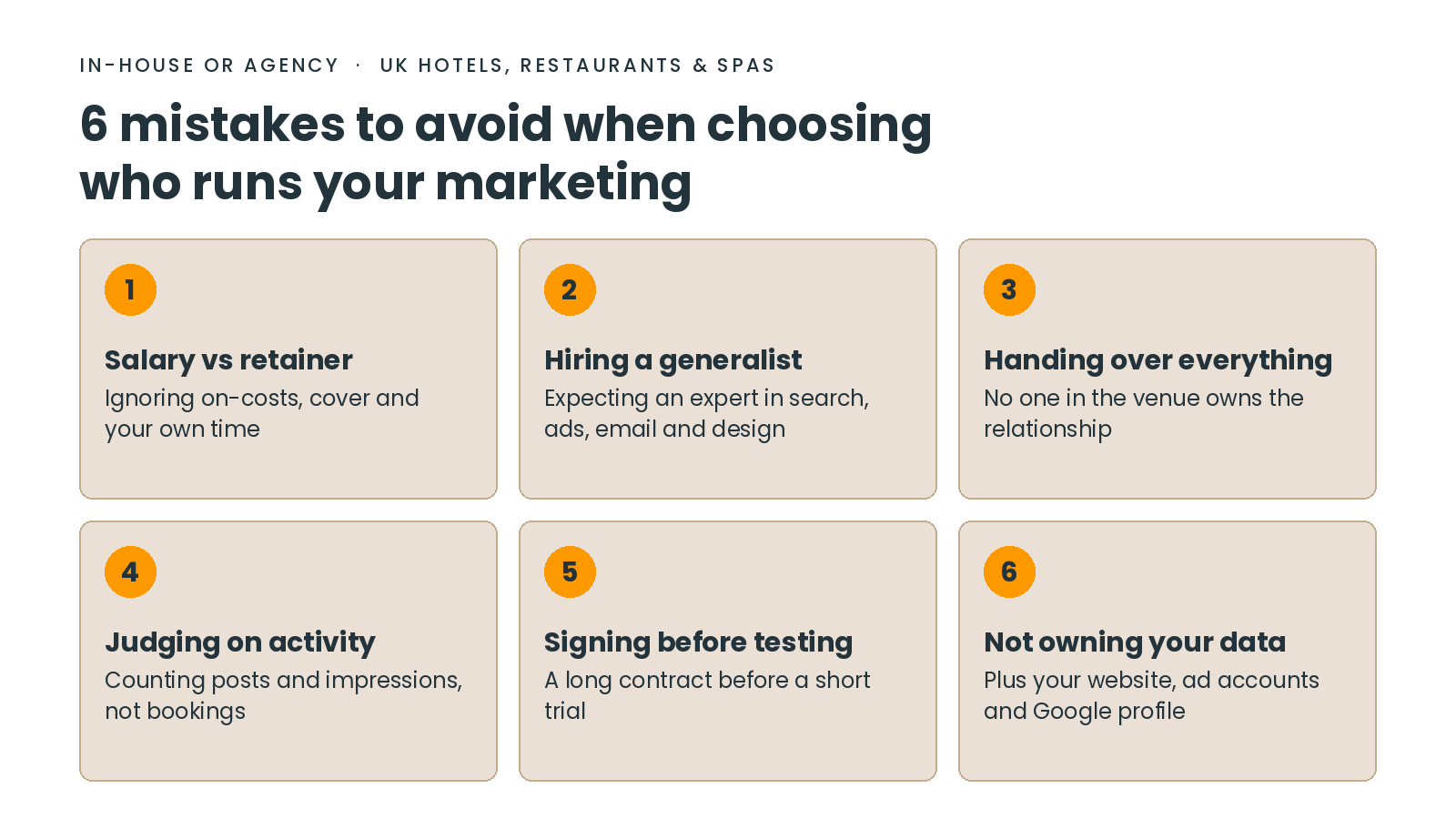
- Comparing salary with retainer and ignoring on-costs, cover, and your own time.
- Hiring a generalist and expecting an expert in search, ads, email, and design.
- Handing over everything to an agency without anyone in the venue who owns the relationship.
- Judging on activity (posts, impressions) rather than bookings and cost per booking.
- Signing a long contract before a short trial.
- Not owning your accounts, website, or data.
10. Key takeaways
- A marketing manager in the UK costs roughly £66,000 a year before software, training, and cover. An executive is closer to £40,000.
- Agency retainers vary widely. Get three quotes and ask what is included.
- Many single-site venues do best with a hybrid: one person in-house for the basics and a specialist outside for the technical work.
- Use the six-question test, then run a 90-day trial and judge on bookings.
- Always keep ownership of your website, ad accounts, Google profile, and data.
Next, read our hospitality marketing guide for small businesses for the bigger picture.
Sources: Ashdown Group, Marketing Salary Guide 2026; GOV.UK, Rates and thresholds for employers 2026 to 2027; whito.co.uk, UK agency retainers (compiled January–May 2026). We are an agency, so weigh our view accordingly.
11. Frequently asked questions
It depends on workload. A full-time hire costs salary plus employer National Insurance, pension, software, training and cover, which for a manager at the UK median is roughly £66,000 a year. An agency retainer can cost less for a small venue, but you also spend your own time managing it. Compare the full cost, not just the headline.
Published guides vary widely. One 2026 UK compilation gives about £1,000–£3,500 a month for SEO, £500–£1,500 for ad management and £800–£2,500 for social media, with full-service from around £3,500, all excluding VAT and ad spend. Get at least three quotes and ask exactly what is included.
Usually not for a single site, unless you have enough steady work to keep one person busy, such as several venues or a large events programme. Most small venues do better with a specialist outside the business and one person in-house who owns the basics.
An agency gives you a team with several skills and tools, while a freelancer gives you one named person, often at lower cost and with more flexibility. Freelancers suit defined projects. Agencies suit ongoing work that needs several skills.
Ask who will do the work, what is included, how results are reported and who owns your accounts. Be wary of guaranteed rankings, long lock-in contracts, and reports that show impressions but not bookings.
Yes, and it is often the best option for small venues. Keep the day-to-day basics, such as reviews, offers and your Google profile, in-house, and use a specialist for search, ads, tracking and email. Make sure one person sets goals and reviews results each month.
Give it at least 90 days with clear goals set at the start. Paid ads can show results quickly, but search, reviews and email take longer. Judge on bookings, enquiries and cost per booking, not activity.