

Hotels lose up to 30% of potential marketing revenue when campaigns go untracked. In 2026, the tracking challenge has moved beyond simply “adding Google Analytics” — third-party cookies are functionally gone across Chrome, Safari, and Firefox, and hotels relying on browser-based tracking alone are now losing 25–35% of real conversion data before they even see it. The fix is a layered stack: server-side tracking to capture what cookies miss, AI-powered attribution to make sense of long, multi-device booking journeys, and unified reporting that ties every channel back to actual RevPAR — not vanity metrics.
This guide covers the essential hotel marketing metrics to track, the tools that track them, and — critically — the cookie-less, AI-driven tracking infrastructure most hotel marketing guides still haven’t caught up to.
1. Why tracking fails most hotels: The cookie-less reality
Here’s the problem most hotel marketing tools guides don’t mention: third-party cookie deprecation is no longer a future concern – it’s already happened.
| Your complete guide to digital marketing tracking and automation tools starts here. Let’s dive into:: |
|
Chrome completed its phase-out through 2024–2025, joining Safari and Firefox, which blocked third-party cookies years earlier. Combined with consent rejection, this now affects the majority of web traffic across major browsers.
What this means practically for a hotel: if your tracking still relies solely on browser pixels (a Meta pixel, a Google Ads tag, a GA4 cookie), you are structurally unable to see a large share of your actual bookings. Server-side tracking – capturing the conversion event on your own server and sending it directly to ad platforms and analytics tools – captures 25–35% more conversions than pixel-only setups, simply by bypassing ad blockers, iOS restrictions, and cookie rejection.
The three-layer fix for 2026:
- Server-side tagging (via Google Tag Manager’s server container, or a dedicated platform) — captures the booking event at the source, not in the guest’s browser
- First-party data collection — your own PMS, CRM, and booking engine data, which no privacy change can take away from you
- AI-assisted attribution modelling — machine learning fills the gaps for anonymous, cross-device guest journeys that deterministic tracking can no longer fully capture
Hotels that skip this shift aren’t just missing a “nice to have” — they’re making budget decisions on incomplete data, typically underreporting the true performance of paid social and remarketing campaigns specifically, since those rely most heavily on browser-based signals.
2. Essential hotel marketing metrics to track
A winning marketing automation strategy starts with a simple principle: what gets measured gets managed.
(i) Website Traffic & Conversion Rates
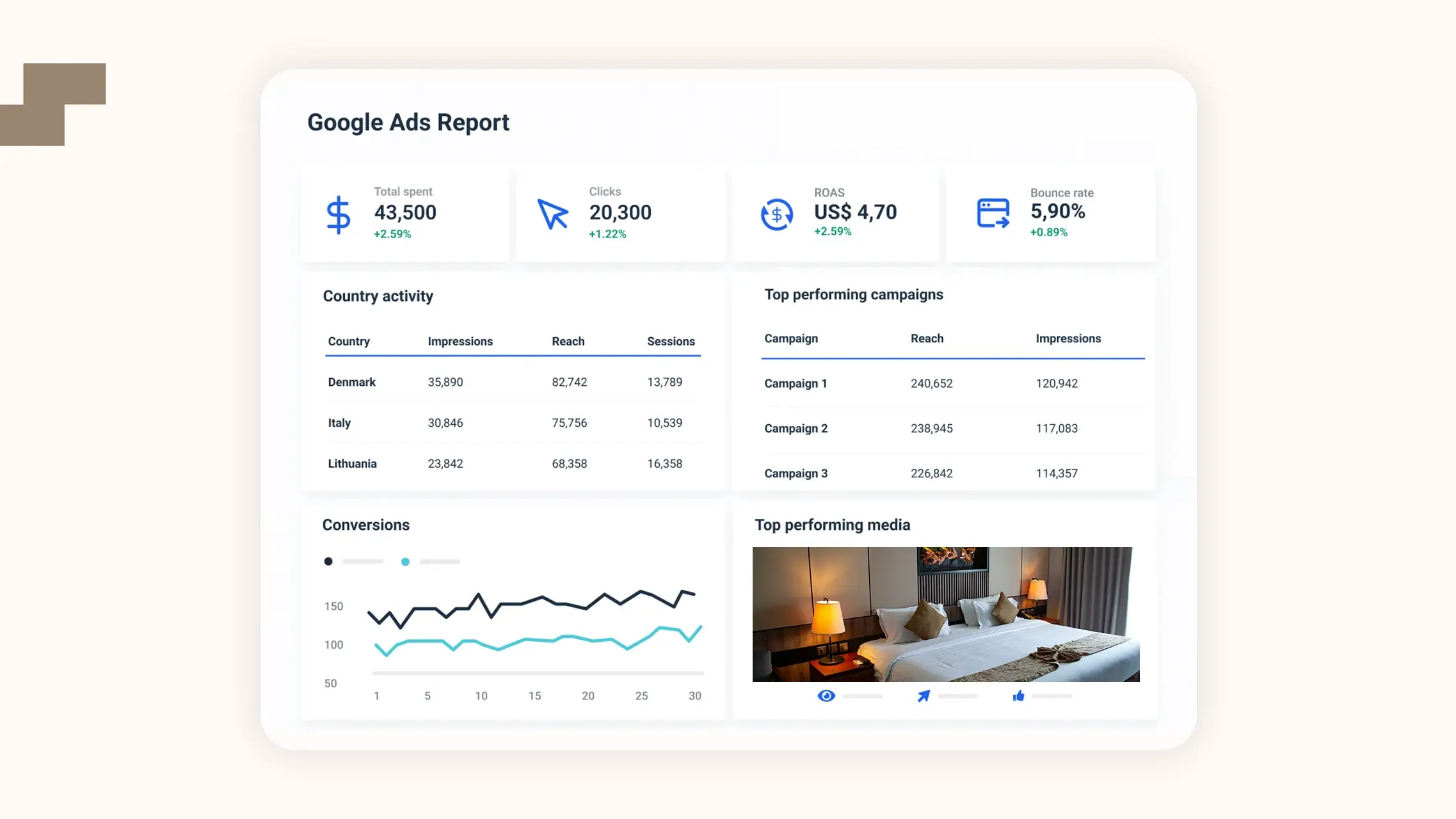
Track visits, sessions, bounce rate, and booking completion via GA4. A well-optimised hotel site converts at roughly 3–5%; anything below that signals a UX or messaging problem.
(ii) Direct vs. OTA Bookings
Use PMS or channel manager analytics to see the real split. Direct bookings avoid OTA commissions of 15–25% (often higher with promotional placements), so shifting this ratio has a direct, compounding effect on margin.
(iii) RevPAR (Revenue per Available Room)
ADR × Occupancy Rate remains the universal barometer of hotel performance. Tools like OTA Insight or Revinate tie RevPAR shifts back to specific campaigns and pricing changes.
(iv) Customer Acquisition Cost (CAC) & Return on Ad Spend (ROAS)
CAC = total marketing cost ÷ new guests acquired. ROAS = revenue ÷ ad spend. Without channel-level breakdowns, hotels routinely overspend on underperforming campaigns simply because no one can see which channel is actually underperforming.
(v) Email Marketing Metrics
Open rate, click-through rate, and booking conversion — but treat open rate as directional only. Apple’s Mail Privacy Protection and similar client-side privacy features now inflate reported opens, so click-to-open rate and revenue-per-email are more reliable signals for retention and upsell performance.
(vi) Social Media Engagement & Reach
Impressions, reach, and engagement are tied to conversions via server-side event tracking rather than pixel-only attribution, which increasingly undercounts social-driven bookings.
(vii) Online Reputation & Review Metrics
Average rating, sentiment trend, and review volume. Raising a Google rating by 0.2 stars can lift conversion by roughly 6%, making reputation tracking a direct revenue lever, not just a brand exercise.
(viii) Search Engine Rankings & Visibility
Keyword rankings (e.g., “boutique hotel in [city]”), click-throughs, and crawl errors — increasingly alongside visibility in AI-generated answers (Google AI Overviews, AI Mode), which traditional rank trackers don’t yet fully capture.
3. Web analytics & performance tracking tools
a. Google Analytics 4 (GA4)
Set up event-based tracking: “Search availability,” “Room selection,” “Checkout start,” “Booking complete,” “Contact form submit.” Hotels using event-based tagging typically see meaningful improvements in booking conversion visibility within 90 days.
2026 update: Enable Google signals and GA4’s enhanced measurement features, which use aggregated, modelled data to maintain visibility as cookie-based tracking degrades. This is now a baseline setup step, not an optional extra.
Key reports to monitor: conversions by channel, funnel abandonment, session duration, new vs. returning users.

b. Google Search Console (GSC)
Monitoring search performance:
Track impression volumes, clicks, and position for phrases like “boutique hotel in [city]”.
Identifying SEO issues:
GSC flags mobile usability, page speed, crawl errors, and duplicate content—issues that hamper visibility.
Pro Insight:
Hotels fixing 90% of crawl errors in GSC often see a 20% lift in organic traffic in 2–3 months.
c. Google Tag Manager (GTM)
Simplified tracking implementation:
Remove reliance on developers. Add tags for ads, chat, heatmaps, and conversion events through GTM.
Event tracking for performance:
Capture scrolls, button clicks, video plays, and simulated bookings—all tied back to UTM parameters for attribution.
d. Heat Mapping Tools: Hotjar / Crazy Egg
Visual insights into user behavior:
These tools show how guests scroll, where they click, and what they ignore.
Optimise booking funnels:
If button clicks drop off mid-page, test moving your “Book Now” CTA earlier. A hotel client raised form submissions by 27% after redesigning based on heatmap data.
Live session recordings:
Observe real users interacting with your website, revealing technical or UX issues.
e. Combining Tools for Maximum Impact
A clear analytics stack for hotels:
These online marketing tracking tools provide a digital marketing baseline revealing where your website is converting, leaking, or underperforming, and informing your marketing automation strategy moving forward.
4. Revenue & booking analytics tools
Measuring website performance is only the surface; true ROI comes from tying metrics to real revenue. Let’s explore systems that bridge marketing and bookings:
a. Property Management System (PMS) Analytics
Common hotel PMS tools such as Opera, Cloudbeds, and RoomRaccoon offer dashboards with:
– Booking source breakdown (website vs OTA vs walk-in)
– Average stay length
– Cancellation rates
– Room-value segmentation
Integration benefit:
Connect PMS to your GA4 via APIs or platforms like Zapier to push booking data into dashboards, enabling analysis of marketing channel performance end-to-end.
b. Channel Manager Analytics
Tools like SiteMinder and RateTiger provide granular insights into each distribution channel:
– Booking volume by channel
– Rate parity grant check
– Commission cost
– Length of stay trends
Why it matters:
If promotion spikes on Booking.com but lowers RevPAR due to discounted pricing, channel manager data helps quantify the trade-off.
c. Business Intelligence Platforms
Advanced BI systems (e.g., Duetto, OTA Insight, Revinate) pull together PMS, OTA, and website funnels to create:
– Revenue forecasts
– Occupancy projections
– Competitor rate benchmarking
– Personalised pricing suggestions
Value proposition:
Hotels using BI platforms for pricing optimization consistently hit 5–12% higher RevPAR YoY.
d. AI-Powered Predictive Analytics
This is where 2026 tooling has moved fastest. Machine-learning models now forecast cancellation risk and booking pace well enough to trigger timely, targeted campaigns — an email nudge to a guest showing cancellation-risk signals, for example — automatically, rather than through manual review.

5. Digital marketing campaign tracking (and the attribution layer most hotels skip)
a. Social media analytics
Facebook Ads Manager, Instagram Insights, and LinkedIn Campaign Manager remain useful on their own, but their native pixel tracking is exactly the layer degraded by cookie deprecation and iOS restrictions. Feeding this data through server-side conversion APIs — Meta’s Conversions API and Google’s Enhanced Conversions are the current standard — meaningfully improves what these platforms can actually attribute.
b. Email marketing platforms
Mailchimp, Klaviyo, and Campaign Monitor track open/click rates, booking conversion from email, and segment performance. Behavioural-trigger emails (abandoned booking, past-stay anniversary) consistently outperform generic blasts by a wide margin.
c. Paid advertising tools
Google Ads, Microsoft Ads, and Meta Ads Manager remain core channels — but in 2026, connect them to server-side conversion tracking rather than relying on browser pixels alone, or you will be optimising budget allocation against incomplete data.
d. Cookieless, AI-Powered attribution – The missing layer
This is the single biggest gap in most hotel marketing tech stacks. Purpose-built cookieless attribution platforms (Cometly, Triple Whale, Rockerbox, Segment, and similar tools) combine:
- Server-side data collection — captures conversions, cookies, and pixels that are missed entirely
- First-party pixel/identity resolution — stitches anonymous, cross-device guest journeys together without relying on third-party cookies
- AI-driven attribution modelling — machine learning fills gaps for opted-out users and cross-device breaks, and feeds enriched conversion data back to ad platforms, improving their own targeting algorithms over time
- Offline/online blending — some platforms (Rockerbox) even correlate offline channels like local radio or print with website traffic spikes, useful for destination hotels running regional campaigns
Why this matters for a hotel specifically: the hospitality booking journey is long — often weeks between inspiration and booking, across multiple devices. This is exactly the scenario where cookie-based, single-touch attribution most badly undercounts real performance, and where AI-assisted multi-touch modelling adds the most value.
A practical note on accuracy: identity-graph based matching now typically achieves 70–85% accuracy, fingerprinting 60–75%, and probabilistic modelling 50–65% — all lower than the 85–90% cookies once delivered, but the difference is that server-side methods capture conversions cookies never saw at all (ad-blocked users, iOS devices, cross-device paths), so the net picture is often more complete despite lower per-method precision.
6. Reputation & review management tools
a. Review Aggregators: ReviewPro & Revinate
Monitor reviews across OTAs, Google, and TripAdvisor, flag negative reviews for rapid response, and track sentiment over time. Hotels improving response rates meaningfully often see average score gains within six months.
b. Google Business Profile & TripAdvisor Analytics
Track views, clicks, map vs. discovery search share, and photo performance. Active, complete profiles generate materially more direct contact enquiries — and, per the AI Mode shift reshaping hotel discovery, a complete profile is now also one of the core inputs AI systems read before recommending a property at all.
c. Sentiment & Competitive Analysis
AI-based tools like GuestRevu and Podium benchmark emotional tone in reviews against local competitors, surfacing patterns a manual read-through would miss.
7. All-in-one marketing analytics platforms
When data lives in five different dashboards, insight suffers. HubSpot, Salesforce Marketing Cloud, and Adobe Analytics unify email, ads, CRM, and website data under one roof:
- HubSpot CRM/Marketing Hub — combines email, ads, forms, and web analytics with built-in multi-touch attribution; scales from boutique to enterprise
- Salesforce Marketing Cloud — streamlines email, SMS, ads, and CRM data with blended reporting and automation
- Adobe Analytics — suited to larger portfolios needing advanced path analysis
For independent hotels wanting multi-channel analytics at lower cost, Zoho Marketing Hub and Brevo offer a lighter-weight alternative that still centralises the core data sources.
Implementation guide & best practices
- Audit existing tools and data sources (PMS, website, ad platforms)
- Define 3–5 top KPIs (bookings, CAC, ROAS, review score)
- Map data sources to reporting tools and attribution flows
- Prioritise server-side tagging setup before adding more dashboards — this is the 2026 foundation step most hotels skip
- Choose a tool stack based on budget; start small, expand deliberately
- Install and QA tags, integrations, and attribution paths
- Train the team on dashboards and the specific actions each metric should trigger
Practical tips:
- Use consistent UTM parameters across every channel
- Document tag triggers in GTM (client-side and server-side)
- A/B test booking CTAs based on heatmap findings
- Benchmark metrics monthly, not quarterly — cookieless attribution data shifts faster than legacy cookie-based baselines did
8. Free vs Paid Tools Comparison
| Need | Free Tools | Paid Upgrade |
|---|---|---|
| Web Analytics | RGA4 + GTM | Heatmaps (Hotjar/CrazyEgg) |
| SEO Monitoring | GSC | SEMrush, AHRefs |
| Booking Data | Standard PMS | Duetto, OTA Insight |
| Campaign Attribution | UTM + GA4 | Ruler Analytics, Wicked Reports |
| Email & Automation | Mailchimp Free Plan | Klaviyo, ActiveCampaign |
| Review Monitoring | Manual review check | ReviewPro, Revinate |
| All-in-One Suites | None | HubSpot, Salesforce, Adobe Analytics |
ROI note: a modest monthly investment in a proper analytics and attribution stack typically pays for itself several times over within six months through better ad spend allocation, improved booking-funnel conversion, and stronger review-driven visibility — but only once server-side tracking closes the conversion gap that pixel-only setups now leave open.
9. Conclusion
Effective hotel digital marketing in 2026 isn’t just about adding more dashboards — it’s about closing the gap that cookie deprecation has opened in every hotel’s tracking stack. Combining event-based web analytics, PMS and revenue data, server-side and AI-powered attribution, and reputation intelligence gives you a genuinely complete view of what’s driving bookings, not a partial one distorted by browser privacy restrictions.
Smaller hotels can start with free foundational tools, but the properties pulling ahead in 2026 are the ones layering in server-side tracking and AI-assisted attribution early — before their competitors close that same gap.
Ready to Get Started?
Let our expert team build your personalized marketing automation strategy and robust analytics layer
10. FAQs
GA4 is still essential, but on its own it relies heavily on browser-based tracking, which now misses a significant share of conversions due to cookie deprecation across Chrome, Safari, and Firefox, plus rising consent rejection rates. Pairing GA4 with a server-side GTM container and first-party data sources closes most of that gap.
Server-side tracking captures the booking event on your own server rather than relying on a browser pixel, which means it isn’t affected by ad blockers, iOS restrictions, or cookie rejection. It’s valuable at any property size, since even small hotels lose real conversion data to the same browser restrictions large chains face — the difference is usually implementation complexity, not necessity.
Untracked or fragmented tracking can obscure up to 30% of potential marketing revenue, largely because budget stays allocated to channels that look like they’re underperforming simply because their real conversions aren’t being captured.
Cookie-based attribution uses a single browser identifier across a session, which is shared across devices and disappears when cookies are blocked or deleted. AI-powered attribution uses machine learning to model likely conversion paths from server-side events, first-party data, and identity resolution, filling gaps that deterministic cookie tracking can no longer cover.
Direct vs. OTA booking split, RevPAR by campaign, and click-to-open rate on email (rather than open rate alone) give the clearest picture of both profitability and real guest engagement without requiring a large tool stack.
They cover foundational web and SEO tracking well, but they don’t solve the attribution gap created by cookie deprecation. Most small hotels benefit from adding at least one server-side or first-party attribution layer alongside free tools, even on a modest budget.
Foundational fixes like event-based GA4 tagging and crawl error cleanup often yield measurable improvements within 2–3 months. Attribution and automation gains from a fuller stack (server-side tracking, AI-assisted modelling) typically compound over 3–6 months as more data accumulates.









This is brilliant. Simple and to the point.
There is noticeably a bundle to find out about this. I assume you made certain nice points in options also.
Bravo, you were visited with simply excellent idea.