Think about what your best receptionist did last Tuesday. Somewhere between welcoming guests and solving problems, they probably rewrote the same pre-arrival email, tidied a set of handover notes, and drafted a reply to a review. That is valuable time spent on work an AI draft could start for them.
This guide shows UK hotel teams how to use ChatGPT, or any similar AI assistant, for that repeat admin. You will get a simple briefing framework, eight prompts to copy and adapt, and the data-protection and accuracy rules to set before anyone on your team uses them. For the wider picture, see our guide to AI in the hospitality industry.
Quick answer
ChatGPT prompts for hotels work best when you give the AI your real facts, one clear task, and a check rule: “use only the facts given and mark anything missing as [CHECK]”. Start with one repeatable task, such as pre-arrival emails, keep guest personal data out of the prompt, and have a person approve every message before it reaches a guest.
1. Why admin is the best place for a hotel to start with AI
Most hotel teams lose time to jobs that follow a pattern: pre-arrival emails, review replies, shift handovers, owner reports and event proposals. They repeat, but each one still needs your hotel’s facts, standards, and voice. That is why generic AI output often disappoints. The fix is not a cleverer tool. It is better input.
| A UK hotel team's guide to ChatGPT prompts: from guest emails to a reusable assistant. |
Admin is also a safe place to begin. The work is internal or semi-internal, so a mistake is caught before a guest sees it. And you can measure the result in minutes saved each week, which makes it easier to decide what to try next. Your team keeps the judgement, warmth, and decisions. The AI prepares the first draft.
2. The five-part hotel brief for any ChatGPT prompt
Most disappointing AI output comes from thin instructions. A five-part brief fixes that, and you can reuse it for almost any task.
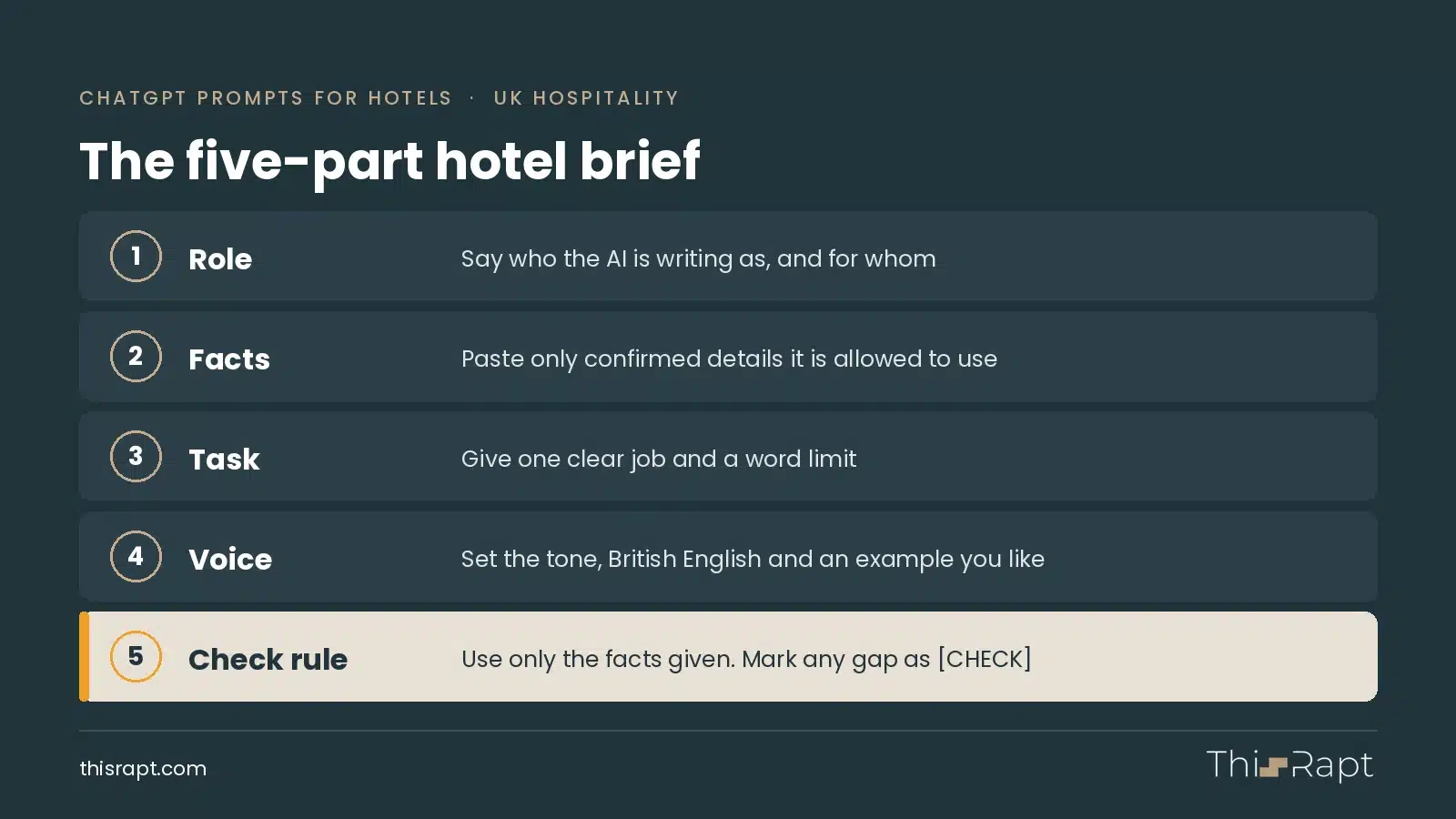
| Part | What to include | Example |
|---|---|---|
| 1. Role | Who the AI is writing as, and for whom | You are the front office manager at a 30-room hotel in York. |
| 2. Facts | Only confirmed details it may use | Check-in is from 3 pm. Parking is £12 a night. Breakfast is from 7:00 to 9:30. |
| 3. Task | One job and a word limit | Write a pre-arrival email of no more than 120 words. |
| 4. Voice | Tone, language and a sample you like | Warm and concise, British English. Match the sample below. |
| 5. Check rule | A stop on guessing | Use only the facts given. Mark anything missing as [CHECK]. |
The check rule does the most work. Without it, an AI assistant will often fill gaps with plausible-sounding details, such as a transfer price or a late-checkout policy you never offered. With it, a gap becomes a visible [CHECK] flag for your team to resolve, rather than a promise someone has to undo later.
3. Eight ChatGPT prompts for hotels you can copy and adapt
Replace anything in [square brackets]. Keep the check rule in every prompt. Remove guest names and contact details before you paste anything in.
Prompt 1: Pre-arrival email
Front office. Use it for every booking type, then save the version your team likes.
Copy and adapt
You are the front office manager at [hotel name], a [type] hotel in [town]. Write a pre-arrival email to a guest arriving on [date] for [number] nights. Facts: check-in from [time]; parking [details]; breakfast [times and place]; one local tip: [tip]. Tone: warm and concise, British English, no more than 120 words. Use only the facts given. Mark anything missing as [CHECK]. Do not invent prices, times, availability, policies or allergen information.
Prompt 2: Reply to a difficult review
Reputation. Pair it with our guide to hotel review management.
Copy and adapt
Draft a reply to this guest review for [hotel name]. Review: [paste review with the guest’s name removed]. What we know happened: [facts from the manager’s notes]. What we are offering: [specific action, or ‘nothing yet’]. Tone: calm, specific and non-defensive, under 130 words, no excuses. Leave any decision on compensation to me. Use only the facts given. Mark anything missing as [CHECK]. Do not invent prices, times, availability, policies or allergen information.
Prompt 3: Shift handover
Operations. Turns messy notes into something the next team can act on.
Copy and adapt
Turn these rough notes into a handover for the [morning] team. Group them under: arrivals and departures, guest requests, maintenance, and decisions needed. Put urgent items first and keep it to one screen. Notes: [paste notes]. Use only the facts given. Mark anything missing as [CHECK]. Do not invent prices, times, availability, policies or allergen information.
Prompt 4: Event enquiry to proposal
Reservations and sales. Saves rereading a long email thread.
Copy and adapt
Here is an email thread about an enquiry for [event]. Summarise what the client has asked for, what we have quoted and what is still undecided. Then draft a one-page proposal using only the confirmed rates and room details below. Rates and rooms: [paste]. Thread: [paste with personal details removed]. Use only the facts given. Mark anything missing as [CHECK]. Do not invent prices, times, availability, policies or allergen information.
Prompt 5: Owner or GM monthly summary
Revenue. Turns the numbers into a readable story, without inventing causes.
Copy and adapt
Here are this month’s figures against last year: occupancy, ADR and RevPAR [paste table]. Write a plain-English summary of about 150 words for the owner: what changed, reasons the data supports, and three questions we should look into. Do not state a reason the data does not support. Use only the facts given. Mark anything missing as [CHECK]. Do not invent prices, times, availability, policies or allergen information.
Prompt 6: Repeat-guest email
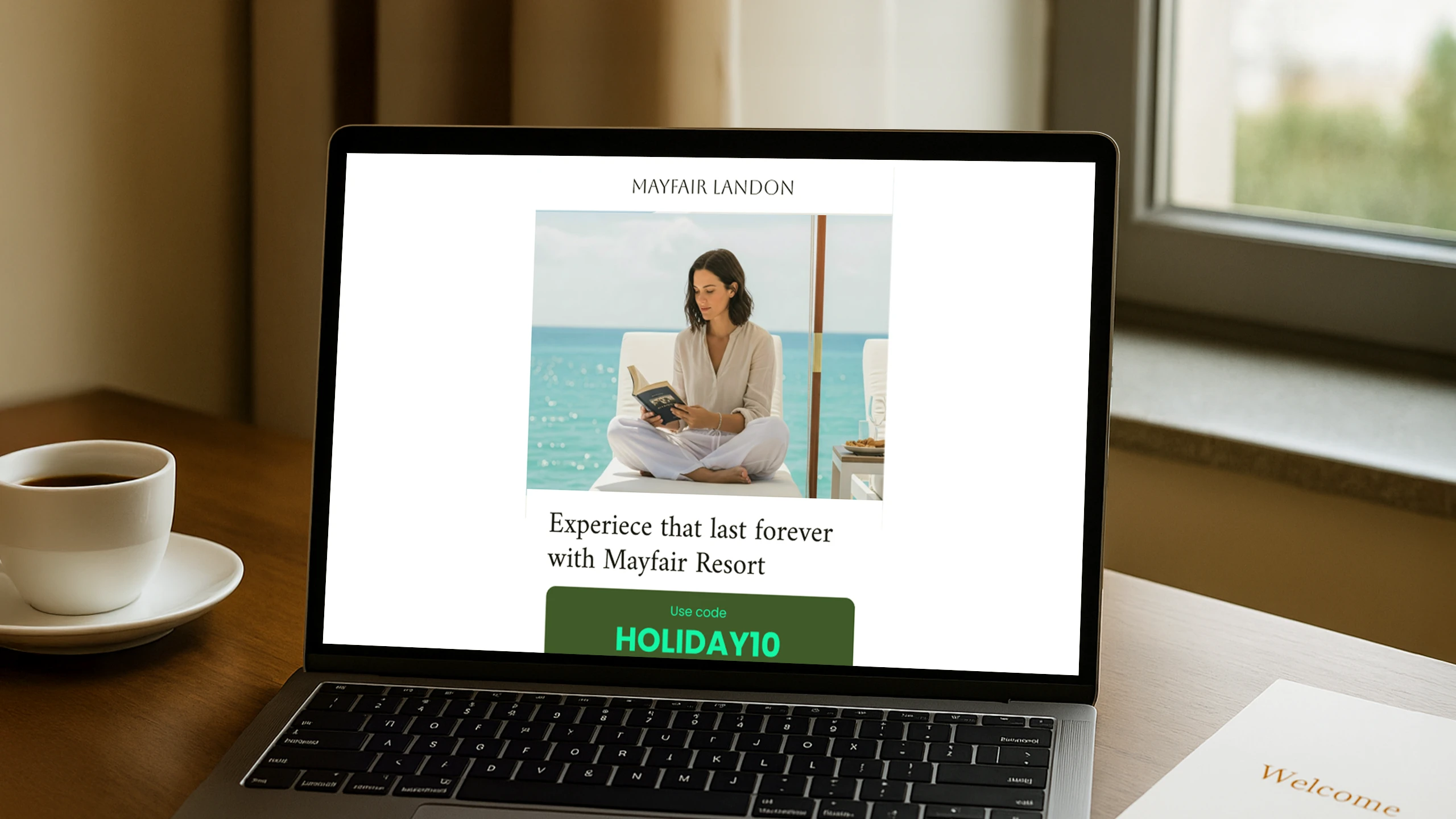
Marketing. A first draft for your hospitality email marketing, ready for a manager to approve.
Copy and adapt
Write a short email to guests who stayed with us in [season] last year, inviting them back. Facts: [offer or reason to return, dates, how to book]. Tone: friendly and personal, no pressure, under 110 words, one clear call to action. Do not mention anything about their previous stay. Use only the facts given. Mark anything missing as [CHECK]. Do not invent prices, times, availability, policies or allergen information.
Prompt 7: Menu change briefing
Food and beverage. Gets front-of-house ready for guest questions.
Copy and adapt
Turn this week’s menu changes into a briefing for front-of-house: what is new, a one-line description of each dish, and questions guests may ask. For every dish, write [CHECK: allergens from the recipe sheet] instead of listing allergens. Menu changes: [paste]. Use only the facts given. Mark anything missing as [CHECK]. Do not invent prices, times, availability, policies or allergen information.
Prompt 8: Housekeeping procedure in plain English
Operations. Makes a procedure easier to follow and train from.
Copy and adapt
Rewrite this housekeeping procedure as a numbered checklist of no more than 12 steps in plain English. Mark any step that depends on our equipment or products with [CHECK]. Procedure: [paste]. Then suggest a short version in [language] that a native speaker on our team can review before anyone uses it. Use only the facts given. Mark anything missing as [CHECK]. Do not invent prices, times, availability, policies or allergen information.
More tasks worth trying beyond the eight prompts
- HR: a first draft of a job advert or interview questions, with no personal staff details included.
- Finance: a plain-English summary of a cost variance or supplier terms, checked by a person before it is used.
- Training: a short quiz built from one of your own procedures.
- Multilingual teams: a staff notice in two languages, reviewed by a native speaker before it goes out.
Want your hotel found when guests ask AI where to stay?
ThisRapt works exclusively with UK hospitality SMEs on search, AI visibility and direct bookings. Book a free consultation to see where your hotel stands today.
4. Turn your best briefs into a reusable hotel assistant
Once a brief works, stop pasting the same facts every time. Most AI tools let you save standing instructions and reference documents in one place, for example, as a project or a custom assistant. Names and features vary by product and plan, so check what yours offers. Set one up for your hotel and store four things:
- Approved facts: room types, check-in and check-out times, parking, breakfast times and policies.
- Your voice: three sample emails you are proud of, and any words or phrases you never use.
- Standard answers: common guest questions with the replies your manager has approved.
- Your rules: the check rule, no allergen information, and no promises about compensation.
Each task then starts with one line, such as “Write the pre-arrival email for a guest arriving on Friday”, instead of a full brief. Some tools also let you save a repeatable routine, such as a handover template, that your team can run in one step. Review the stored facts every month, because outdated information leads straight to wrong answers, and keep guest personal data out of the stored files as well.
5. What to keep out of your prompts: data protection for UK hotels
Guest information is personal data under UK data protection law, so how you use AI tools matters as much as what you ask them. This is general guidance, not legal advice. Check your own position with your data protection lead or adviser.
- Leave out names, contact details, booking references and payment details. Use placeholders such as “Guest A”.
- Keep health information out too, including accessibility or dietary needs linked to a named guest.
- Use a business or team account, and check the provider’s settings on whether your inputs may be used to train models. These settings differ between products and plans.
- Never rely on AI for allergen information, safety procedures, or legal wording. These must come from your verified records.
- Add AI use to your staff guidance: what is allowed, what is not, and who approves any guest-facing message.
- Read the Information Commissioner’s Office guidance on AI and data protection. If you plan to process guest data with AI at scale, you may need a data protection impact assessment first. Our guide to guest data personalisation for hotels covers using guest data well.
6. How to roll out AI in your hotel in four weeks
- Pick one repeat task, such as pre-arrival emails, and time how long it takes now.
- Build the five-part brief and test it on real examples with the personal details removed. Save the version that works.
- Share the brief with the team and agree who approves what before it reaches a guest.
- Compare the time taken, keep what works, and add one more task.
Save your best briefs in one shared place so new staff start from them. If a task is stable and repeated, consider whether it belongs in an automated workflow. Our hospitality marketing automation guide explains where to begin. For guest-facing chat, see how to make hotel chatbots sound human.
7. Beyond admin: being found when guests ask AI where to stay
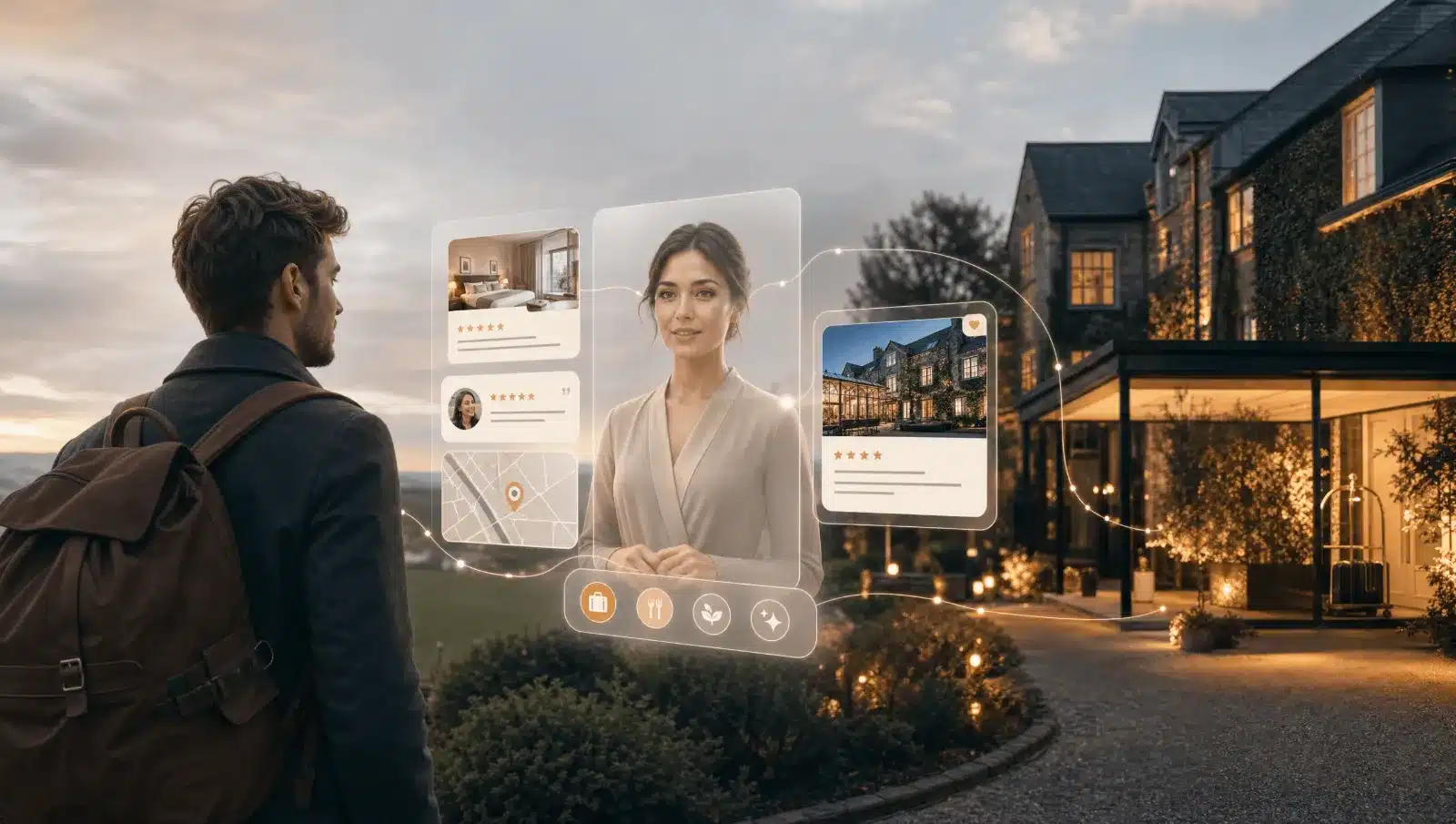
Your team is not the only one using AI. Guests increasingly ask AI tools for hotel suggestions, and those tools draw on what is published about your hotel across your website, Google Business Profile, and review sites. If those facts are inconsistent, the answers about you may be too. Keeping your information accurate is the foundation for both. Our guide to GEO for hotels explains how to make your hotel easier for AI tools to find and describe correctly.
Notice how guests ask. They rarely type a neat keyword. They tell an assistant what they need: “three quiet days somewhere beautiful” or “somewhere memorable to propose”. Content that answers situations like these, such as a page for proposals or a page for quiet midweek breaks, written with specific facts about your rooms, grounds, and location, gives AI tools something real to draw on. It also carries a responsibility. When guests share personal context to get a good recommendation, treat it with care.
The platforms are also beginning to carry advertising. OpenAI has been testing ads in ChatGPT for some users on free plans, and the test has been reported to include the UK. Because an assistant can understand why someone wants to travel, not only what they typed, an ad or recommendation can land at the moment a guest is ready to book. Details are changing quickly, so check OpenAI’s current guidance before planning any spend.
You do not need an ad budget to prepare. Four steps help whichever way the channel develops:
- Keep core facts identical everywhere: room types, prices, policies, location, parking, accessibility, and whether dogs are welcome.
- Keep collecting and answering reviews, because they are part of what any platform can use to describe you.
- Build a direct line to past guests. Search engines, AI tools and booking platforms all sit between you and the guest, so an email list and a repeat-guest offer reduce your reliance on third-party visibility. Start with our guide to how to increase direct hotel bookings.
- Respect the line between helpful and intrusive. Guests welcome help that feels useful and resent help that feels creepy, so use only what they have chosen to share, explain it in your privacy notice, and give them control.
8. Key takeaways
- Start with admin: repeat tasks with a pattern, such as pre-arrival emails, review replies and handovers.
- Use the five-part brief: role, facts, task, voice and a check rule.
- The check rule, “use only the facts given and mark anything missing as [CHECK]”, turns guesses into flags.
- Keep guest personal data and health information out of prompts, and use a business account.
- Save your approved facts, voice samples, and rules in one reusable assistant, and review them monthly.
- A person approves every guest-facing message. AI drafts, your team decides.
- Guests ask AI about situations, not keywords. Accurate, specific hotel information helps you appear when they do.
- ChatGPT ads are being tested, and the rules are changing, so check current guidance before spending. A direct line to past guests reduces your reliance on any one platform.
Once your team has time back, put it into the channels that bring guests to you directly: search, AI visibility, and email. ThisRapt can help you plan it.
Turn the time you save into more direct bookings
ThisRapt works exclusively with hospitality SMEs to grow direct bookings through search, email and social.
9. Frequently asked questions
It can be, if you protect guest data and keep a person in the loop. Leave names, contact details and health information out of prompts, use a business account with the right data settings, and approve every message before it is sent. This is general guidance, not legal advice.
Yes, as a first draft. Give it the review with the guest’s name removed, what actually happened and what you are prepared to offer. Edit the reply before posting so it is specific and accurate. Never let it promise compensation or admit fault on its own.
Use five parts: role, facts, task, voice and a check rule. Say who the AI is writing as, paste only confirmed facts, set one task with a word limit, describe the tone, and tell it to mark missing information as [CHECK] instead of guessing.
You cannot remove the risk entirely, but you can reduce it. Supply the facts yourself, tell the AI to use only those facts, mark gaps for checking, and have a manager verify prices, times, policies and allergen details before anything is used.
AI is better suited to drafting and organising than to hospitality itself. It can prepare a first draft of routine messages, which leaves more time for welcoming and helping guests. Judgement, warmth and decisions stay with your team.
Yes. Many AI tools let you save standing instructions and reference documents. Start with your approved facts, three sample emails in your voice, standard answers and your rules, such as the check rule. Keep guest personal data out of the stored files, and review the contents every month.
Guests describe the trip in their own words, such as three quiet days somewhere beautiful, and ask for suggestions. Answers draw on published information about hotels, so clear, consistent details and good reviews can make a hotel easier to recommend. Keep your website, Google Business Profile and listings aligned.
OpenAI has been testing ads in ChatGPT for some users on free plans, and reports say the test has reached the UK. Access and rules are changing quickly, so check OpenAI’s current advertiser guidance before spending. Accurate, consistent information about your hotel helps you appear in AI answers without paid placement.
Avoid using AI to decide compensation, give allergen or safety information, handle complaints involving legal or health issues, or process guest personal data without a checked data-protection approach. Use it to draft, never to decide.