It’s a busy Friday night. The chain restaurant down the road has a queue out the door, even though the food is average and the service is slower than yours. Your dining room, meanwhile, has three empty tables. The difference usually has nothing to do with cooking. It comes down to something much simpler: they show up when people search, and you don’t.
For UK independent restaurants, cafes, and pubs serving food, Google is now the front door. Diners decide where to eat before they ever walk past your window – often from a phone, often within minutes of feeling hungry, and often based on nothing more than what Google Maps shows them. If your restaurant isn’t visible at that moment, a competitor’s is.
This guide explains what restaurant SEO actually means, why your Google Business Profile sits at the centre of it, and gives you a practical plan to improve your visibility without needing a marketing degree or a large budget.
1. What is Restaurant SEO (and Why Google Business Profile is the core of it)
Restaurant SEO is the practice of making your restaurant easy to find when people search online for a place to eat. It covers your Google Business Profile, your website, your reviews, your menu information, and how consistently your restaurant’s details appear across the web.
For most other industries, SEO is split fairly evenly between website content and local listings. For restaurants, the balance tips heavily towards local search. A hungry diner rarely browses a restaurant blog before choosing where to eat – they search a dish or a cuisine near their location, glance at the map results, and decide within seconds. That makes your Google Business Profile, not your website, the single most important asset in restaurant SEO.
1.1 Local SEO vs Traditional SEO for Restaurants
Traditional SEO focuses on ranking a website for informational searches – recipes, guides, comparisons. Local SEO focuses on ‘near me’ and location-based searches, where the searcher wants to visit or order from a specific place, right now. For restaurants, local SEO carries far more commercial weight, because the person searching almost always intends to act within the hour.
2. Why restaurant SEO matters for independent restaurants in 2026
The data on how people now find somewhere to eat is striking, and it should change how any independent restaurant thinks about its marketing priorities.
- The majority of consumers research a business online before visiting, and for restaurants this figure runs even higher than the general average
- A large majority of people who search for something nearby on a mobile device visit that business within 24 hours
- Restaurants receive more Google Business Profile views on average than almost any other local business category, reflecting how often people search for food
- Around half of people who use voice search do so specifically to find somewhere to eat, making food service the leading category for voice and conversational local search
- Each additional star on a restaurant’s Google rating is associated with a meaningful uplift in revenue, according to industry analysis of thousands of restaurant profiles
The pattern is consistent across every source: restaurants are searched for constantly, decisions are made quickly, and Google’s local results – not a restaurant’s own website – are where most of that decision happens.
3. How Google decides which restaurants to show
Google’s local ranking algorithm for Maps and the local pack weighs three factors: relevance, distance, and prominence.
How well your profile matches what someone searched for. If your primary category is ‘Italian Restaurant’ but your profile never mentions pizza, you may be skipped for a ‘pizza near me’ search, even if you serve excellent pizza.
how close your restaurant is to the searcher, or to the location named in their search. This is the one factor you cannot influence directly.
how well-known and trusted your restaurant appears to be, based on review volume, review recency, star rating, backlinks, citation consistency, and engagement with your profile.
Distance is fixed. Relevance and prominence are not — and they are exactly where a focused restaurant SEO strategy makes the difference between showing up and staying invisible.
4. The complete Google Business Profile optimisation checklist for restaurants
Work through each step below. Together, they cover the areas that most influence whether your restaurant appears in the local pack and how many of those views turn into bookings, calls, or walk-ins.
Step 1: Claim and Complete Every Field
An incomplete profile is a weaker signal to Google and a worse experience for diners. Fill in your business name exactly as it appears on your signage and website, your full address, phone number, website URL, and accurate opening hours, including any seasonal or bank holiday changes.
Step 2: Choose the Right Categories and Attributes
Select the most accurate primary category (for example, ‘Italian Restaurant’ rather than the generic ‘Restaurant’), and add secondary categories where relevant. Complete every attribute Google offers – outdoor seating, dietary options, family-friendly, accepts reservations, wheelchair accessible – since these attributes directly answer the filters diners use when searching.
Step 3: Keep Your Menu Current - and Never as a PDF Only
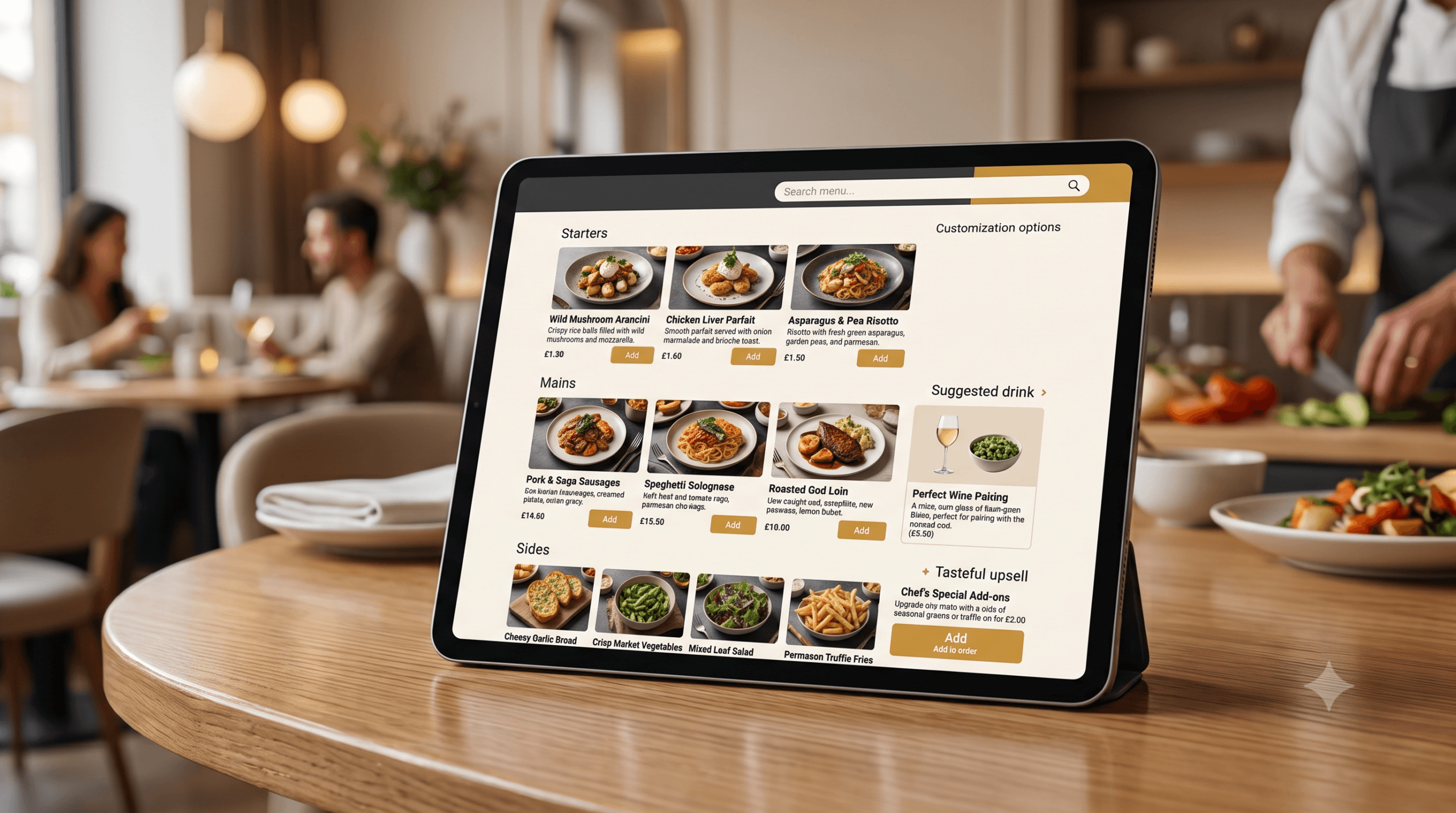
Add your menu directly to your Google Business Profile using Google’s menu editor, not just as a link to a PDF. A PDF menu cannot be read by Google’s local ranking systems the way structured menu items can, which means dish names and prices inside a PDF do almost nothing for your search visibility.
Step 4: Build a Photo Library That Works Harder
Restaurants with a strong photo library consistently win more clicks than those with only a handful of images. Cover your food, your dining room, your bar, your exterior, and your team. Upload new photos regularly – photo recency is one of the simplest, lowest-effort signals you can influence, and it directly affects click-through from your profile.
Step 5: Treat Reviews as an Ongoing Programme, Not a One-Off Ask
Review volume matters, but review velocity — how often new reviews arrive — matters just as much. A restaurant gaining a steady trickle of recent reviews consistently outperforms one with a larger but ageing collection. Ask happy guests for a review at the end of a good service, add a QR code to receipts or table cards, and respond to every review, positive or negative, within 48 hours.
Step 6: Publish Google Posts Weekly
Google Posts – short updates about offers, events, or seasonal dishes – are one of the cheapest ways to lift click-through on your profile. A weekly post takes minutes and keeps your listing looking active, which is itself a signal Google’s algorithm takes into account.
Step 7: Use the Q&A Section Proactively
Add answers to the questions diners actually ask before booking: is it child-friendly, do you take walk-ins, is there parking nearby, do you cater for dietary requirements. Don’t wait for guests to post questions – add them yourself from your GBP dashboard, written as full, direct sentences.
Step 8: Keep Your Details Consistent Everywhere (NAP Consistency)
Your restaurant’s name, address, and phone number should match exactly across your website, Google Business Profile, TripAdvisor, Just Eat, Deliveroo, OpenTable, and any local directories. Inconsistent details confuse Google’s understanding of your business and are one of the most common, and most overlooked, reasons an otherwise good restaurant fails to rank.
Optimising your Google Business Profile is foundational, but it’s only one piece of the puzzle. Discover how to build on this visibility and scale your revenue with our six-figure restaurant business strategy for 2026.
5. Beyond GBP: Website and on-page SEO for restaurants
A Google Business Profile can only take a restaurant so far. Your website still matters, particularly for menus, bookings, private dining enquiries, and building the kind of trust and authority Google’s prominence signal rewards.
5.1 Local content and location pages
If you operate more than one site, give each location its own page with its own address, phone number, opening hours, and embedded map, rather than a single generic ‘Locations’ page. For a single-site restaurant, local content can still help – a page about a nearby landmark, event, or neighbourhood you’re associated with builds relevance for local searches.
5.2 Menu and schema markup
Adding Restaurant and Menu schema to your website gives search engines, and increasingly AI tools, a structured, unambiguous version of what you serve, your price range, and your opening hours. This supports both traditional local rankings and your visibility in AI-generated answers to questions like ‘best Italian near me’.
5.3 Local citations and backlinks
Claim and correct your listing on the major directories – Yell, TripAdvisor, Bing Places, Facebook, OpenTable – and aim for at least a handful of genuine backlinks from local press, food bloggers, or community sites. A single mention from a well-known local food blog often carries more ranking weight than a dozen generic directory listings.
Ready to keep your tables full?
Stop guessing what to post. Take control of your local visibility and drive predictable reservations by grabbing
6. A practical example: Restaurant SEO in action
Consider an illustrative example: an independent Italian restaurant in Leeds with excellent food and loyal regulars, but a dining room that’s noticeably quieter than it should be on weeknights. A search for ‘pizza near me’ in the area returns two competitors ahead of it – neither with better reviews.
The likely explanation isn’t quality; it’s visibility. The competitors’ profiles list ‘pizza’ explicitly in their menu items and posts, carry 40 or more recent photos, and respond to every review within a day or two. Our example restaurant’s Google Business Profile lists only a PDF menu, hasn’t had a new photo in over a year, and its last ten reviews span eighteen months. None of these gaps are difficult to close – but until they are, the restaurant is effectively invisible at the exact moment nearby diners are deciding where to eat.
7. Common restaurant SEO mistakes independents make
- Uploading the menu only as a PDF, making dishes and prices invisible to search engines
- Treating Google Business Profile as a one-time setup rather than something updated weekly
- Letting review requests happen randomly instead of building them into the end of every good service
- Allowing the restaurant’s name or address to differ slightly across delivery apps, directories, and the website
- Choosing a generic primary category instead of the most specific one available
- Ignoring negative reviews instead of responding professionally and promptly
Mastering your reviews is a huge part of this process. If you want to turn feedback into a growth engine, read our complete guide to hospitality online reputation management for the UK.
8. Key takeaways
- Restaurant SEO is led by local search – Google Business Profile matters more here than for almost any other business category
- Google ranks local results on relevance, distance, and prominence; only the first and third can be improved directly
- A complete, photo-rich, regularly updated profile with a genuine menu and steady review flow outperforms a larger but neglected one
- NAP consistency across your website, GBP, and delivery platforms is one of the most overlooked ranking factors
- Small, specific fixes – a structured menu instead of a PDF, a weekly Google Post, a faster review response – often matter more than a full website rebuild
9. Get more diners finding your restaurant
ThisRapt works with hospitality SMEs – including independent restaurants, cafes, and pubs – to build local search visibility that turns into bookings and covers, not just impressions. If you’d like to know exactly where your restaurant stands in local search, book a free Google Business Profile audit with our team.
Ready to see how your restaurant ranks locally?
ThisRapt works exclusively with hospitality SMEs to improve local and AI search visibility.
10. Restaurant SEO FAQs
Improvements to your Google Business Profile — photos, menu, categories, Q&A – can influence visibility within weeks. Building a stronger review base and website authority is a longer process, typically showing meaningful movement over three to six months of consistent effort.
There’s no fixed number, but the data suggests that reaching consistently high double or triple-digit review counts, with a rating above four stars and a steady flow of new reviews, is what tends to hold a top-three local pack position in competitive areas.
Yes. A website you own and control supports bookings, private dining enquiries, and brand trust in a way that Google Business Profile and third-party delivery platforms cannot, and it gives you a place to send traffic without paying a commission on every order.
Most of the highest-impact steps – completing your profile, managing reviews, keeping the menu current – can be done in-house with a little consistency. Specialist help tends to pay off most for citation clean-up across dozens of directories, schema implementation, and ongoing content or link-building work.
Replace a PDF-only menu with items added directly in Google Business Profile, and check that your restaurant’s name, address, and phone number match exactly across your website and every delivery app or directory you’re listed on.