Picture a guest typing a question into ChatGPT: “dog-friendly hotel near the Peak District with a good breakfast.” They don’t get a list of ten blue links to scroll through. They get one short answer, naming perhaps two or three hotels. If your property isn’t one of them, you haven’t ranked lower – you haven’t appeared at all.
Independent hotels, B&Bs, and small hospitality groups have spent years building solid search foundations: a well-optimised Google Business Profile, keyword-rich web pages, a handful of good backlinks. That work still matters. But increasingly, the guest journey that used to end on a search results page now starts – and sometimes ends – inside an AI-generated answer, and the rules for being included in that answer are not quite the same as the rules for ranking on page one.
This is where Generative Engine Optimisation, or GEO, comes in. It is becoming as important to hospitality marketing as local SEO was a decade ago, and hospitality SMEs that get ahead of it now have a genuine opportunity to be the property AI tools recommend by default, rather than the one guests have to go looking for.
1. What is Generative Engine Optimisation (GEO)?
Generative Engine Optimisation is the practice of structuring your hotel’s website and business listings so that AI-powered search tools – Google AI Overviews, Google Gemini, ChatGPT, Perplexity, and Microsoft Copilot – can accurately understand your property and choose to mention it in their generated answers.
Traditional SEO is about earning a position in the search results. GEO is about earning a mention inside a single, synthesised answer. That answer might name three hotels and describe two amenities for each, then send the guest straight to a booking decision. If your property isn’t one of the three, the guest may never see your website at all — however well it ranks in classic search.
1.1 GEO, AEO, and AIO: Untangling the acronyms
Because these terms overlap, it helps to be precise about what each one covers:
- SEO (Search Engine Optimisation) – optimising for ranking position in traditional search results.
- AEO (Answer Engine Optimisation) – structuring content so it can be extracted as a direct answer, whether that’s a Featured Snippet, a voice assistant response, or an AI Overview.
- GEO (Generative Engine Optimisation) – optimising specifically for generative AI tools that synthesise answers from multiple sources, such as ChatGPT and Gemini.
- AIO (AI Overview Optimisation) – a narrower term some agencies use for visibility specifically inside Google’s AI Overviews.
In practice, these four disciplines share the same foundations: clear structure, accurate data, and content that answers real questions in plain language. For a hospitality SME, it makes more sense to treat them as one connected strategy than as four separate projects.
2. Why GEO matters for hospitality SMEs right now
Independent research into traveller behaviour shows this shift is well underway. Industry surveys report that the large majority of travellers who have tried generative AI for trip planning found it genuinely useful, and comfort with using AI to plan a trip has grown noticeably year on year. Guests are not waiting for hospitality brands to catch up – they are already asking AI tools where to stay, what’s nearby, and whether a property suits their needs.
When an AI Overview appears above the normal search results, industry studies have recorded a significant drop in the click-through rate for the page that would otherwise have ranked first. That means even a hotel with strong traditional SEO can see fewer visitors than expected once AI Overviews start appearing for its target searches. This isn’t a future risk – AI Overviews already appear for a meaningful share of local and travel-related queries.
A traditional search results page might show ten hotels. An AI-generated answer typically names two or three. Being the property an AI tool chooses to mention carries outsized value compared with sitting in position six of a results page nobody scrolls to anymore. Being left out, conversely, means losing that guest’s attention entirely – not just losing a click.
Local, conversational searches such as “hotel near Bath with parking and a late check-out” and “pet-friendly hotel near the Lake District” are exactly the kind of long, specific questions that generative AI tools handle well. Exactly the kind of question hospitality businesses are naturally placed to answer, because they are local businesses with concrete answers to concrete questions. Research into local search behaviour consistently finds that a large share of consumers already use voice search to find local business information. That behaviour maps directly onto how people phrase questions to AI tools.
3. How AI tools decide which hotels to recommend
AI search tools don’t “index” content in quite the same way traditional search engines do. Instead, they build an understanding of your property from every corner of the web where it’s mentioned, and they favour information that is easy to trust and easy to extract. Four factors matter most.
– Whether AI crawlers can actually read your site
If your website blocks AI crawlers such as GPTBot or ClaudeBot in robots.txt – sometimes accidentally, through an overly broad rule – you are invisible to that tool by default, regardless of how good your content is. This is the first thing to check, and often the easiest to fix.
– Structured data and schema markup
Hotel, LocalBusiness, FAQPage, and Review schema give AI systems a machine-readable version of the facts a guest might ask about: location, amenities, price range, policies, and ratings. Structured data doesn’t just help traditional search engines produce rich results – it gives generative engines a clean, unambiguous source to draw from, rather than having to infer facts from paragraphs of marketing copy.
– Entity consistency across the web
AI models build a picture of your hotel from many sources – your website, your Google Business Profile, TripAdvisor, OTA listings, local press. If your hotel’s name, address, or description are inconsistent across these sources, AI systems may treat them as different, less trustworthy entities, or may simply default to whichever source is most consistent and most cited – often an OTA rather than you.
– Content Written to Answer, Not Just to Sell
Generative engines favour pages that state a clear answer early, in plain language, rather than pages that build towards a sales message. A paragraph that opens with “Yes, we welcome dogs, with no additional charge for stays under a week” is far easier for an AI tool to lift and quote than three sentences of atmosphere before pets are mentioned in passing.
4. Building a GEO strategy: A step-by-step approach for hospitality SMEs
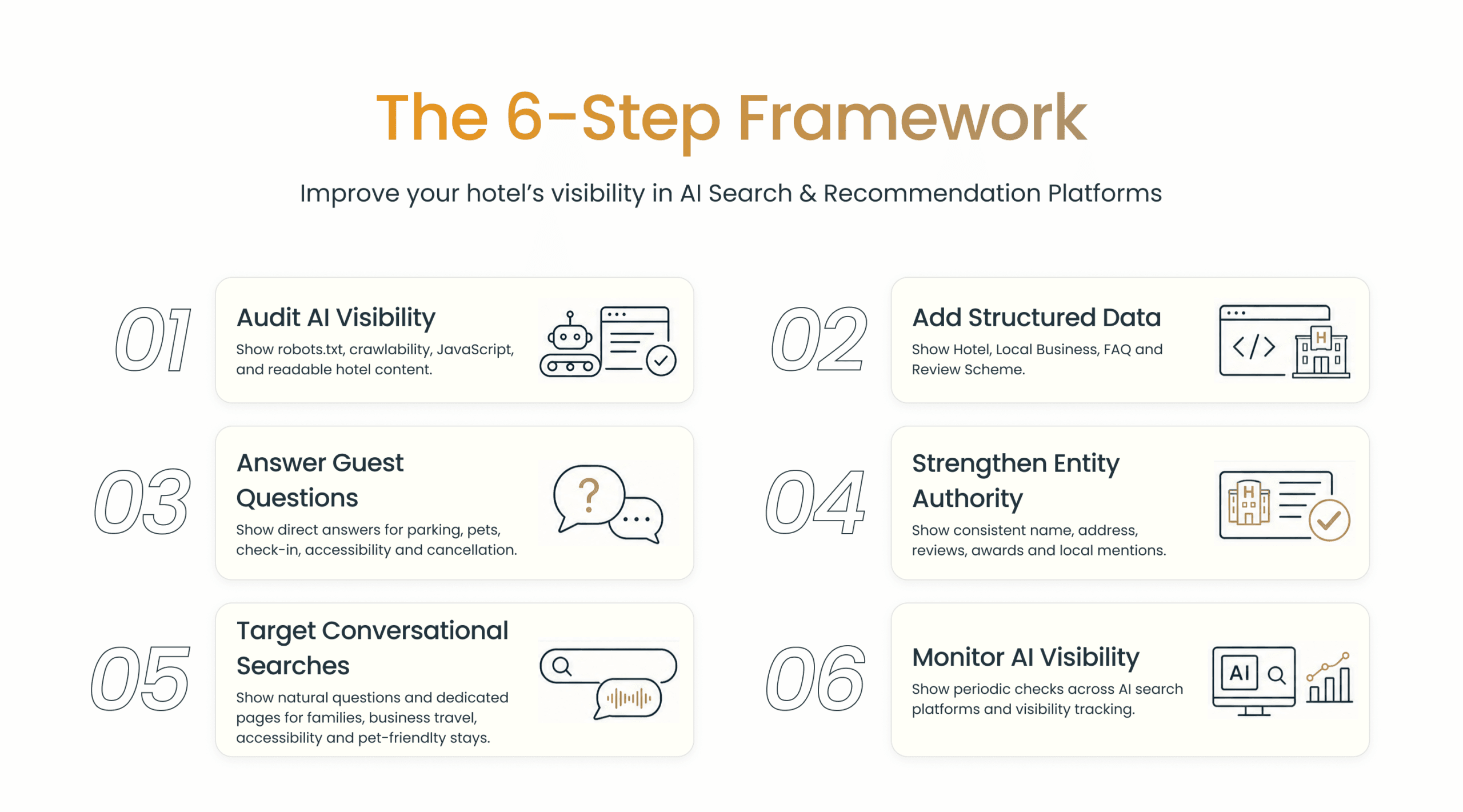
1: Audit What AI Tools Can Actually See
Check your robots.txt file for accidental blocks on AI crawlers. Confirm your key pages aren’t hidden behind heavy JavaScript rendering that crawlers struggle with. Make sure your most important information – rooms, amenities, policies, location – isn’t locked away in PDFs or image-only content that can’t be read as text.
2: Add Structured Data to Your Key Pages
Implement Hotel, LocalBusiness, FAQPage, and Review schema across your homepage, rooms pages, and policy pages. If you don’t have development resources in-house, most booking engine and website providers can add this for a modest cost, and it’s one of the highest-value technical fixes available.
3: Rewrite Key Pages in an “Answer-First” Format
Take your most-asked guest questions – parking, pets, check-in times, accessibility, cancellation policy — and give each one a direct, complete, one-paragraph answer near the top of the relevant page, before any promotional copy. Use question-style subheadings that mirror how guests actually ask (“Do you allow dogs?” rather than “Our Pet Policy”).
4: Strengthen Entity Consistency and Authority
Audit your hotel’s name, address, and description across your website, Google Business Profile, TripAdvisor, and major OTAs, and make them consistent. Build genuine authority signals: awards, accreditations, local press mentions, and a steady flow of recent, detailed guest reviews. AI systems weigh recency and consistency heavily when deciding which source to trust.
5: Optimise for Conversational and Local Long-Tail Queries
Map the natural-language questions your guests actually ask — not just short keywords — to specific pages, and write content that answers them directly. A dedicated “Families”, “Business Travel”, “Accessibility”, or “Pet-Friendly Stays” page, written in plain, specific language, will typically outperform a single generic amenities list for GEO purposes.
6: Monitor Your AI Visibility Over Time
AI platforms don’t yet offer full analytics dashboards in the way Google Search Console does, but you can track early signals: monitor branded and category search impressions in Search Console, and periodically ask ChatGPT, Gemini, and Perplexity the questions your guests would ask, noting whether and how your property is mentioned. Treat this as an ongoing quarterly check rather than a one-off task.
5. A practical example: How GEO plays out for a small hotel
Consider an illustrative example: a 12-room boutique hotel in the Cotswolds. Its website ranks reasonably well in traditional Google search for “hotels in the Cotswolds”, but a guest asking an AI assistant “which boutique hotel in the Cotswolds is good for a weekend with a dog” gets an answer naming two competitors – neither of which, on paper, has a stronger guest offering.
The likely explanation isn’t quality. It’s structure. The competitors’ websites state their pet policy in a single sentence near the top of a dedicated page, carry accurate LocalBusiness and Review schema, and have consistent, recent reviews that mention being dog-friendly by name. Our example hotel’s pet policy exists, but it’s buried in a downloadable PDF welcome pack; its Google Business Profile lists a slightly different trading name to its website; and its most recent reviews are over a year old.
None of these are difficult fixes. They are, however, exactly the kind of detail that decides which two names an AI tool picks when it can only mention a handful.
6. Common GEO mistakes hospitality SMEs make
- Treating GEO as a one-off project rather than an ongoing discipline – much like a Google Business Profile, it needs continual updates, not a single setup
- Focusing entirely on Google while overlooking that ChatGPT draws heavily on Bing’s index, which means a Bing Places for Business listing is frequently neglected
- Writing amenity and policy pages for tone and atmosphere first, answers second, which makes them harder for AI tools to extract cleanly
- Allowing inconsistent hotel names or addresses to persist across booking platforms and directories
- Assuming that ranking well in traditional search automatically means visibility in AI-generated answers – the two are related but increasingly distinct
7. Key takeaways
- Generative Engine Optimisation (GEO) is about making your hotel understandable, trustworthy, and quotable to AI-powered search tools – not just visible in a traditional results list
- Travellers are already using AI tools to plan trips, and AI Overviews are already reducing clicks to pages that would once have ranked first
- AI tools favour properties with accessible websites, accurate structured data, consistent entity information, and answer-first content
- A practical GEO strategy starts with a crawler and schema audit, then moves through content restructuring, authority building, and ongoing monitoring
- Small, specific fixes – a clear pet policy sentence, consistent naming, recent reviews – often matter more than a full website rebuild
8. Get your hotel ready for AI search
ThisRapt works with hospitality SMEs to build AI search visibility that turns into direct bookings, not just impressions. If you’d like to know how your property currently appears – or doesn’t appear – in AI-generated answers, book a free GBP and AI visibility audit with our team.
Ready to see where your hotel stands in AI search?
ThisRapt works exclusively with hospitality SMEs to improve AI and local search visibility.
9. GEO FAQs
No. GEO builds on the same foundations as good SEO – clear structure, accurate information, credible authority – and adapts them specifically for how generative AI tools read and summarise content. A hotel with strong traditional SEO already has a head start on GEO.
Technical fixes such as removing crawler blocks or adding schema can take effect quickly. Being consistently included in AI-generated recommendations tends to build over weeks and months, as AI tools re-crawl content and as authority signals such as reviews and citations accumulate.
Yes, often more easily than in traditional SEO. Generative engines reward specific, well-structured, trustworthy answers rather than sheer content volume or advertising budget, which puts independent properties on a more level footing than they typically have in paid search.
Most hospitality websites already have the right information — it usually needs restructuring rather than replacing. Rewriting existing pages to lead with a direct answer, and adding schema markup, often delivers more impact than producing entirely new content.
Check that your robots.txt file isn’t accidentally blocking AI crawlers, then make sure your Google Business Profile and website use the same hotel name and address. These two checks take under an hour and remove the most common reasons a hotel is invisible to AI tools altogether.