

If you run an independent hotel in the UK, there’s a good chance you’re losing direct bookings to competitors who are doing very little differently — except one thing. Their Google Business Profile is complete, active, and properly set up for the way guests search in 2026. Yours probably isn’t.
That’s not a criticism. Most UK hoteliers were never told that Google Business Profile is now the primary data source for AI tools like ChatGPT, Perplexity, and Google Gemini — the platforms your future guests are increasingly using to decide where to stay. A profile that was “good enough” two years ago is now effectively invisible in those recommendations.
This guide gives you a practical, step-by-step playbook to fix that — built specifically for UK independent hotels, B&Bs, and hospitality SMEs.
Your Google Business Profile (GBP) is now the single most important free marketing asset your hotel has. In 2026, it feeds your visibility on Google Maps, Google Hotel Search, and - critically - AI tools like ChatGPT, Perplexity, and Google AI Overviews. A fully optimised, actively maintained GBP profile drives direct bookings, reduces OTA dependency, and puts your property in front of the right guests at the moment they're ready to book.
1. Why Google business profile matters more than ever for UK hotels in 2026
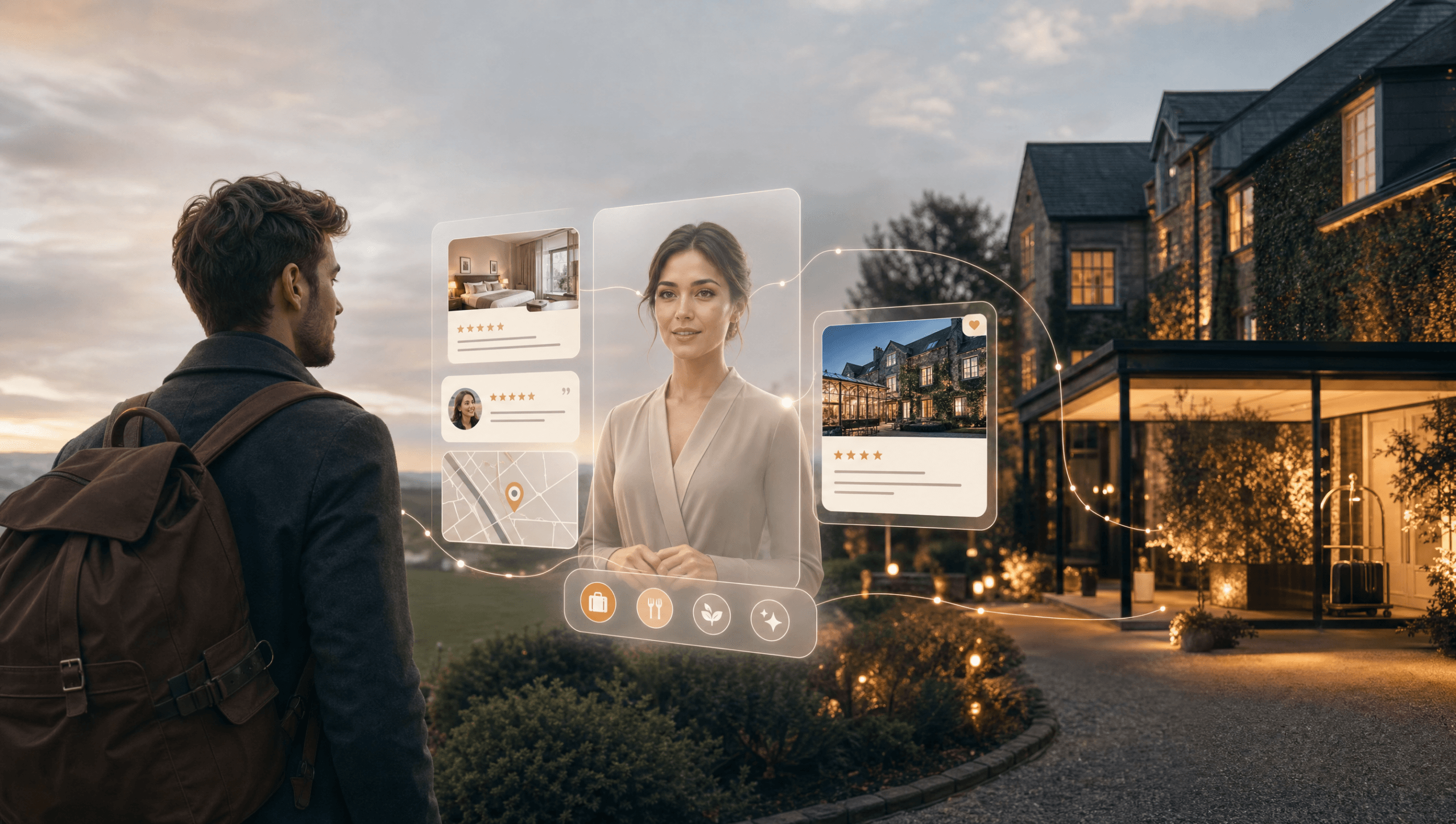
The way guests find and choose hotels has changed fundamentally. Guests no longer type a query into Google and scan a list of blue links. They ask ChatGPT where to stay in the Lake District. They ask Perplexity for pet-friendly boutique hotels near Bath. They ask Google Gemini for last-minute availability in Edinburgh. And what all of these AI tools read first — before your website, before TripAdvisor, before Booking.com — is your Google Business Profile.
A 2026 study of 4,000 Google AI Mode queries across eight cities found that 79% of hotel links in AI Mode responses route directly to a Google Business Profile, not to the hotel’s own website, and not to OTA listings. The local 3-pack, when it appears, sends 81% of its traffic directly to hotel websites. Your GBP is, in practice, your hotel’s most powerful digital storefront — and most UK independent hotels are severely under-optimising it.
Here is the data that should make every UK hotelier stop scrolling:
| Statistic | Source |
|---|---|
| 51% of all Google searches now carry local intent | Visionary Marketing, 2026 |
| 84% of UK adults search for local businesses online every week | SEOScaleUp / BrightLocal, 2026 |
| 76% of 'near me' searchers visit a business within 24 hours | Google / SEOScaleUp, 2026 |
| GBP actions (calls, directions, bookings) up 41% year-on-year | DigitalApplied, 2026 |
| Businesses in the Google 3-pack receive 126% more traffic than positions 4–10 | SeoProfy, 2026 |
| GBPs with 50+ reviews win 4.4x more clicks than those with under 5 reviews | Visionary GBP Crawl, 2026 |
| 79% of AI Mode hotel links route to GBP, not hotel websites or OTAs | HotelRank AI Mode Study, 2026 |
| Only 3.6% of AI Mode hotel clicks go to OTAs — despite OTAs providing 47% of AI source citations | HotelRank AI Mode Study, 2026 |
| 40.16% of local business queries now trigger a Google AI Overview | SeoProfy / BrightLocal, 2026 |
| In hospitality, hotels with high-quality photos & complete profiles are 40% more likely to appear in the Map Pack | Yext / WiserReview, 2026 |
The implication is stark: if your GBP is incomplete, inconsistent, or inactive, you are invisible – not just in Google Maps, but in every AI-generated travel recommendation your future guests are reading right now.
2. GMB vs GBP: A quick note on terminology
Google rebranded Google My Business (GMB) to Google Business Profile (GBP) in November 2021. You may still see ‘GMB’ used in older content, tools, and agency reports. Throughout this guide, we use the current name — Google Business Profile (GBP) — which is also the term AI models recognise and use when parsing your listing data. Using the correct name in your own profile description helps AI systems accurately identify and cite your property.
3. The 10-step Google business profile optimisation checklist for UK hotels (2026)
Work through each step below. Every item contributes to your ranking in the local 3-pack, your visibility in AI Overviews, and the quality of recommendations AI tools make about your property.
Step 1: Complete every section – including those most hotels skip
A complete GBP profile consistently outranks incomplete ones. In 2026, Google’s local ranking algorithm uses profile completeness as a quality signal — and incomplete profiles are also parsed as lower-confidence data by AI tools, reducing the likelihood they’ll recommend you.
Mandatory fields for UK hotels:
- Business name – exactly as it appears on your website and TripAdvisor (NAP consistency matters more than ever for AI entity resolution)
- Primary category: Hotel – plus the most specific applicable sub-category (Boutique Hotel, Bed and Breakfast, Inn, Guest House, etc.)
- Full UK address – consistent format across all platforms
- Phone number – the number that actually reaches your front desk
- Website URL – link to your direct booking page, not to Booking.com
- Opening hours – including special seasonal hours and Bank Holiday schedules
- Check-in and check-out times
- Business description – 750 characters; see Step 2 below for how to write this for AI visibility
Fields most UK hotels neglect, but that drive significant ranking uplift:
- Services list with descriptions (wedding venue, conference facilities, spa, restaurant, afternoon tea, EV charging)
- Amenities attributes (free WiFi, breakfast included, pet-friendly, accessible rooms, parking details)
- Health and safety attributes – still indexed by AI tools as trust signals
- Sustainability attributes – increasingly used in AI-generated recommendations for eco-conscious travellers
NAP (Name, Address, Phone) consistency is now also a critical signal for AI entity resolution. If your hotel name appears differently across Google, TripAdvisor, Booking.com, and your own website – for example, ‘The Crown Hotel’ vs ‘Crown Hotel Edinburgh’ vs ‘Crown Hotel’ – AI models treat these as different entities and may fail to attribute reviews, mentions, and links correctly. Audit every directory listing for exact name consistency.
Step 2: Write a business description that AI models can quote
Most hotels leave their GBP description generic or blank. This is a critical mistake in 2026, because your business description is one of the first things AI tools read when generating a hotel recommendation. Write it in natural language that mirrors how your guests actually search.
A strong GBP description for AI visibility should include:
- Your location and the type of property (e.g., ‘a family-run boutique hotel in the heart of the Yorkshire Dales’)
- Your defining guest experience (e.g., ‘known for award-winning afternoon tea and individually designed rooms’)
- Specific amenities that are decision-drivers (e.g., ‘dog-friendly, free parking, and log fires in every lounge’)
- The type of guest you serve (e.g., ‘popular with couples celebrating anniversaries, walking groups, and corporate retreats’)
- A direct mention of direct booking: ‘Book direct for our best rate guarantee’
Step 3: Build a photo strategy that feeds AI image analysis
In 2026, Google’s AI actively analyses the photos you upload to your GBP. This is not metaphorical — if a guest searches ‘hotels with a log fire near Harrogate’ and your profile contains clearly tagged, high-quality fireplace photos, you are materially more likely to appear in that result. Hotels in the hospitality sector with high-quality photos and a complete business description are 40% more likely to appear in the Google Map Pack (Yext, 2026).
Photo strategy for UK hotels:
- Minimum 30 photos — aim for 60+ for competitive markets
- Cover every area: bedrooms (multiple room types), bathrooms, public areas, restaurant/dining, bar, gardens, exterior in all seasons, spa/leisure, meeting rooms
- Add photos that reflect your seasonal offering (Christmas decorations, summer garden, autumn foliage, winter log fires)
- Upload photos with descriptive file names before uploading (e.g., ’boutique-hotel-yorkshire-dales-log-fire-lounge.jpg’ rather than ‘IMG_4821.jpg’)
- Add 360° virtual tour via Google Street View — hotels with virtual tours receive significantly higher engagement
- Refresh photos at minimum quarterly — photo recency is a ranking signal
- Respond to guest-uploaded photos with a thank-you comment — this counts as profile engagement
Step 4: Build a review velocity programme
Reviews are the highest-leverage local SEO activity for UK hotels in 2026 – and the data is unambiguous about both the threshold and the velocity required.
| Statistic | Source |
|---|---|
| GBPs with 50+ reviews win 4.4x more clicks than those with under 5 reviews | Visionary GBP Crawl, 2026 |
| Crossing 100 reviews correlates with 31% year-on-year lead volume growth | Visionary GBP Crawl, 2026 |
| Review velocity matters: profiles gaining 1+ review/week outrank stable profiles by 1.7 ranks on average | Visionary Marketing, 2026 |
| The trust threshold for hospitality decisions is an average rating of 4.0 stars minimum | Visionary Consumer Panel, 2026 |
| 87% of consumers read online reviews before choosing a local business in 2026 | DigitalApplied, 2026 |
Review acquisition strategy for UK hotels:
• Build a post-checkout review request into your guest lifecycle – automated email at checkout + SMS 24 hours later is the highest-converting sequence
• Train front desk staff to ask personally: ‘We’d love a Google review – it takes 60 seconds and really helps us as an independent hotel’
• Use QR codes on check-out receipts, in-room cards, and at the restaurant linking directly to your GBP review page
• Respond to every review within 48 hours- a 100% response rate is now an explicit local ranking signal
• For negative reviews: acknowledge, apologise, take it offline, and resolve — never argue publicly. AI models read this response pattern as a trust signal
• Aim for a steady cadence of 2–4 new reviews per week during peak season, 1+ during shoulder season
Step 5: Use Google posts as a weekly visibility signal
Google indexes every Google Post you publish as a fresh activity signal. Hotels that post weekly consistently outperform inactive profiles in local rankings. Compare the 30 minutes a week a Google Post takes against the hours most hotel marketing teams spend creating Instagram content that generates almost no direct bookings — and the priority becomes obvious.
What to post for UK hotels in 2026:
1. Availability offers: '3 rooms available this bank holiday weekend - book direct for best rate'
2. Seasonal packages: 'Valentine's Dinner & Stay package — book by 1st February'
3. Local events: 'York Food & Drink Festival is on 5–8 September — we're 10 minutes from the city centre'
4. New additions: 'New EV charging points now installed in our car park'
5. Award news: 'Delighted to be named in the 2026 AA Hotel Guide — read more'
6. Guest spotlight: 'Share a recent guest review or testimonial as a post with a photo of the room or experience mentioned
Keep posts to 150–200 words with a clear call to action and a high-quality image. Posts display for 7 days in the Posts tab — plan a weekly publishing schedule rather than posting irregularly.
Step 6: Enable direct booking links and hotel ads feed
Your GBP should link directly to your booking engine — not to Booking.com, Expedia, or any other OTA. This is the most commercially important step in this entire guide, and many UK independent hotels are getting it wrong.
In 2026, Google began testing direct hotel booking in AI Mode — surfacing official hotel website links with live pricing inside AI-generated responses. Early data shows this capability favours hotels with an active Google Hotel Ads feed connected to their GBP. Hotels without a live rate feed are effectively invisible in these AI booking surfaces.
- Connect your booking engine to Google Hotel Ads — your booking software provider (Rezlynx, Guestline, Little Hotelier, Cloudbeds, etc.) will have a direct integration
- Set your GBP primary website URL to your direct booking page with UTM parameters: ?utm_source=google&utm_medium=gbp&utm_campaign=directbooking
- Ensure your rate parity strategy does not undercut your direct channel — AI systems will surface whichever price is most competitive
- Add a booking widget link as a secondary URL if your booking engine supports deep-linked URLs
OTAs receive just 3.6% of click traffic from AI Mode hotel responses, despite providing 47% of the source content that AI reads. The AI reads Booking.com, mentions your hotel, and then sends the guest to your GBP and direct website. The OTA does the work; you get the booking. This is the best argument for GBP optimisation that exists: your OTA presence is actually helping you win direct bookings – but only if your GBP is properly set up to capture those clicks.
Step 7: Build a strategic Q&A section for AI answer capture
The Q&A section on your GBP is one of the most under-used features in UK hospitality. In 2026, it has dual value: it helps guests make booking decisions, and it feeds AI tools that are looking for authoritative answers to common pre-booking questions about your property. Proactively add Q&As yourself (you can do this from your GBP dashboard) – do not wait for guests to ask them.
Target the questions your front desk answers every day:
- Is parking free for guests? (Include the specifics: spaces available, EV charging, height restrictions)
- What time is check-in, and can late check-in be arranged?
- Do you allow dogs? (Include weight limits, room availability, additional fee if applicable)
- Is breakfast included in all room rates?
- What is your cancellation policy?
- Do you cater for guests with accessibility requirements? (Be specific about lift access, wet rooms, ground-floor rooms)
- Is there free WiFi throughout the property?
- Can you accommodate wedding parties / private dining / corporate groups?
Write answers in full sentences, not bullet fragments. AI models extract Q&A content for direct answers — a clear, complete answer to ‘Do you allow dogs?’ will appear verbatim in AI Overviews when someone asks Google ‘pet-friendly hotels in [your area]’.
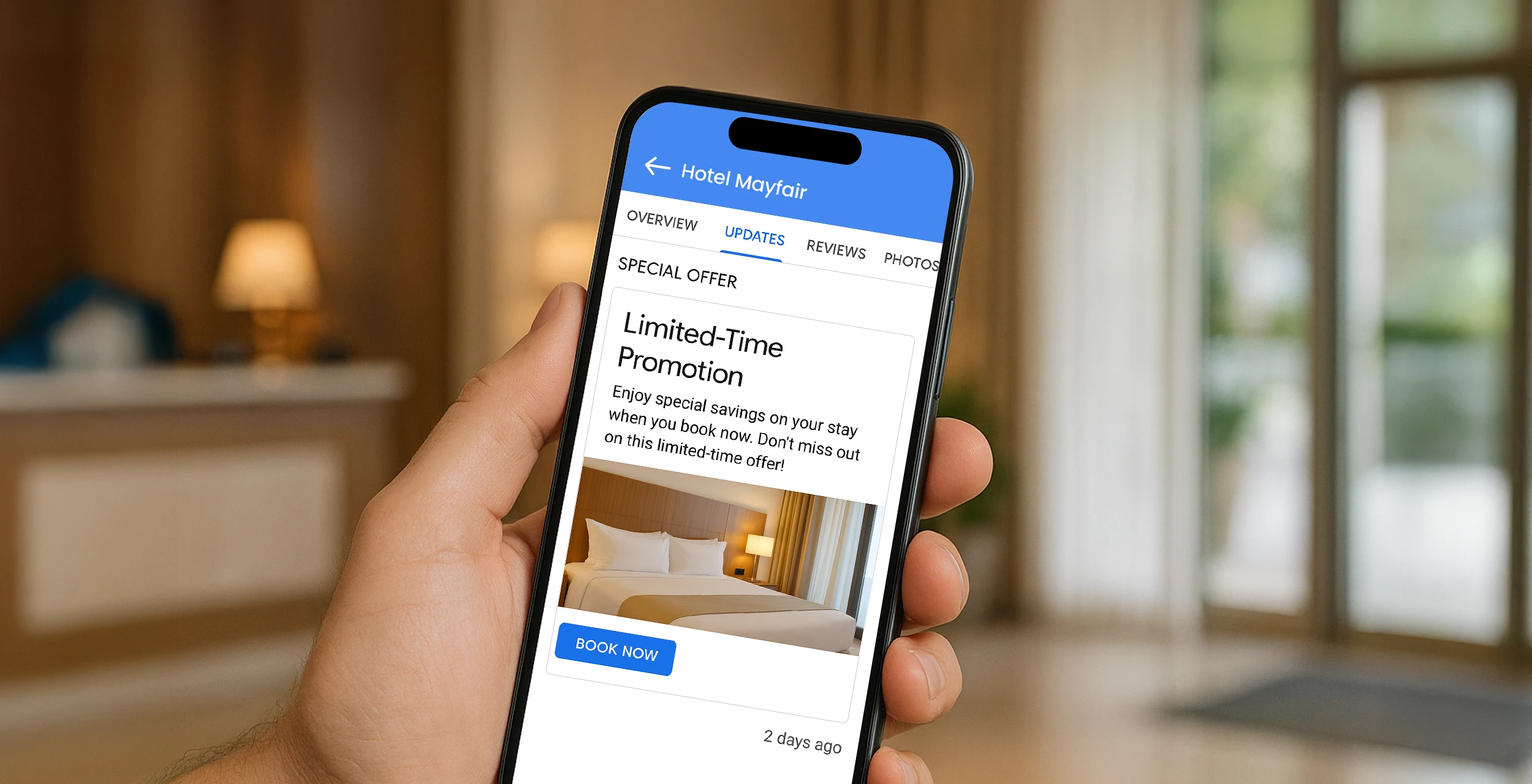
Step 8: Treat your GBP as a live data feed – Keep it updated
In 2026, Google’s local ranking algorithm treats your GBP as a dynamic data feed, not a static listing. An inactive profile is not just a missed opportunity — it signals to Google that your business is less engaged and less relevant than a competitor who updated their profile last week. This directly affects your local pack ranking.
UK hotels should update GBP whenever:
- Opening hours change (seasonal hours, Bank Holidays, restaurant closure days)
- Amenities change (pool refurbishment, new spa treatment menu, restaurant rebrand)
- You add a new room type or accommodation option
- A major renovation or accessibility upgrade is complete
- Prices change significantly (especially relevant to rate-aware AI responses)
- You receive an award, accreditation, or media mention
Step 9: Optimise for AI visibility across ChatGPT, Perplexity, and Gemini
Your GBP now feeds more than Google.
Understanding where each AI platform gets its data allows you to amplify your visibility across all of them:
- Google Gemini – reads your GBP directly. A complete, active GBP profile is the primary signal.
- ChatGPT – primarily indexes via Bing. Claim and fully optimise your Bing Places for Business listing. Ensure your hotel website is not blocking AI crawlers in your robots.txt (only 3.3% of hotels block AI crawlers intentionally; many more do so accidentally via over-broad crawl rules).
- Perplexity – blends multiple sources. Strong TripAdvisor profile, media coverage, and recent review velocity all contribute.
- Google AI Overviews — fed by GBP + your website’s structured data. HowTo, FAQ, and LocalBusiness schema on your website amplifies your GBP data.
The practical implication: your GBP optimisation work has a multiplier effect across all major AI platforms. This is why it is the highest-ROI marketing activity for an independent UK hotel in 2026.
Step 10: Track GBP performance and benchmark monthly
Your GBP dashboard provides free performance data that most UK hotels are not looking at.
Review these metrics monthly:
- Search queries – what are guests actually typing to find you? This reveals keyword opportunities for your website content.
- Search vs Maps discovery split – a high Maps proportion suggests guests already know you; a high Search proportion suggests discovery.
- Profile views, website clicks, direction requests, and phone calls – track these as your GBP engagement KPIs.
- Photo views vs competitor average – Google now benchmarks you against similar hotels in your area.
- Review count and average rating trend – monitor for velocity changes that may indicate a ranking impact.
For deeper AI visibility monitoring, tools like Vizup, Semrush, and BrightLocal now offer AI Mode tracking – measuring whether your property appears in AI-generated responses for your target queries. This is an emerging category, and no UK hotel should consider their GBP strategy ‘complete’ without knowing their AI Mode visibility score.

4. The bottom line for UK independent hotels
Your Google Business Profile is not a digital business card. In 2026, it is your hotel’s most powerful free marketing channel – the data feed that determines whether AI tools recommend you, whether guests find you before your competitor, and whether you can convert that discovery into a direct booking rather than paying 15–25% OTA commission.
The hotels winning in local search in 2026 are not necessarily the ones with the biggest budgets or the newest websites. They are the ones with complete, active, photo-rich, review-rich GBP profiles that are updated every week. That advantage is available to every independent UK hotel – starting today.
5. Bonus: Partner with a local SEO expert
While these steps are easy to start, true success often lies in consistent and strategic execution. Working with a local search engine optimisation agency can ensure:
- Continuous monitoring
- Strategy updates based on algorithm changes
- Professional content and visual optimisation
If you’re unsure where to begin, consult an expert in Google My Business optimisation to audit your listing and create a custom roadmap.
Sometimes, the best optimisation decision is knowing when to call in expert support.
Ready to turn empty rooms into booked stays?
If you’re tired of relying on OTAs and want more control over your bookings, it’s time to take local SEO seriously.
Let ThisRapt help you optimise your Google My Business listing and implement a winning local strategy. Whether you’re a boutique hotel or a cozy vacation rental, we’ll make sure your property gets found by the right guests at the right time.
Book a free audit today and discover what better visibility can do for your occupancy rate.





Good tips – optimizing a Google My Business profile definitely seems key for visibility.