If your hotel’s social strategy is still “post a nice photo and hope,” you’re already behind.
Social media stopped being a branding line item once platforms started letting guests check out without leaving the app – Marriott’s Instagram native checkout pilot lifted direct bookings 15%, and a Hilton short-video push delivered a 13% bump across Instagram and TikTok. That’s not brand awareness. That’s revenue, measured in bookings, from content most hotels still treat as decoration.
1. Performance-driven storytelling, not pretty posts
Social media has moved beyond aesthetics. A beautifully shot video that people scroll past in three seconds loses to a rougher video that holds attention for fifteen — because watch-time, not visual polish, is what platform algorithms now reward most heavily.
What high-performing hotels are doing:
- Narrative series over random posts – a 30-day “A Week in Paradise” story arc builds anticipation and repeat viewership in a way isolated posts never do
- Reporting performance metrics, not likes, click-through rate, saves, and story exits, is what should reach your GM’s desk, not follower counts
Why watch-time matters specifically: Instagram and TikTok’s algorithms now prioritize retention over raw engagement. Videos under 90 seconds keep roughly half their viewers watching to the end — a completion rate static images simply can’t produce. And it’s not a vanity metric: 64% of travellers say video specifically helped them decide where to stay, and 73% now prefer learning about a product or place through short-form video over any other format.
Practical application: build hooks into the first 2 seconds, deliver the value fast, and structure content so the payoff lands before attention drifts.
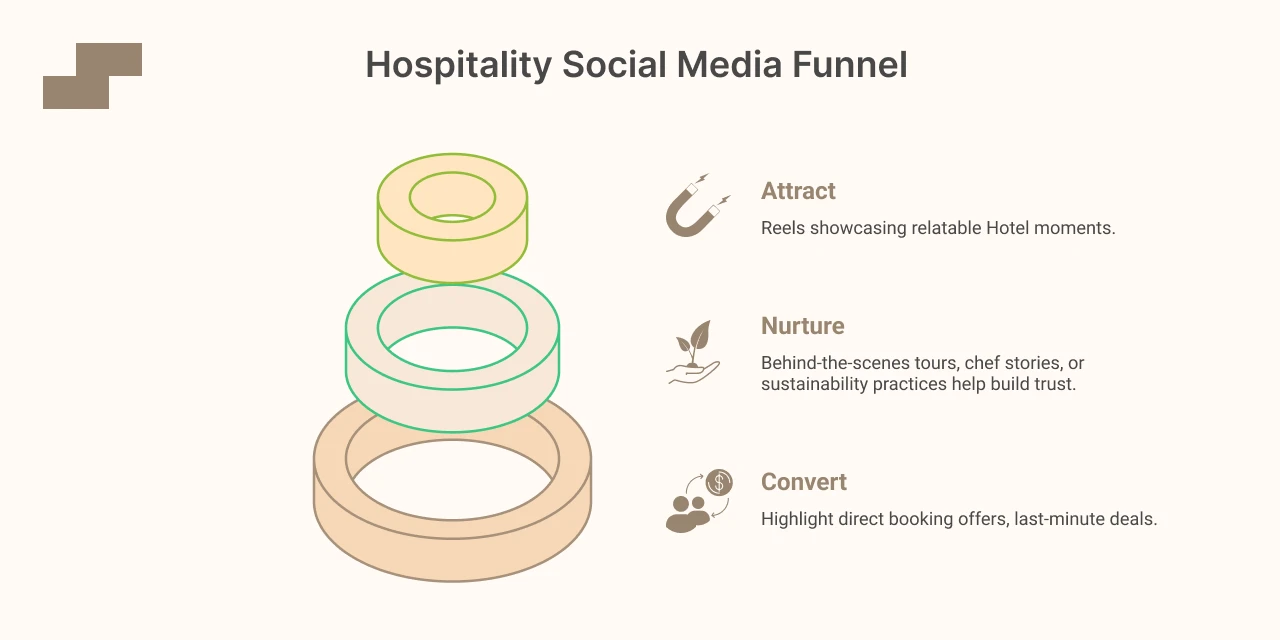
2. The 3-tier funnel for hospitality social media
Most hotels skip funnel thinking on social entirely, posting the same type of content regardless of where the viewer actually is in their decision journey. That’s the single biggest strategic gap in hotel social media today.
| Funnel Stage | Content Objective |
| Top (Attract) | Highly shareable, relatable moments — “POV: you finally check into a room that looks exactly like the photos.” Entertainment-led, lightly branded, optimised for scroll-stopping rather than immediate booking |
| Mid (Nurture) | Behind-the-scenes tours, chef stories, sustainability practices — building the trust that makes someone choose you over an equally nice-looking alternative |
| Bottom (Convert) | Direct booking offers, last-minute deals, and specific guest testimonials — content built for someone who already knows who you are and just needs a reason to book now |
Bonus tip: use UTM tracking on every link you post, segmented by funnel stage. This is how you learn which content types actually drive bookings rather than just engagement — and where to put next month’s content budget.
3. Video marketing beyond room tours
Short-form video is your most powerful booking trigger in 2026 — but generic room walkthroughs are the weakest version of it. What’s actually working:
- First-person guest experiences — “Spend a day with us” content following a guest’s full journey (check-in, breakfast, poolside, night views) builds aspirational value that a static gallery can’t
- Problem-solution hooks — “Hate noisy hotels? Here’s how we guarantee silence” grabs attention by naming a real traveller frustration before showing your answer to it
- Behind-the-scenes, staff-led stories — a chef’s prep routine or a long-serving team member’s story humanises the brand in a way polished marketing footage rarely does
Why this specifically works: video builds trust faster than static content and holds attention longer, which both platform algorithms and human viewers reward. Landing pages and posts featuring demo-style or testimonial video consistently outperform static-only content on engagement and stated purchase influence.
4. Social commerce has arrived – Don’t get left out of it
This is the development most hotel social media guides still haven’t caught up to: platforms are becoming booking engines, not just discovery channels.
- Marriott’s pilot of Instagram’s native checkout lifted direct bookings by 15%
- TikTok has expanded its own in-app booking integrations, and TikTok-driven bookings are measurable enough that hotel groups now track them as a distinct channel
- Retargeted social ads — shown to users who already visited your site or engaged with your content — convert bookings 2–4x better than cold, first-touch ads
Practical priority: if your booking engine and social platforms aren’t connected for retargeting and, where available, in-app checkout, you’re leaving the highest-converting audience segment (people who already showed intent) to book elsewhere — often through an OTA that intercepts them at exactly this stage.
5. Paid strategy that doesn’t waste budget
Boosting posts without a conversion strategy is the most common way hotels burn paid social budget. Smarter approaches:
- Lookalike audiences built from your past guest database, not generic demographic targeting
- Retargeting abandoned bookings — social ads shown specifically to site visitors who didn’t complete checkout
- Geo-fencing — promoting last-minute availability to people already physically in your city, an underused tactic with high conversion potential given the existing intent
Influencer amplification tip: hotels that “whitelist” strong influencer content – running it as paid ads from the influencer’s own handle rather than repurposing it as brand creative – see those ads perform 20–50% better than standard brand-only ads. Among travellers who go on to book trips, 72% say influencer content played a role in shaping those plans, which makes this one of the higher-leverage paid tactics available, provided the creator’s audience genuinely matches your guest profile.
6. Hotel promotions that feel personal, not generic
“20% Off This Weekend” rarely cuts through anymore. What converts better in 2026:
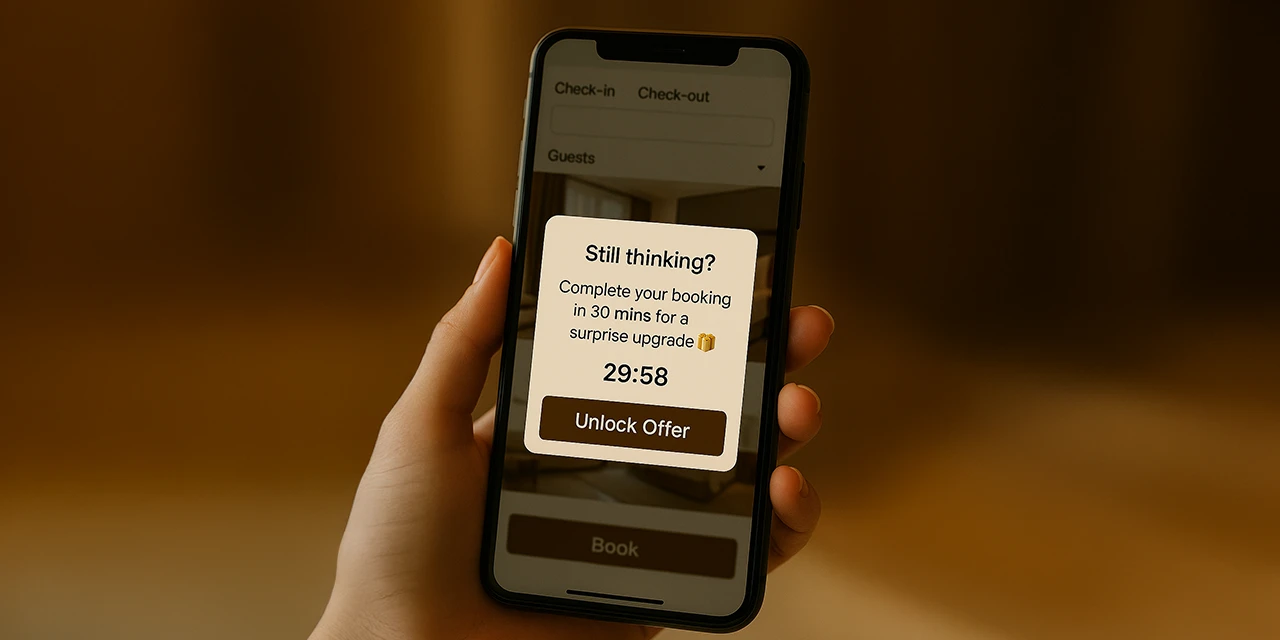
- Dynamic, behaviour-triggered discounts — “Complete your booking in the next 30 minutes for a surprise upgrade”
- Platform-exclusive drops — limited-time packages available only via Instagram Stories or a private WhatsApp community, creating genuine scarcity rather than manufactured urgency
- UGC-driven contests — encouraging past guests to share content for a giveaway- build organic reach and trust simultaneously, since user-generated content consistently outperforms brand-only content on both metrics
7. Operational integration is the real differentiator
Most hotels still treat social media as a marketing-only function. The properties pulling ahead integrate it across operations entirely:
- Concierge via DMs — travellers increasingly expect to ask about spa availability or dinner recommendations directly through Instagram or WhatsApp, not just a phone line. A dedicated social concierge function improves response time and captures bookings that would otherwise stall
- Real-time feedback loop — Story mentions and tags now function like comment cards; monitoring them lets teams resolve issues before a guest even checks out, often turning a near-complaint into a public positive
- Staff as content creators — some of the best-performing hotel content comes from housekeeping tips, chef plating secrets, or a long-serving concierge’s local recommendations, not professional creators. It humanises the brand and doubles as a recruitment and retention signal, particularly with Gen Z staff
8. Structuring this content for AI search visibility
One more layer most hotel social strategies ignore entirely: AI tools increasingly influence travel decisions before a guest ever lands on a booking page, and the content you produce for social can – and should – feed that visibility too.
Publish supporting blog content around your best-performing social themes (destination guides, behind-the-scenes features) with proper Article and FAQ schema, since blogs materially increase the likelihood of being directly cited by AI systems compared to social posts alone, which most platforms don’t expose to AI crawlers
Keep captions and on-screen text factually specific (prices, distances, policies) rather than purely atmospheric — this is what both search engines and AI systems extract and cite
Treat your Google Business Profile and website as the “source of truth” AI systems reference, and use social content to reinforce those same facts consistently rather than introducing conflicting details
9. Final thoughts: Rethinking social media in hospitality
2026 will demand a radically different approach to marketing strategies for hotels. What used to work—random posts, weak CTAs, passive engagement – isn’t enough.
The new playbook for social media includes:
- Story-driven, funnel-based content planning
- Data-backed personalization and retargeting
- Smart integration of video marketing in hospitality
- Purposeful and personal hotel promotions on social media
- Cross-functional collaboration between marketing and operations
- Story-driven, funnel-based content planning
If your hospitality social media strategy isn’t actively working to drive revenue and retention, it’s time to reinvent it.
Because in 2026, the hotels that will win online will be those that stop treating social media like decoration and start treating it like a digital profit center.
Ready to turn your content into stories people remember? Let’s begin!
10. Social Media Marketing FAQs
Short-form video paired with behind-the-scenes storytelling consistently drives the highest watch time and conversion. 64% of travellers say video specifically helped them decide where to stay, making it the highest-leverage format available.
Consistent weekly content with planned themes works better than sporadic high-volume posting — for example, offers on Monday, staff stories on Wednesday, guest experiences on Friday. Predictability helps both audience habit and algorithmic favour.
Yes, paired with organic strategy. Retargeted ads specifically — shown to users who already engaged with your content or visited your site — convert 2–4x better than cold, first-touch campaigns, making them one of the most efficient paid formats available.
It depends on your guest profile, but the platform’s influence has moved beyond entertainment into genuine booking behaviour — 32% of consumers have booked accommodation they discovered on TikTok specifically. If your target guest skews under 40, it’s increasingly hard to justify skipping.
Both, increasingly. 72% of travellers who go on to book trips say influencer content shaped those plans, and whitelisting strong influencer content as paid ads (rather than only using it organically) sees those ads outperform standard brand creative by 20–50%.
It’s shifting toward real transactions. Marriott’s Instagram native checkout pilot lifted direct bookings 15%, and TikTok has its own in-app booking integrations expanding. Treat social as an emerging direct channel to capture, not just a discovery layer to hand off to your website.
Indirectly but meaningfully — social platforms generally aren’t crawled by AI systems the way websites are, so the practical move is publishing supporting blog content (with proper schema) around your strongest social themes, keeping facts consistent across both, so AI engines have a citable, structured source to pull from.